Languages
Sunday, October 18, 2026



News and Views from the Global South
Trade & Investment

Civil Society in Latin America Campaigns Against Trans-Pacific Partnership
Civil society organisations from Chile, Mexico and Peru are pressing their legislatures and those of other countries not to ratify the Trans-Pacific Partnership (TPP).
Building Africa’s Energy Grid Can Be Green, Smart and Affordable
It’s just after two p.m. on a sunny Saturday and 51-year-old Moses Kasoka is seated outside the grass-thatched hut which serves both as his kitchen and bedroom.Unfounded Debt Fears Block Economic Recovery
Debt anxieties are not new, often fanned by political competition. But so is a double dip recession due to premature deficit reduction. For example, to seek re-election, President Roosevelt backed down from his New Deal in 1937, promising that “a balanced budget [was] on the way”. In 1938, he slashed government spending, and unemployment shot up to 19 per cent.
Western Nations, Blaming Cash Crunch, Pull out of UNIDO
The 134-member Group of 77, the largest single coalition of developing countries, has expressed serious concern over the “unprecedented” withdrawal of nine member states from the Vienna-based UN Industrial Development Organization (UNIDO).
Leaving Saudi Arabia
The Eastern Province of Saudi Arabia is not one pilgrims or foreign tourists normally visit. Set against the Persian Gulf, it is the heart of the kingdom’s oil industry. Unsurprisingly, it is also home to most of its migrant workers whose labour populates this sector.Brexit and Its Economic Fallout
The United Kingdom is now in the midst of a Shakespearean dilemma, “to stay or not to stay”. Voters will decide in a referendum on June 23 whether to stay in the European Union or to break the four decades old relationship they forged, i.e. opt for “Brexit” as it is popularly known. If the majority decides to leave, it will have implications for Britain across the spectrums, political, economic, and social. While in the last referendum on this issue in 1975, an overwhelming 68 percent of the electorate had decided to stay, this time the margin will be narrower, one way or the other. Britain's departure from the EU will also undoubtedly set a bad example for advocates of Customs Union, an economic arrangement of sovereign countries set up to facilitate trade and economic integration through trade.
Drought Dries Up Money from Honey
“It is everything” is how smallholder farmer Nyovane Ndlovu describes beekeeping, which has long been an alternative sweet source of income for drought-beaten farmers in Zimbabwe.
A Healthy Trading System Requires Progress and Engagement at All Levels
This is a challenging time for global trade. According to the current World Trade Organization (WTO) new trade forecasts, global goods trade is expected to grow by 2.8%, making 2016 the fifth consecutive year of sub 3% growth. The gross domestic product (GDP) is still the most critical variable in the trade expansion equation, and as long as GDP growth remains low, trade numbers are likely to follow a similar trend.
Addressing the Land Question
In a developing country such as Bangladesh, where the implementation of democracy still seems a far flung dream as national budgets blur the line between fantasy and expectation, land has come to be the defining issue of the day. It is of little surprise that a third-world country, caught in the throes of frantic industrial development, would have to deal with the issue of land. Add to it the fact that Bangladesh is the most densely populated country in the world and what you basically have is a recipe for development induced disasters. But even taking all of these challenges into account the current state of land rights in the country is appalling. Almost 56 percent of the entire population is functionally landless, getting by either through odd jobs or becoming part of the industrial division of labour. The average size of land holding is a meagre 0.6 hectare. For a country that is yet almost completely dependent on agrarianism as part of its economy, that is a terrible figure.
Water Scarcity Could Impact West Asian Credit Ratings
Water scarcity, conflict and refugee exodus is the strongest megatrend in West Asia, indicating the status of current trends and how these factors may shape the future, according to UN Environment Programme’s sixth Global Environment Outlook - GEO-6 Regional Assessment for West Asia released May 2016.
Uruguay Seeks Future as Oil Producer in Ultra-Deep Waters
Uruguay is just weeks away from finding out if it will have a chance to stop being totally reliant on oil imports at some point in the future, when the first offshore exploration well in national waters – which set a new world record in terms of water depth - is completed.
Students Journey: A Step Closer to the SDGs in Rural India
As the seventh largest economy in the world by nominal GDP, India has fared better than many. Through a mix of interventions from the public and private sector, India’s economy has promoted growth and welfare. However, in spite of these developments, the challenge of hunger and malnutrition remain.
‘What Can We Do for You?’ Aid Projects Pour Into Myanmar
International aid agencies, big and small, are beating a path to Myanmar, relishing the prospect of launching projects in a nation of 51 million people tentatively emerging from more than five decades of military rule.
Asia-Pacific Region Aims at Hunger-Free Goal by 2030
The Asia Pacific region - home to two of the world's most populous countries - faces major food security challenges. According to the Asian Development Bank (ADB), both China and India are not only two of the world's biggest producers of food but also the world's biggest consumers.
New Protocol Aims to Cut Trillion-Dollar Food Waste Bill
Four years ago, 27-year-old Tsering Dorji of western Bhutan’s Satsam village took to organic vegetable farming. Since then, thanks to composted manure and organic pesticide, the soil health of his farm has improved, and the yield has increased manifold.
World Bank Slightly Downgrades Global Economic Prospects for 2016
Global economic growth prospects for 2016 have been downgraded to 2.4 percent, in contrast to the initial 2.9 percent rate expected in January 2016, according to a World Bank report released here Wednesday.
No More Dumping of Milk in Laikipia
Daniel Mithamo, 28, grew up knowing that dairy farming is about producing milk in large quantities. You sell a few litres, consume some with your family, and dump the rest for lack of cold storage and decent roads to access markets.Issues of Overdevelopment
Urbanisation in Pakistan has been moving at a swift pace, albeit in a rudderless fashion. The Planning Commission estimates that half of our population shall be living in cities by 2030. Among other impacts, the approach and conduct of land governance shall drastically change for the worse, clear evidence of which is visible even today.
World Oceans Day – A Death Sea Called Mediterranean
While the United Nations identifies 17 major regional seas in its planning, the Mediterranean is perhaps the most dramatic case as it has gone from being the so-called cradle of civilization to be a cemetery for thousands of asylum-seekers and migrants. And it is most probably also the most polluted water basin the whole world. See this report.
Mega Dams Remain Controversial Source of Energy
Although mega dams can have devastating impacts on ecosystems and indigenous communities, many of the world’s poorest countries still see them as a way to fill gaping holes in their energy supplies.Hardening US Stance
`Interesting` times are upon Pak-US ties again. A US drone strike killed Mullah Mansour in Balochistan; the proposed US F-16 sale to Pakistan formally expired. The Obama administration failed to convince lawmakers on Capitol Hill to allow use of US public funds to complete the transaction and Pakistan refused to pay for them in toto; and the US Congress is moving to put further Haqqani network-related conditionalities on assistance to Pakistan.« Previous Page — Next Page »





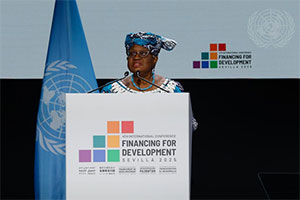 Opening of 4th International Conference on Financing for Development. Credit: UN Photo/Mariscal
International trade and investment are crucial elements of the world economy. While they can be powerful stimulators of development, they can also lead to global imbalances and dynamics of exploitation. In 2025, international trade entered a period of immense disruption, driven in part by a new wave of United States tariffs that reshaped global supply chains and investment flows. The increase in the US tariff rate, the highest since the 1930s, has forced bilateral renegotiations with global trading partners. Furthermore, the debt crisis in developing nations has accelerated while Official Development Assistance (ODA) has substantially dropped 7.3% in 2024.
In the 21st century, advancements in economic diversification in formerly colonized nations have propelled them into more central roles in the global economy. For example, both China and Mexico were able to develop their manufacturing sector and channel this development into booming export flows, thus advancing into the position of emerging economies. Foreign investment also plays an essential role in providing capital for developing countries, although they are oftentimes accompanied by social and environmental exploitation. For example, rising Chinese investments in natural resources in Latin America have often been met with tension as these investment projects fail to properly mitigate environmental risks and protect workers’ rights. In a more multifaceted vein, Sino-African relations have led to infrastructure development in Sub-Saharan Africa while also heightening the region’s economic dependency on China. IPS reports on global news in trade and investment, while shining a light on the nuanced nature of these endeavors.

The Week with IPS

NEXT STOP - SDGs
Tracking global progress towards a sustainable world
Tracking global progress towards a sustainable world
