Languages
Monday, August 31, 2026



News and Views from the Global South
Trade & Investment

More Than Half of Africa’s Arable Land ‘Too Damaged’ for Food Production
A report published last month by the Montpellier Panel - an eminent group of agriculture, ecology and trade experts from Africa and Europe - says about 65 percent of Africa's arable land is too damaged to sustain viable food production.
Haitians Worry World Bank-Assisted Mining Law Could Result in “Looting”
With Haiti’s Parliament having dissolved on Tuesday, civil society groups are worried that the Haitian president may move to unilaterally put in place a contentious revision to the country’s decades-old mining law.
Oil, An Invasive Water Species in the Carnival Capital
"We ran down to the beach and found a black tide, whose waves didn’t make the sound of water, but the slurp of a thick paste,” said Alexandre Anderson, describing the oil spill in Guanabara bay in the Brazilian state of Rio de Janeiro which turned him into an activist and leader among the local small-scale fishing community.
St. Vincent Embarks on Renewable Energy Path
For decades, the fertile slopes of La Soufriere volcano, which occupies the northern third of this 344-kilometre-square island, has produced illegally grown marijuana that fuels the local underground economy, and the trade in that illicit drug across the eastern Caribbean.
Women ‘Sewing’ a Bright Future in Northern Pakistan
At 46, Naseema Nashad is starting her life over, not out of choice but out of necessity. The Afghan woman was just 25 years old when Taliban militants stormed Kabul and her family was forced to flee to neighbouring Pakistan to escape what they knew would be a brutal regime.
Bhopal Cloud Hovers Over Industrial Safety in India
Three decades after 40 tons of deadly methyl isocyanate gas leaked from the Union Carbide India Limited plant in the central Indian city of Bhopal on Dec. 3, 1984 – killing an estimated 4,000 almost instantly and maiming and blinding hundreds of thousands of others – the world's worst industrial disaster remains a sharp lesson on the need for greater safety regulations in Asia’s third-largest economy.
OPINION: No Nation Wants to Be Labeled “Least Developed”
Since 1971, Maldives is one of only three countries that have graduated from the ranks of the world’s “least developed countries” (LDCs) – the other two being Botswana and Cape Verde.
Sri Lanka’s Minorities Choose “Unknown Angel” Over “Known Devil”
When the initial results started trickling in a little after midnight on Jan. 9, it still wasn’t clear exactly which way the country would swing: had Sri Lanka’s 15 million eligible voters thrown in their lot with incumbent President Mahinda Rajapaksa for a third term? Or would the desire for change put common opposition candidate Maithripala Sirisena at the helm?
Integrated Farming: The Only Way to Survive a Rising Sea
When the gentle clucking grows louder, 50-year-old Sukomal Mandal calls out to his wife, who is busy grinding ingredients for a fish curry. She gets up to thrust leafy green stalks through the netting of a coop and two-dozen shiny hens rush forward for lunch.
The Rise and Fall of the World’s Poorest Nations
The world's 48 Least Developed Countries (LDCs) - a special category of developing nations created by the General Assembly in 1971 but refused recognition by the World Bank - have long been described as "poorest of the poor" in need of special international assistance for their economic survival.
Spectre of Violence Hangs Over Sri Lanka Polls
As 14.5 million Sri Lankans prepare to select their next leader, there is growing fear that violence could mar the Jan. 8 elections, billed as the closest electoral contest in the island’s history.
OPINION: Sabotaging U.S.-Cuba Détente in the Kennedy Era
I grew up in Hickory Hill, my family’s home in Virginia which was often filled with veterans of the failed Bay of Pigs invasion.
OPINION: JFK’s Secret Negotiations with Fidel
On the day of President John F. Kennedy’s assassination in November 1963, one of his emissaries was secretly meeting with Fidel Castro at Varadero Beach in Cuba to discuss terms for ending the U.S. embargo against the island and beginning the process of détente between the two countries.
Children Starving to Death in Pakistan’s Drought-Struck Tharparkar District
The main entrance to the Civil Hospital in Mithi, headquarters of the Tharparkar district in Pakistan’s southern Sindh Province, is blocked by a couple of men clad in traditional dress and turbans. They are trying to console a woman who is sobbing so heavily she has to gasp for breath.
Pakistan’s Tribal Areas Demand Repatriation of Afghan Refugees
They number between two and three million; some have lived in makeshift shelters for just a few months, while others have roots that stretch much further back into history. Most fled to escape war, others simply ran away from joblessness.
Sri Lanka Still in Search of a Comprehensive Disaster Management Plan
About six months after a massive tsunami slammed the island nation of Sri Lanka on Dec. 26, 2004, large plumes of smoke could be frequently seen snaking skywards from the beach near the village of Sainathimaruthu, just east of Kalmunai town, about 300 km from the capital, Colombo.
OPINION: We Have So Much to Learn From Cuba
Earlier this month, President Barack Obama announced the restoration of diplomatic relations with Cuba after more than five decades of a misguided policy which my uncle, John F. Kennedy, and my father, Robert F. Kennedy, had been responsible for enforcing after the U.S. embargo against the country was first implemented in October 1960 by the Eisenhower administration.
Poverty and Fear Still Rankle, Ten Years After the Tsunami
It took just 30 minutes for the killer waves to leave 350,000 dead and half a million displaced. Less than one hour for 100,000 houses to be destroyed and 200,000 people to be stripped of their livelihoods.
Falling Oil Prices Threaten Fragile African Economies
The sharp decline in world petroleum prices - hailed as a bonanza to millions of motorists in the United States - is threatening to undermine the fragile economies of several African countries dependent on oil for their sustained growth.
What the U.S. Should Learn from Russia’s Collapse
After months of whispered warnings, Russia’s economic troubles made global headlines when its currency collapsed halfway through December. Amid the tumbling price of oil, the ruble has fallen to record lows, bringing the country to its most serious economic crisis since the late 1990s.
GDP and the Unaccounted for 82 Percent of National Wealth
Virtually all countries use Gross Domestic Product (GDP) as their primary measurement of economic progress and overall societal progress. At the same time, countries express allegiance to the doctrine of sustainable development. This exposes an obvious disconnect.« Previous Page — Next Page »


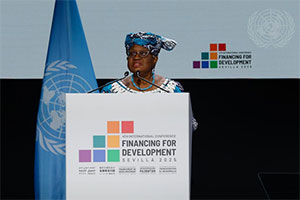 Opening of 4th International Conference on Financing for Development. Credit: UN Photo/Mariscal
International trade and investment are crucial elements of the world economy. While they can be powerful stimulators of development, they can also lead to global imbalances and dynamics of exploitation. In 2025, international trade entered a period of immense disruption, driven in part by a new wave of United States tariffs that reshaped global supply chains and investment flows. The increase in the US tariff rate, the highest since the 1930s, has forced bilateral renegotiations with global trading partners. Furthermore, the debt crisis in developing nations has accelerated while Official Development Assistance (ODA) has substantially dropped 7.3% in 2024.
In the 21st century, advancements in economic diversification in formerly colonized nations have propelled them into more central roles in the global economy. For example, both China and Mexico were able to develop their manufacturing sector and channel this development into booming export flows, thus advancing into the position of emerging economies. Foreign investment also plays an essential role in providing capital for developing countries, although they are oftentimes accompanied by social and environmental exploitation. For example, rising Chinese investments in natural resources in Latin America have often been met with tension as these investment projects fail to properly mitigate environmental risks and protect workers’ rights. In a more multifaceted vein, Sino-African relations have led to infrastructure development in Sub-Saharan Africa while also heightening the region’s economic dependency on China. IPS reports on global news in trade and investment, while shining a light on the nuanced nature of these endeavors.

The Week with IPS

NEXT STOP - SDGs
Tracking global progress towards a sustainable world
Tracking global progress towards a sustainable world
