Languages
Sunday, September 6, 2026



News and Views from the Global South
Trade & Investment

Fishing for Peace in Korea
Environmental problems, by their nature, don’t respect borders. Air and sea pollution often affect countries that had nothing to do with their production. Many extreme weather events, like typhoons, strike more than one country. Climate change affects everyone.
As TPP Trade Talks Miss Third Deadline, Opponents Claim Momentum
For the third year in a row, government negotiators for 12 Pacific Rim countries have missed an internal deadline to reach agreement on a controversial U.S.-led trade deal.
Filipinos Take to the Streets One Year After Typhoon Haiyan
People covered their bodies with mud to protest against government ineptitude and abandonment; others lighted paper lanterns and candles and released white doves and balloons to remember the dead, offer thanks and pray for more strength to move on; while many trooped to a vast grave site with white crosses to lay flowers for those who died, and to cry one more time.
More Economic Equality Brings Greater Political Polarisation in Brazil
“If I had to choose today I would stay back home, I wouldn’t come to look for work here,” said Josefa Gomes, who 30 years ago moved from Serra Redonda, a small town in Brazil’s semiarid northeast, to the city of Rio de Janeiro, 2,400 km away.
Extractives Companies “Not Ready” for Transparency Requirements
The world’s largest corporations continue to publicise scant information about their global operations, according to new analysis that warns that extractives companies in particular are unprepared for pending disclosure requirements.
More Women Managers in Argentina, But They’re Still Doing the Chores
In Argentina there are more and more women in management-level positions in the public and private sectors, although they still have to forge their way amidst gender stereotypes, while shouldering the double burden of home and work responsibilities.
UNIDO Comes a Long Way
The United Nations Industrial Development Organisation (UNIDO) has come a long way since 1997, when it faced the risk of closure in the aftermath of the end of the Cold War.UNIDO Forum Expresses Cautious Optimism on Ethiopia’s Economic Strides
With annual economic growth rates of over 10 percent and attractive investment conditions due to low infrastructural and labour costs, Ethiopia is eagerly trying to rise from the status of low-income to middle-income country in the next 10 years.
When Is a Corporate Media Group Too Powerful?
A multi-million-dollar grant from a major media conglomerate to a communications school here has been hailed by some as a shining example of corporate philanthropy working to improve the quality of journalism.
Inside Pakistan’s Untapped Fishing Industry
If you want to know what ‘sea traffic’ looks like, just go down to the Karachi Harbour. Built in 1959, the dockyard houses close to 2,000 big and small boats anchored in the grey sludge at the edge of Pakistan’s southern port city, which opens into the Arabian Sea.
Middle-Income Kenya Still in Need of Aid
Coffee farmer Gabriel Kimwaki from Nyeri County, in central Kenya, is considering “giving up farming altogether”.Global Tax-Evasion Crackdown Sidestepping Poorest Countries
While a major global campaign to cut down on tax evasion is picking up momentum, anti-poverty advocates say the initiative overlooks the world’s poorest countries.
U.N. Favours Changeover from Landlocked to ‘Land-linked’
Some 440 million people are living in 32 countries that are among the world’s poorest, most of them least developed, and geographically isolated from world markets not only because they have very few commodities to export, but also because they have no direct territorial access to the sea.
Using Phytotechnology to Remedy Damage Caused by Mining
Combating the negative effects of its own production processes is one of the challenges facing the mining industry, one of the pillars of the Chilean economy.
Inside Pakistan’s Untapped Fishing Industry
 If you want to know what ‘sea traffic’ looks like, just go down to the Karachi Harbour. Built in 1959, the dockyard houses close to 2,000 big and small boats anchored in the grey sludge at the edge of Pakistan’s southern port city, which opens into the Arabian Sea.

OPINION: Rousseff Re-elected President – What Lies Ahead for Brazil?
The tight race between incumbent President Dilma Rousseff of Brazil’s Workers’ Party and her opponent, Aecio Neves from the centre-right Brazilian Social Democracy Party (PSDB) party, ended on Sunday, Oct. 26 with the re-election of Rousseff.
Fossil Fuels Won’t Benefit Africa in Absence of Sound Environmental Policies
Recent discoveries of sizeable natural gas reserves and barrels of oil in a number of African countries — including Uganda, Tanzania and Kenya — have economists hopeful that the continent can boost and diversify its largely agriculture-based economy.
OPINION: Towards an Inclusive and Sustainable Future for Industrial Development
As representatives of the United Nations Industrial Development Organization (UNIDO), we are sometimes asked whether industrial development is still relevant to a world which many observers have claimed over the past decades to have entered the “post-industrial age”. Our answer is always an emphatic “yes”, shaped both by the evidence of history and current events.
They Say the Land is ‘Uninhabited’ but Indigenous Communities Disagree
Disregarding the rights of indigenous people to their traditional lands is costing companies millions of dollars each year, and costing communities themselves their lives.
Bougainville Voices Say ‘No’ to Mining
The viability of reopening the controversial Panguna copper mine in the remote mountains of Central Bougainville, an autonomous region in the east of Papua New Guinea, has been the focus of discussions led by local political leaders and foreign mining interests over the past four years.
A Jungle Shrine Awaits its Blessed Moment
Rising out of a thick forest about 17 km from the nearest main road, the Madhu Church is a symbol of spiritual harmony and tranquility. When the wind blows you hear the leaves rustle. Other times a solemn silence hangs in the air. Old-timers say that once, almost an entire generation ago, the grass grew six feet high in the church compound, and elephants wandered through it.« Previous Page — Next Page »


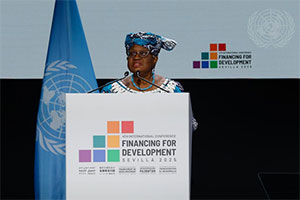 Opening of 4th International Conference on Financing for Development. Credit: UN Photo/Mariscal
International trade and investment are crucial elements of the world economy. While they can be powerful stimulators of development, they can also lead to global imbalances and dynamics of exploitation. In 2025, international trade entered a period of immense disruption, driven in part by a new wave of United States tariffs that reshaped global supply chains and investment flows. The increase in the US tariff rate, the highest since the 1930s, has forced bilateral renegotiations with global trading partners. Furthermore, the debt crisis in developing nations has accelerated while Official Development Assistance (ODA) has substantially dropped 7.3% in 2024.
In the 21st century, advancements in economic diversification in formerly colonized nations have propelled them into more central roles in the global economy. For example, both China and Mexico were able to develop their manufacturing sector and channel this development into booming export flows, thus advancing into the position of emerging economies. Foreign investment also plays an essential role in providing capital for developing countries, although they are oftentimes accompanied by social and environmental exploitation. For example, rising Chinese investments in natural resources in Latin America have often been met with tension as these investment projects fail to properly mitigate environmental risks and protect workers’ rights. In a more multifaceted vein, Sino-African relations have led to infrastructure development in Sub-Saharan Africa while also heightening the region’s economic dependency on China. IPS reports on global news in trade and investment, while shining a light on the nuanced nature of these endeavors.

The Week with IPS

NEXT STOP - SDGs
Tracking global progress towards a sustainable world
Tracking global progress towards a sustainable world
