Languages
Thursday, September 10, 2026



News and Views from the Global South
Trade & Investment
Bougainville Voices Say ‘No’ to Mining
The viability of reopening the controversial Panguna copper mine in the remote mountains of Central Bougainville, an autonomous region in the east of Papua New Guinea, has been the focus of discussions led by local political leaders and foreign mining interests over the past four years.
A Jungle Shrine Awaits its Blessed Moment
Rising out of a thick forest about 17 km from the nearest main road, the Madhu Church is a symbol of spiritual harmony and tranquility. When the wind blows you hear the leaves rustle. Other times a solemn silence hangs in the air. Old-timers say that once, almost an entire generation ago, the grass grew six feet high in the church compound, and elephants wandered through it.
“Yeil” – The New Energy Buzzword in Argentina
In Argentina they call it “yeil”, the hispanicised version of “shale”. But while these unconventional gas and oil reserves are seen by many as offering a means to development and a route towards energy self-sufficiency, others believe the term should fall into disuse because the global trend is towards clean, renewable sources of energy.
Zimbabwe’s Rich Fuel Inequality Through Illicit Financial Flows
Zimbabwe has lost 12 billion dollars in illicit financial flows over the last three decades and experts say this illegal practice is perpetuating social inequalities and poverty in this southern African nation.Put People Not ‘Empire of Capital’ at Heart of Development
President Rafael Correa Delgado of Ecuador does not mince words when it comes to development. ”Neoliberal policies based on so-called competitiveness, efficiency and the labour flexibility framework have helped the empire of capital to prosper at the cost of human labour,” he told a crowded auditorium at the 15th Raul Prebitsch Lecture.Central Asia Hurting as Russia’s Ruble Sinks
Pensioner Jyparkul Karaseyitova says she cannot afford meat anymore. At her local bazaar in Kyrgyzstan’s capital, Bishkek, the price for beef has jumped nine percent in the last six weeks. And she is not alone feeling the pain of rising inflation.
Añelo, from Forgotten Town to Capital of Argentina’s Shale Fuel Boom
This small town in southern Argentina is nearly a century old, but the unconventional fossil fuel boom is forcing it to basically start over, from scratch. The wave of outsiders drawn by the shale fuel fever has pushed the town to its limits, while the plan to turn it into a “sustainable city of the future” is still only on paper.
The Nagoya Protocol: A Treaty Waiting to Happen
For over 20 years, Mote Bahadur Pun of Nepal’s western Myagdi district has been growing ‘Paris polyphylla’ - a Himalayan herb used to cure pain, burns and fevers.
OPINION: Europe is Positioning Itself Outside the International Race
The new European Commission looks more like an experiment in balancing opposite forces than an institution that is run by some kind of governance. It will probably end up being paralysed by internal conflicts, which is the last thing it needs.
Pacific Islanders Take on Australian Coal
The recent blockade of ships entering the world’s largest coal port in Newcastle, Australia, has brought much-needed attention to the negative impacts of the fossil fuel industry on global climate patterns. But it will take more than a single action to bring the change required to prevent catastrophic levels of climate change.
OPINION: Innovation Needed to Help Family Farms Thrive
Family farms have been contributing to food security and nutrition for centuries, if not millennia. But with changing demand for food as well as increasingly scarce natural resources and growing demographic pressures, family farms will need to innovate rapidly to thrive.
Pressure Building on Obama to Impose Ebola Travel Ban
President Barack Obama is under significant pressure to impose a range of restrictions on travellers coming to the United States from West African countries affected by the current Ebola outbreak.
Africa Can Be its Own ‘Switzerland’
Africa has the capacity to access at least 200 billion dollars for sustainable development investment but it will remain a slave to foreign aid unless it improves the climate for investment and trade and plugs illicit financial flows, development experts say.
Regional Trade Agreements Cannot Substitute the Multilateral System
Regional trade agreements have grown very rapidly in recent years, and today the World Trade Organisation (WTO) has been notified that 253 are in force.
Ahead of Myanmar Trip, Obama Urged to Demand Extractives Transparency
Lawmakers here are urging President Barack Obama to put transparency in the extractives sector at the centre of an upcoming trip to Myanmar.
Vanuatu Puts Indigenous Rights First in Land Reform
Stemming widespread corruption in the leasing of customary land to investors is the aim of bold land reform, introduced this year in the Southwest Pacific Island state of Vanuatu, which puts the rights of traditional landowners above the discretionary powers of politicians.
Curbing the Illegal Wildlife Trade Crucial to Preserving Biodiversity
For over five years, 33-year-old Maheshwar Basumatary, a member of the indigenous Bodo community, made a living by killing wild animals in the protected forests of the Manas National Park, a tiger reserve, elephant sanctuary and UNESCO World Heritage Site that lies on the India-Bhutan border.
New Trains, New Hopes, Old Anguish
The kids of Kodikaman, a dusty village straddling the newly laid railway line in Sri Lanka’s northern Jaffna District, enjoy a special treat these days.Karabakh Question Clouds Armenia’s Eurasian Union Accession
Armenia has finalised its accession to the Russia-led Eurasian Economic Union, an intended regional counterweight to the European Union. But while Armenian and Russian officials focus on future prosperity, some Armenian observers believe membership in the bloc could exacerbate Armenia’s security challenges.
New Trains, New Hopes, Old Anguish
 The kids of Kodikaman, a dusty village straddling the newly laid railway line in Sri Lanka’s northern Jaffna District, enjoy a special treat these days.

Marine Litter: Plunging Deep, Spreading Wide
Imagine a black-footed albatross feeding its chick plastic pellets, a baby seal in the North Pole helplessly struggling with an open-ended plastic bag wrapped tight around its neck, or a fishing vessel stranded mid-sea, a length of discarded nylon net entangled in its propeller. Multiply these scenarios a thousand-fold, and you get a glimpse of the state of the world’s oceans.« Previous Page — Next Page »


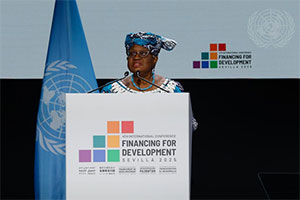 Opening of 4th International Conference on Financing for Development. Credit: UN Photo/Mariscal
International trade and investment are crucial elements of the world economy. While they can be powerful stimulators of development, they can also lead to global imbalances and dynamics of exploitation. In 2025, international trade entered a period of immense disruption, driven in part by a new wave of United States tariffs that reshaped global supply chains and investment flows. The increase in the US tariff rate, the highest since the 1930s, has forced bilateral renegotiations with global trading partners. Furthermore, the debt crisis in developing nations has accelerated while Official Development Assistance (ODA) has substantially dropped 7.3% in 2024.
In the 21st century, advancements in economic diversification in formerly colonized nations have propelled them into more central roles in the global economy. For example, both China and Mexico were able to develop their manufacturing sector and channel this development into booming export flows, thus advancing into the position of emerging economies. Foreign investment also plays an essential role in providing capital for developing countries, although they are oftentimes accompanied by social and environmental exploitation. For example, rising Chinese investments in natural resources in Latin America have often been met with tension as these investment projects fail to properly mitigate environmental risks and protect workers’ rights. In a more multifaceted vein, Sino-African relations have led to infrastructure development in Sub-Saharan Africa while also heightening the region’s economic dependency on China. IPS reports on global news in trade and investment, while shining a light on the nuanced nature of these endeavors.

The Week with IPS

NEXT STOP - SDGs
Tracking global progress towards a sustainable world
Tracking global progress towards a sustainable world
