Languages
Sunday, September 27, 2026



News and Views from the Global South
Featured

A New Wave of “Communist” Hysteria is Threatening to Spread Across US Politics
Senator Joseph R. McCarthy (Republican of Kansas) rose to public attention in the 1950s with his allegations that hundreds of “Communists” had infiltrated the State Department and other federal agencies.
Extreme Heatwave Escalates Urgency of Climate Adaptation in Europe
As Western Europe endured its worst-ever June heatwave in recorded history, the imperative for climate adaptation is now urgent as the continent accelerates beyond others to become the fastest-warming region in the world.
Cockroach Protests: How India’s Youth Movement Led to Minister’s Resignation
On July 25, after 50 days of protest at Delhi's Jantar Mantar, Union Education Minister Dharmendra Pradhan resigned.
UNHCR: 75 years on, the Refugee Convention Remains a Lifeline for Millions
Seventy-five years after the Refugee Convention was opened for signature on 28 July 1951, it remains the foundation of the international refugee protection system and one of the most consequential international legal instruments ever adopted.
Guatemala: A Narrow Opening in a Captured Justice System
José Rubén Zamora, founder of elPeriódico, Guatemala’s now-defunct leading investigative newspaper, spent 1,295 days in detention before a court granted him house arrest on 12 February. He endured long stretches of solitary confinement in a military jail, held in near-constant darkness and subjected to treatment that six UN experts warned could amount to torture. His offence was simply doing his job. For decades, he exposed the corrupt dealings of Guatemala’s economic and political elites. Prosecutors are still trying to send him back to prison.
From Castel Gandolfo to Campidoglio: Call for Human Dignity to Be at the Heart of the AI Revolution
After two days of debate at an international conference devoted to the challenges of artificial intelligence (AI), nuclear war and global security, Nobel laureates, former heads of state and government, scientists, human rights defenders, religious leaders and representatives of civil society adopted a joint declaration, calling for it to be based on human dignity.
What Development Looks like in Myanmar Today
When asked what development looks like today, a community leader in Kalaw township points to these fields. Once destroyed by a typhoon, they are now productive again. What began as emergency food assistance in the first month was followed by UNDP support in the community—seeds, training, debris removal, support to microbusinesses and small infrastructure—backed by the Republic of Korea, Norway and Switzerland. One year on, the fields sustain three annual production cycles—rice and flowers—with more resilient practices and higher yields. “This is what development looks like to us,” he says.
Human-Caused Climate Change, Not El Niño, Drives Most Coral Bleaching Events – Research
Every morning, as the Indian Ocean retreats from the reef off Zanzibar's Jambiani village, Chiku Chande steps into the knee-deep lagoon carrying bundles of seaweed seedlings. Years of farming these waters have taught her about every channel and coral outcrop. But lately, the corals that once glowed in brown and gold have become chalky white.
Trump’s Authoritarian Gambit to Muzzle the Foreign Press
Under a new rule proposed by the Department of Homeland Security, the duration of “I visas” for foreign media will be slashed from renewable multi year periods—often up to five years—to a maximum of 240 days, and just 90 days for Chinese journalists. Renewals would no longer be a routine administrative step tied to continued employment and compliance with the law, but a discretionary privilege the government can grant or withhold at will.
Africa’s Health Defenses Have Improved But Its Funding Has Not
In September 2024, an outbreak of Marburg virus disease in South Ethiopia was confirmed, contained, and declared over within three months.
US Plans to Restrict Visas to Foreign Journalists Come Under Fire
A proposal to restrict US visas to foreign journalists assigned to cover the US has triggered a strong protest from the New York-based Foreign Press Association (FPA).
Africa Can Grow Faster With AI—If It Moves Now
A farmer in Kenya gets weather and planting advice on a basic phone. A teacher in Nigeria uses a chatbot to help students catch up in math. South Africa’s revenue authority uses data analytics to better target tax audits. These are not futuristic examples from Silicon Valley. They are early signs of the broader transformation that artificial intelligence (AI) could bring to sub-Saharan Africa.
ALBANIA: ‘The Public Only Learns about These Development Megaprojects Once Construction Machinery Arrives’
CIVICUS discusses land grabs and environmental damage linked to a luxury coastal resort project with Eva Kushova, Director of Destination Management Organisation Albania, a civil society organisation that supports sustainable tourism in Albanian destinations, seeking to preserve culture and nature while maximising benefits for communities.
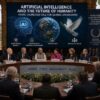
Artificial Intelligence and the Future of Humanity: Nobel Laureates Call for Global Safeguards
"I’m sorry, Dave. I’m afraid I can’t do that.” By bringing the supercomputer HAL 9000 to life in his 1968 film 2001: A Space Odyssey, American director Stanley Kubrick created one of the most powerful symbols of the fear of artificial intelligence (AI) escaping human control.
From the General Assembly to Harlem: Mandela’s Call to Action Endures
Sixty-seven minutes. That is how long volunteers spent serving lunch to people experiencing food insecurity at Refettorio Harlem in New York City last week – one for every year Nelson Mandela gave to public service.
Global AI Governance Cannot Wait As the Digital Divide Widens
Throughout July 2026, various United Nations (UN) bodies and global experts have underscored the need for increased comprehensive artificial intelligence (AI) governance. Although AI yields significant potential gains for global development, persistent structural barriers continue to impede equitable access and deepen the digital divide.
Efficiency Becomes the World’s ‘First Fuel’ as Leaders at IEA Conference Chart Course for Cleaner, More Secure Energy Future
As geopolitical tensions, rising electricity demand and climate pressures reshape the global energy landscape, more than 600 energy ministers, chief executives, financial leaders and policy experts gathered in Montreal, deliberating upon how to deliver at an unprecedented scale.
Communities vs. Datacentres
Few things unite Donald Trump’s most ardent supporters with the Democratic Party’s progressive wing, but datacentres are one of them. Across the USA, communities are joining forces across the political divide to oppose developments few want but governments seem determined to impose.
Palestine Must Not Disappear
We have just concluded a visit to the West Bank, Israel, Jordan and Lebanon. From all that we have witnessed and heard, our inescapable conclusion is that the government of Prime Minister Netanyahu, and in particular Ministers Smotrich and Ben-Gvir, aim to make Palestine disappear physically, economically, culturally and politically. Yet other governments either are choosing not to see this or lack the will to take meaningful concerted action.
The Oil Market Absorbed the War Shock, but Buffers Are Running Low
The largest disruption to the global oil market in decades should have sent prices soaring. But after spiking at the start of the war in the Middle East, crude prices soon settled in a range of $90 to $100 per barrel, much lower than many had feared. Why didn’t prices climb higher? The answer is that a combination of factors helped cushion the initial blow. But much of that room has now been used up.
SERBIA: ‘We Are Becoming an Electoral Autocracy, a System Where the Government Cannot Lose’
CIVICUS discusses the prospects for elections in Serbia with Rasa Nedeljkov, Programme Director at the Center for Research, Transparency and Accountability, a civil society organisation that monitors electoral processes and the rule of law in Serbia.
« Previous Page — Next Page »


The Week with IPS

NEXT STOP - SDGs
Tracking global progress towards a sustainable world
Tracking global progress towards a sustainable world
