Languages
Friday, November 27, 2026



News and Views from the Global South
Global Governance

Q&A: Tunis and Cairo Reveal a New Popular Militancy
More than 200 years ago, one of the United States' founding presidents, Thomas Jefferson, famously remarked: "Every generation needs a new revolution." Today, his words are more relevant than ever, as young people across the world mark 2011 as a year of change.TRADE: “Poor Countries Have Already Given Enough in Doha Round”
South Africa has expressed sharp concern over concerted attempts by leading industrialised countries, particularly the U.S. and the European Union (EU), to extract onerous commitments from developing countries as a condition to concluding the stalled Doha Round trade negotiations.CORRUPTION: Egyptians Can Claim Mubarak’s Stolen Billions
For decades, European bank accounts and trusts and the real estate market were havens for dictators seeking safe places to deposit billions of dollars they were stealing from their countries of origin.Egypt’s U.S.-Armed Military in Transitory Commanding Role
When embattled Egyptian President Hosni Mubarak reluctantly called it quits after more than two weeks of mass demonstrations against his 30-year-old authoritarian regime, he temporarily turned over the country to an institution trained, armed and nurtured by the United States: the 350,000- strong military.
Q&A: Political Support Needs Financial Backing
"The agenda for women's rights and empowerment in each country must be supported by the political leadership," says Norah Matovu-Winyi, Executive Director, African Women's Development and Communication Network (FEMNET).
Niger Delta Demands for Justice Undaunted by Decades of Violence
Nigerian environmental rights groups have been making the case for the expulsion of oil companies from the Niger Delta in the southeastern part of the country at the World Social Forum in Dakar.
SOUTHERN AFRICA: Securing Safe Water for a Million More
Long years of armed conflict have obstructed development in the areas on either side of the Angola-Namibia border. Now a 45 million dollar infrastructure upgrade is set to improve access to clean drinking water and decent sanitation for one million people.U.S.: Military Intervention Trumping Humanitarian Aid
In the midst of a belt-tightening political climate in which pledges by prominent lawmakers to slash the United States' foreign affairs budget will likely soon be realised, some rights groups and experts are concerned about the increasingly blurry distinction between security and development in the face of shrinking resources.U.S.-IRAN: Unrealistic Agenda Undermined Nuke Talks
No observers of U.S. relations with Iran over the past three decades were surprised when late-January talks in Istanbul failed to hint at, let alone deliver, a breakthrough that would ease tensions between the Islamic Republic and the West.
Q&A: The People Need to Take Leadership
While the international community is now talking of a triple global crisis – food, climate and economic - a weeklong session of the World Social Forum (WSF) is coming to a close in Dakar, Senegal.Pakistan Sinking Into Water Crisis
Pakistan is still reeling from flooding that caused one of the world's costliest natural disasters in 2010, with millions of people lacking shelter, infrastructure in ruins and donations falling short of appeals. But worse may come.
Q&A: Another World Is Possible – It’s Called Ecosocialism
As the powerful collective energy continues to surge through Dakar, veterans of the World Social Forum (WSF) are taking a moment to examine the history, trajectory and future of the alternative global movement.Nepal, Qatar Vie for U.N. Presidency
When the 192-member General Assembly, the highest policy- making body at the United Nations, meets to formally induct its president, the choice is usually a foregone conclusion because the decision is made far in advance of the annual opening session in September.VENEZUELA: Biopiracy Leaves Native Groups Out in the Cold
Millions of cancer patients around the world benefit from a medication called Paclitaxel (Taxol), which may begin to be produced from a new source: fungi found at the summit of Venezuela's flat-topped mountains. But the indigenous communities who have lived in that area since time immemorial will receive no benefits, and were not even consulted on the matter.
WORLD SOCIAL FORUM: “We Don’t Want Everybody to Think the Same”
It is only the second time that the World Social Forum (WSF) takes place in Africa, the first one having been held in Nairobi, Kenya, in 2007. Since the start of the WSF in Porto Alegre, Brazil, 10 years ago, the organisers have been building African participation.Environmental and Demographic Forces Threaten State Failure
Uprisings in Tunisia, Egypt, and across the Middle East at the start of 2011 have reminded the world just how politically fragile some countries are. But the focus of international politics has been shifting for some time now.Behind the Spin, Egypt Gives Tehran Political Heartburn
Judging from official propaganda in both Iran and much of the Arab world, the uprisings that toppled Tunisia's dictatorship and threaten Egypt's authoritarian regime are the direct descendent of the 1979 Islamic Revolution.
Q&A: Alternatives Needed to Western-led Peacebuilding
"Security Sector Reforms" (SSRs) have become the latest catch phrase in donor discussions on post-conflict peacebuilding around the world.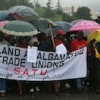
AFRICA: Swaziland in Crisis as Customs Union Revenue Is Slashed
Apart from the looming job losses in Swaziland’s public sector, small and medium enterprises (SMEs) have also warned of retrenchments following the government’s decision to suspend procurement from small businesses.SOUTHERN AFRICA: Together Against the Rising Water
A decade after heavy floods wrecked havoc in Southern Africa, the region is better prepared to monitor and respond to seasonal flooding. This is thanks as much to the growing strength of transboundary institutions as it is to technical improvements.
Q&A: Revolutions Are Not Widgets
Behind the headlines of mass social forums and violent protests, fighting oppression and changing the world requires sustained grassroots action, according to Kenyan social justice activist Onyango Oloo.« Previous Page — Next Page »


The Week with IPS

NEXT STOP - SDGs
Tracking global progress towards a sustainable world
