
Sunday, November 8, 2026



News and Views from the Global South
Armed Conflicts

Q & A: Escalating Tensions in Ethiopia adds to Tenuous Refugee Setting
Already reeling from conflict, extreme weather events and growing displacement due to the COVID-19 pandemic, escalating tensions in Ethiopia’s Tigray region have placed the country on the brink of civil war and many are looking to Nobel Peace Prize-winning Prime Minister Abiy Ahmed to avert a potential humanitarian disaster.
Building Blocks for Nuclear Ban Treaty: NPT & Advisory Opinion of the International Court of Justice
The Treaty on the Prohibition of Nuclear Weapons (TPNW) will become binding law for participating states on January 22, 2021. Entry into force was triggered on October 24, the date marking the 75th anniversary of the United Nations, when Honduras become the 50th state to ratify the TPNW, reaching the threshold set by the treaty.
Nuclear Arms Control in Crisis While US Exerts Pressure on Treaty Signatories
Responding to a question, Albert Einstein, the German-born physicist who won the 1921 Nobel Prize for Physics, predicted rather ominously: “I do not know with what weapons World War III will be fought, but World War IV will be fought with sticks and stones.”
‘The Sahel – a Microcosm of Cascading Global Risks Converging in One Region’
The European Commission this week pledged $27.8 million in humanitarian support to the Sahel region as floods and the coronavirus pandemic exacerbate the stability in a region deeply in conflict. While the figure is less than 2 percent of the $2.4 billion that the United Nations has appealed for, Amnesty International researcher Ousmane Diallo told IPS that despite past donations from international development partners to Sahelian countries, the situation hasn’t improved over the years.
Mahatma’s Non-Violence: Essence of Culture of Peace for New Humanity
I will begin by presenting to you excerpts from the message from UN Secretary-General António Guterres on the International Day of Non-Violence.
Afghanistan, Hope Fading in the midst of Fear and Silence
Distant and blurred, as if it belongs to the past, the war in Afghanistan has never been so fierce and forgotten. On the 7th of October, the country entered the twentieth year since the United States announced the first airstrikes against the Taliban, adding a new chapter to the endless bleeding of this corner of Asia, where more than four decades without peace have left entire generations hopeless.
Q&A: Women in Mali Play Critical Role in Preventing and Resolving Conflicts
The coronavirus pandemic has affected the safety and sense of community for many women in Mali given the travel restrictions and lockdowns in place, Bassirou Gaye, an assistant researcher for a 2019 report on the role of Mali women in peacekeeping, told IPS this weekend.

Scaling Up SDG4 in Crises
Out of global crises spring opportunities for change. In crisis, change is not an option. It is a necessity. And, as Plato famously noted: “Necessity is the mother of invention.” Education Cannot Wait (ECW) is an invention that sprang out of crisis and was borne of necessity.
The Lebanese Disaster
The 26th of September, the Lebanese prime minister Mustapha Adib stepped down after less than a month on his post. The president, Michael Auon, stated: ”Lebanon will be going to Hell if a new government is not formed soon.” The question is if his nation is not there already. A horrifying image of the state of the nation was provided on the 4th of August when 2,750 tons of ammonium nitrate, stored in a dockside hangar, blew up in an explosion killing more than 190 people, injuring 6,500 and damaging thousands of buildings.
Teachers Shoulder the Burden: Improving Support in Crisis Contexts
Teachers are at the heart of children and young peoples’ educational experiences. Teachers play multiple roles in their students’ lives by supporting their learning, providing them with inclusive and safe environments to grow and develop, and helping them become more confident as they make their way in the world. As we commemorate World Teachers’ Day on Monday, 5 October and its theme--Teachers: Leading in Crisis, Reimagining the Future--we must recognize the inspiring and transformative role that teachers working in armed conflicts, forced displacement, climate change induced disasters and protracted crises play in their students’ lives.
Peace in the Middle East
After the fall of the Ottoman Empire at the end of WWI, The League of Nations mandated that Britain administer Palestine. The London administration was quite ineffective, in part, due to the contradictory promises which were made to the Arabs, to the Zionists and to France, the other colonial power which divided the territory with Britain.
Central Sahel – Shaping peace together with women and young people Statement for International Peace Day
The countries of Central Sahel—Burkina Faso, Mali, and Niger—face an unprecedented crisis, marked by violent extremism, forced displacement, and rising insecurity. The sharp increase in armed attacks on communities, health centres, schools and other public institutions and infrastructure has disrupted livelihoods and access to social services. The impact on affected people is devastating.
Peace is the North Star During and the Post COVID-19 Pandemic
Amid various global conflicts in the 1980s and 1990s, the International Day of Peace (IDOP) was established to commemorate the strengthening of the ideals of peace globally. Today, peace is not just the absence of conflict, but a key prerequisite for development. It is in recognition of the crucial linkages between peace, respect for human rights and sustainable development that more than 36 indicators for peace were included across the Sustainable Development Goals (SDGs).
Wise People Know That Winning a War Is No Better Than Losing One
From the desk of the Tricontinental: Institute for Social ResearchDedicated to Soni Prashad, 1929-2020, who spent her life looking for a better world. US President Donald Trump and his ‘war council’ – led by Secretary of State Mike Pompeo – have amplified their aggression against China. What began as a trade dispute in the 1990s has now escalated into the United States making an existential challenge against China.
The Culture of Peace: Change our World for the Better in the Age of COVID 19
Last year, we paid tribute to the 20th Anniversary of the 1999 Declaration of the Program of Action on a Culture of Peace. Today, we need to ask ourselves if we had genuinely carried out our moral responsibilities to transition from a culture of hatred and violence to a culture of tolerance and peace.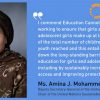
Statement by UN Deputy Secretary-general Amina J. Mohammed at ECW High-level Steering Group
As a friend and strong advocate of Education Cannot Wait, I welcome this opportunity to convey my support for ECW’s critical work and my solidarity with the millions of children and youth who are still being deprived of the opportunity to obtain a quality education because they are caught up in conflict, crisis or disaster.
A Red Notice against Trump?
When INTERPOL is asked to intervene against targeted killing. Introduction Last June, news broke that Iran had issued an arrest warrant and asked INTERPOL for help in detaining US President Donald Trump and dozens of others it believed had carried out the drone strike that killed a top Iranian general in Baghdad.1 INTERPOL denied this request,2 stating that it “would not consider requests of this nature” because “it is strictly forbidden for the Organisation to undertake any intervention or activities of a political, military, religious or racial character.”3

South Sudan – COVID-19 and Ongoing Violence has Catastrophic Impact on Civilians
Large-scale intercommunal violence on civilians in the Jonglei and greater Pibor regions in South Sudan has led to the mass displacement of thousands of people who are living in the open without health care, adequate food, shelter, water or sanitation in the middle of the rainy season.
Powerplay in Paradise: Sino-Indian Tussle in the Maldives
The Maldives is a picturesque country of merely 515,000 people located just beyond the southern tip of the South Asian land mass, in an idyllic Indian ocean setting. The nation is spread across 26 pretty atolls, comprising about 1192 islets, not all still inhabited. These are lapped by crystal blue waters containing flora and fauna of remarkable magnificence. Its scenic bounties attract droves of tourists who frolic in the sands, sun and the sea in salubrious languor. It has a thriving fishing, garment and tourism industry which have recently helped it graduate out of the United Nations list of Least Developed Countries (LDCs).It is so tiny that used to be said that the catch of a single large fish any day could cause a remarkable jump in its Gross National Product (GDP) numbers. It is not without reason that the archipelago has often been compared to a paradise.
The Abraham Accord: Will it Bring Peace or Perpetuate Pain in Palestine?
There is not much good news for President Donald Trump of the United States these days. If electoral polls have any credibility, he is staring at the face of almost certain defeat in the elections come November. So, when the so-called Abraham Accord between Israel and the United Arab Emirates (UAE) was sealed in a telephone call between him and the leaders of Israel and the UAE, signalling a sliver of silver lining in the otherwise hovering dark clouds over him, Trump was ecstatic. A Trump twitter called it a “HUGE breakthrough among “three GREAT friends!”.
Beating Anger into Empathy: the Need of the Hour in Ethiopia
The murder of Haacaaluu Hundeessaa, an icon of the Oromo people in Ethiopia was a tragic loss for all who struggle for rights in systems that fail to accommodate them.« Previous Page — Next Page »





Armed conflicts are a sad constant on daily front pages worldwide. Wars, civil wars, revolts, coups, genocides, ethnic and political violence, and global terrorism capture our attention for the geopolitical landslides, human suffering, food crises and streams of migration that follow in their wake. As in times of natural disaster, man-made crises claim frequent casualties among the poor, women and children. IPS examines emerging and ongoing armed conflicts around the world with an eye on the underlying social and political dynamics, and special focus on the lived experiences of those most affected by armed conflict.

The Week with IPS

Tracking global progress towards a sustainable world
