Languages
Friday, November 20, 2026



News and Views from the Global South
Development & Aid

Zimbabwe’s Thin Line between Child Smuggling and Child Trafficking
Elton Ndumiso*, a bus-conductor who works the route from Zimbabwe’s capital, Harare, to neighbouring South Africa, sees it all the time: Zimbabwean women travelling with three or four children, who are clearly not their own kids, and taking them across the border.It’s a crime that most bus drivers or conductors either turn a blind eye to, or become accomplices in by assisting the women.
Fiscal Policies For Women’s Economic Empowerment
Making sure that opportunities to enter the workforce are fair and rewarding for women benefits everyone. Yet, the average female workforce participation rate across countries is still 20 percentage points lower than the male rate, largely because gender gaps in wages and access to opportunities, such as education, stubbornly persist.
Mr. Ban Ki-moon begins second term in office as President and Chair of GGGI
On February 20, 2020 – Mr. Ban Ki-moon, 8th Secretary-General of the United Nations, has officially begun his second term in office as the President of the Assembly and Chair of the Council of the Global Green Growth Institute (GGGI). In his letter to Members of GGGI, President and Chair Mr. Ban reaffirmed his commitment to raise awareness of the Institute and its work to tackle climate change and help countries accelerate achievement of the Sustainable Development Goals (SDGs).
What Future for the Rohingyas after the ICJ Ruling?
 In a groundbreaking ruling in January 2020, the International Court of Justice demanded that Myanmar halt all measures that contribute to the genocide of the Rohingya community.

U.S. President’s Global Gag Rule is Having Negative Impact on the Health of Malawians: Report
A report released last week has detailed the complex ways in which President Donald Trump’s ‘Global Gag Rule’ (GGR), that blocks U.S. global health assistance to foreign non-governmental facilities providing abortion or abortion-related services, is affecting the population in Malawi, a country already hard hit with numerous climate change disasters.
Global Economy Still Slowing, Dangerously Vulnerable
In an annual ritual early in the year, most major economic organizations have released forecasts for the global economy in 2020. Incredibly, almost as a reminder of where financial power resides in this day and age, the International Monetary Fund (IMF) released its forecasts at the World Economic Forum’s 50th annual meeting in Davos.
Biodiversity & Agriculture: Nature’s Matrix & Future of Conservation
When we were children, a long auto trip would require a stop every hour or so to clean the windshield of the insects that had been intercepted.
Can Indian Farmers Adapt to Water Loss?
Over the last few decades, groundwater has become the major source of irrigation for Indian agriculture. Pumped by millions of privately-owned tube-wells, it contributes 60 percent of the water used for irrigation, having grown by 105 percent since the 1970s.
Coronavirus Epidemic Has Implications for Life Expectancy
As efforts to contain the Coronavirus epidemic enter a critical stage, it is important to remember that the costs cannot be measured purely in economic terms, as the measures taken will have implications for life expectancy across the entire nation.
Tackling Climate Change and Preserving the Water Body: A Bangladeshi Perspective
For any riverine country, the state of the water body around big cities and conditions of major rivers hold a leadership position in the overall climate effects and how the water body is protected and preserved impacts the entire economy and living standards of that country. Bangladesh is renowned for the geomorphic features that include massive rivers flowing throughout the country. Within the border of Bangladesh lie the bottom reaches of the Himalayan Range water sources that flow into the Bay of Bengal totaling the number of rivers by a count of 700. The length of river bodies is about 24,140 km. There are predominantly four major river systems: the Brahmaputra-Jamuna, the Ganges-Padma, the Surma-Meghna, and the Chittagong Region river system. The Brahmaputra is the 22nd longest (2,850 km) and the Ganges is the 30th longest (2,510 km) river in the world. (1) The river system works as a backbone for agriculture, communication, drinking water source, energy source, fishing and as the principal arteries of commercial transportation in Bangladesh. During the annual monsoon period between June and October, the rivers flow about 140,000 cubic meters per second and during the dry period, the numbers come down to 7000 cubic meters per second.
EDUCATION CANNOT WAIT INVESTS $48 MILLION IN CHAD AND ETHIOPIA
In just one week, Education Cannot Wait (ECW), with the Governments of Ethiopia and Chad and implementing partners, launched two new multi-year resilience programmes in Chad (7 February) and Ethiopia (14 February) with US$48 million in seed funding over three years to roll out crucial programme activities and catalyse additional resources.
Why Trade in Services Matters for Development and Inclusiveness in Africa
The rise of the services economy around the world represents a profound transformation that offers significant opportunities for countries' sustainable development strategies.
Coming Down the Davos Mountain with a Gender Lens
In a recent report by World Economic Forum (WEF) shows women suffer a “triple whammy” in the workplace. Without drastic action, gender parity will take more than a lifetime to achieve. This is the challenge that Katja Iversen, President and CEO of Women Deliver is staring down.
From Cocoa to Chocolate, Made With Love in Africa
A premium chocolate maker in São Tomé and Príncipe is on a drive to promote the taste for "made in Africa" chocolate, and tap into a $100 billion global indulgence associated with Valentine’s Day.
Why Paraguay Can Be a “Beacon State” for Forest Management
Imagine a forest that covered half of your entire country. A biodiverse forest which supports thousands of species from giant anteaters to armadillos to jaguars. A forest that is home to one the world’s last uncontacted tribes.1
Desert Locusts Invade East Africa
Widespread hatching and movement of destructive desert locusts will turn into a full-blown crisis in the coming weeks in East Africa and neighbouring countries, the UN Food and Agriculture Organization warns.
Female Genital Mutilation: Not just an Emotional and Health Impact on Women but a $1.4 Billion Dollar Cost to Communities
When society doesn't act to prevent Female Genital Mutilation (FGM) it has a massive economic cost -- over $1 billion -- on communities globally. And while the practice is starting to become less common over time, experts say a large number of women and girls still remain affected.
Restoring Competition in ”Winner-took-All” Digital Platform Markets
Digital platforms are at the centre of the global economy and daily lives of consumers. A handful of these platforms have become dominant in specific markets without facing meaningful competition. They include Amazon as a marketplace, Facebook in social networking, Google in search engines and Apple and Google in application stores.
Landmark Law Empowers Women Farmers
When Pakistan’s eastern Sindh province passed the ‘Sindh Women Agricultural Workers Bill’ on 20 December, giving women in agriculture, livestock, fisheries and other agro-based work the same rights and benefits enjoyed by workers in the industrial sector, it was a revolutionary step for the whole of South Asia.
The Pacific Community launches the Pacific Healthy Recipe Contest
The Pacific Community (SPC) is calling for contestants to join the Pacific Healthy Recipe Contest and showcase their cooking skills and creativity to promote healthy eating and prevention of non-communicable diseases (NCDs).
Q&A: Africa Must Innovate its Food Systems in Order to Beat Hunger and Poverty
Africa needs to invest in agriculture by putting more resources into innovative research and development that can boost food and nutritional security, according to leading scientist, Nteranya Sanginga.« Previous Page — Next Page »


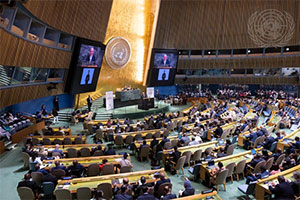 2026 High-level Political Forum on Sustainable Development. Credit: UN Photo/Eskinder Debebe
In 2015, the United Nations and its Member States adopted the Sustainable Development Goals (SDGs) in an effort to make the world a more sustainable and peaceful place for future generations. Progress on the 17 SDGs has been uneven, and inequality persists across the globe. 10 years after adoption, the 2025 UN SDGs Report revealed that only 35% of the SDG targets are on track, with more than half moving too slowly, and 18% moving backwards from the 2015 baseline. Poverty remains one of the world’s most pressing issues, with hunger, violence, and inequality impeding the opportunities for all people to achieve success. In September 2024, the United Nations Summit of the Future introduced a new goal: to eradicate global poverty by 2030, ensure universal rights to basic services, and increase the overall standard of living in terms of industrialization, economic well-being, citizen health, and literacy. Furthermore, recent shifts in United States foreign aid policy – notably, major budget cuts to USAID and the termination of thousands of development programmes– have severely threatened vital lifelines of financial aid to impoverished communities around the world. Additionally, the United States’ withdrawal from the Paris Climate Agreement has undercut international efforts at sustainable development. With the upcoming 2030 deadline, the UN Secretary-General has called for urgent multilateralism across six priority areas: food systems, energy, digital connectivity, education, jobs and social protection, and climate and biodiversity. IPS sheds light on marginalized communities that struggle on a daily basis to survive and have their stories heard and respected.
Updated by Yilan Batista and Shuli Wong August 2026

The Week with IPS

NEXT STOP - SDGs
Tracking global progress towards a sustainable world
Tracking global progress towards a sustainable world
