
Wednesday, November 25, 2026



News and Views from the Global South
Environment
U.N. Report Optimistic on Anti-Poverty Strides
Despite the ongoing financial crisis, global poverty rates are expected to fall by half in the next five years compared to 1990, according to the Millennium Development Goals (MDG) Report 2010 launched on Wednesday by Secretary-General Ban Ki- Moon.
INDIA: Animals Nearing Extinction Need Urgent Attention – Experts
With threats looming large on the survival of several wildlife species in the Himalayan state of Jammu and Kashmir in northern India, experts warn that these species could go extinct in the coming years unless immediate steps are taken to prevent their extinction.DEVELOPMENT-CONGO: Deforestation Threatens South With Famine
The trees are falling in Pool, and there are plenty of people to hear the sound. In a painful irony, the end of armed conflict in 2003, has signaled the wholesale devastation of forests in this southern region of the Republic of Congo.ECUADOR: Chinese Mega Loan for Dam Draws Fire
The opposition and experts in Ecuador are questioning a 1.68 billion dollar loan from China to finance 85 percent of the construction and equipment of the Coca Codo Sinclair hydroelectric dam.Raising Water Productivity to Increase Food Security
With water shortages constraining food production growth, the world needs an effort to raise water productivity similar to the one that nearly tripled land productivity over the last half-century.
AFRICA: Cautionary Notes Sounded as South-South Trade Booms
An Indian textile engineer and entrepreneur called Raj Rajendran visited Rwanda in 1999. He was tasked to close down an unviable textile factory following the civil war. But he discovered propitious agro-climatic conditions, particularly volcanic soil -- ideal for the rearing of silk worms to produce raw silk.
AFRICA: “Help Small Fishers to Fish Less, Earn More”
Sanitary and phyto-sanitary measures are a headache for African fish exporters but aid for trade may help small-scale fisherpersons to meet these standards.
Natural Heritage of the Honduran Caribbean on a Tightrope
The great biodiversity of a protected area on the Honduran Caribbean coast is at risk, despite the efforts of a handful of residents and local institutions.
Río de la Plata Under Land-Based Attack
The waters of the Río de la Plata (River Plate) estuary flowing into the Atlantic Ocean suffer the effects of poor management along the Uruguayan coast, though there are some signs of improvement.Ecobreves – BRAZIL: Logging Town Halts Deforestation
The Green Municipality program in the district of Paragominas, in the northern Brazilian state of Pará, is held up as an example for having dramatically reduced deforestation, planting 50 million trees and standardizing rural properties -- which means better environmental regulation.Ecobreves – CUBA: Quake Alert Continues
Cuba has beefed up its system of prevention for dealing with a major earthquake disaster after the series of temblors that followed the tragic January quake in nearby Haiti.Ecobreves – HONDURAS: Agatha Cost 72 Million Dollars
Tropical storm Agatha left a wake of destruction in her path across Honduras three weeks ago, causing 72 million dollars in losses in farming and road infrastructure, say officials.Ecobreves – VENEZUELA: Yellow Butterflies Return to Caracas
The yellow butterflies have returned, after a harsh dry season, as the rainy months begin in the valley where Caracas is located. These insects have been absent for nearly three decades as a result of urban sprawl.Caribbean Under Fire for Pro-Whaling Stance
The votes of six Caribbean countries could help decide whether or not the International Whaling Commission (IWC) will ease the 1986 global ban on commercial whaling and allow hunting in the Southern Ocean Whale Sanctuary around Antarctica.
Q&A: “Sustainability Is Paramount for Latin American Development”
Although the financial, climate, energy and food crises continue to create new challenges, Colombian biologist Margarita Astrálaga believes that now could be the time for Latin America "to advance towards a more equitable and sustainable development."EU: To Kill, But Not Pollute
European Union subsidies earmarked for reducing air travel's contribution to climate change may help develop deadlier warplanes than those already found in the world's arsenals, Brussels officials have admitted.HONDURAS: Miskito Women Fight on Nature’s Side
Seven years ago, in the isolated Honduran region of Mosquitia, on the Caribbean coast, a group of women, mostly single mothers, elderly or widowed, overcame their fear and timidity -- thanks in part to a waste recycling project.ARGENTINA: Turning Wasteland into Woodland
In Santiago del Estero, one of the Argentine provinces hit hardest by deforestation and desertification, an oasis of native tree species is being created to restore the soil and entice back farmers who were forced to leave their land.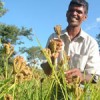
INDIA: Farmers Push Comeback of ‘Cereal of the Poor’
Eshwarappa Banakar has been a farmer most of his adult life, but these days he has also turned banker – banker of seeds, that is, and especially of millet strains.
ENERGY: Brazilian Dams in Peru’s Jungle, to Supply Brazil
An energy deal that Peru and Brazil signed this week in the Amazon city of Manaus in Brazil is opposed by environmentalists and local indigenous communities in Peru where the planned hydroelectric dams will be built. What is at stake?
PARAGUAY: “Pause” Farming Expansion in Gran Chaco, Say Activists
Extensive cattle farming in northwestern Paraguay is the leading cause of deforestation in the Gran Chaco, one of the world's leading regions in biodiversity and South America's second largest forested area, after the Amazon.« Previous Page — Next Page »


Through our global network of local writers, we are continuing our award-winning coverage of global and local environmental challenges, with a focus on the people for whom the ecosphere matters in a direct way: rural dwellers who have little means to protect themselves against adverse conditions; communities that need to switch to sustainable development in order to survive; poor women and children, who are the most vulnerable in natural disasters. Sponsored by the United Nations Environment Program (UNEP), the United Nations Development Program (UNDP) and The World Bank (WB), IPS also maintains the award-winning Tierramérica, a specialised information service on environment and development.

The Week with IPS

Tracking global progress towards a sustainable world


