Languages
Saturday, November 28, 2026



News and Views from the Global South
Food and Agriculture
TRADE: Whither African Cotton Producers After Brazil’s Success?
African cotton-producing countries hope that Brazil’s intended retaliation after its success at the World Trade Organisation’s (WTO) dispute settlement body will have a positive spin-off for them but seem reticent about pursuing a similar course of action against the U.S. for its continued use of subsidies in cotton production.WORLD WATER DAY: Water Everywhere but Not a Drop to Drink
When there are water cuts in Bulawayo, the plants in 59-year-old Ntombizodwa Makati’s vegetable garden are still watered - but she and her family go thirsty.U.S.: Water Crisis High on Policy Agenda, Clinton Says
On a rainy morning here Monday, U.S. Secretary of State Hillary Clinton emphasised the centrality to U.S. foreign policy of addressing the world's water challenges.EAST AFRICA: Impatient EU Pushes for Progress on EPA Trade Deal
The European Commission (EC) is increasing the pressure on the East African Community (EAC) to sign the free trade deal known as an economic partnership agreement with the EU.CLIMATE CHANGE-BRAZIL: The Threat Posed by Livestock
The livestock industry has less economic clout than the oil industry, but ranchers say it has better arguments to defend itself from accusations regarding its share of responsibility for global warming.
Q&A: Tapping Women’s Enterprise to Topple Rural Poverty
Employees at the International Fund for Agricultural Development (IFAD) may have cause to fear for their jobs after Yukiko Omura was appointed vice president of the United Nations' rural poverty agency in February.BALKANS: Farming Prospers as Farmers Suffer
Official statistics put Serbian agriculture as the single most productive branch of the economy and one that not only survived the financial meltdown but chalked up a record trade surplus of almost a billion US dollars in 2009.
EDUCATION-URUGUAY: Gardens of Knowledge
"Nature is wise, and if we take the time to observe it, we can learn so much" is the underlying philosophy of a number of innovative programmes being carried out in Uruguayan schools that are using gardens as a teaching resource, explained Edith Moraes, director of the national Primary Education Board.
TANZANIA: Weather Changes Turn Farming into Gamble with Nature
Changes in weather patterns have turned agriculture into a gamble with nature for Tanzanian farmers. Prolonged droughts and floods have made the lives of small-scale farmers, who don’t have access to irrigation, extremely difficult.MALAWI: Patrilineal Inheritance Prevents Women’s Access to Land
Mercy Gondwe, 51, from Rumphi in northern Malawi, was married for 34 years. When her husband died in 2008, she assumed she would inherit the land they had been cultivating together since they got married. But this was not the case.
MEXICO: Scientists Reinvent the Corn Tortilla
The process of making corn tortillas - the filling, age-old traditional food throughout much of Mexico and Central America - pollutes huge volumes of water and consumes a great deal of energy.MALAWI: Climate Change Is Changing Farming Methods
As they slept soundly on the night of Feb. 28, a family of four was killed when their house collapsed over their heads in Malawi’s southern district of Chikhwawa.HEALTH: Potato Drags GM Food Into Europe
Genetically modified (GM) foods appear to be back on the European Union's political menu - thanks to a potato.
DR CONGO: Will Poultry Project Live up to Expectations?
For some seven million Congolese living in Kinshasa the only meat and poultry they could buy to eat since the 1980s was frozen imports from Western countries, distributed locally by a few local businessmen.MALAWI: Extra Money Allocated for Drought Relief
Maize farmer Anita Yunus has lived near the Mulanje Mountain in southern Malawi for over 30 years. And she does not remember there ever being a drought in the area.
U.S.: Hispanic Farmers Seek Redress for Years of Bias
When the Barack Obama administration urged Congress to settle a protracted anti-discrimination lawsuit for 1.25 billion dollars on behalf of African American farmers last week, Lupe Garcia of Las Cruces, New Mexico was paying close attention.BULGARIA: Govt Forced Down on Genetically Modifed Crops
Campaigning by environmental groups and the general public has weakened the determination of the Bulgarian government to allow the cultivation of genetically modified (GM) crops in this country.POLITICS-PHILIPPINES: Rice and Condom on the Election Agenda
Rice and condoms do not usually land on the same list of household basics in the predominantly Catholic Philippines, but extremely poor couples here with huge families would choose rice if given the two options.DEVELOPMENT: Free Hungry Mouths of Red Tape
Developing countries must tone down the booming voice bureaucrats have in policies and target corruption if commitments to defeat hunger are to be turned into action, leaders and experts at a United Nations meeting said Wednesday.HAITI: Food Crisis Looms
Haiti's misery after last month's earthquake will be compounded by a food catastrophe if the international community continues to ignore the country's agricultural needs, the United Nations has warned.
ENERGY-ARGENTINA: Agrofuels Rev Their Engines
In a measure that was delayed by supply problems, this year Argentina is beginning to require that gasoline be mixed with ethanol and diesel fuel with biodiesel, at a proportion of five percent, to possibly reach 20 percent by 2015.« Previous Page — Next Page »


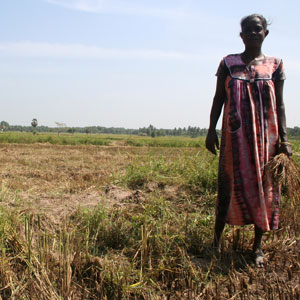
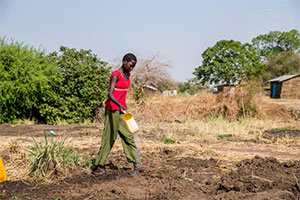 Farming on the Outskirts of Juba. Credit: UN Photo/JC McIlwaine
Promoting human and planetary health is a central focus of the United Nations, as laid out in the 2030 Sustainable Development Goals (SDGs). World hunger and unsustainable farming practices continue to be pressing concerns for the world. According to the 2025 State of Food Security and Nutrition in the World report by the Food and Agriculture Organization (FAO), 673 million people faced hunger in 2024. There are stark regional disparities, with the FAO projecting that 60% of the world population facing hunger will reside in Africa by 2030. Globally, the prevalence of food insecurity has remained consistently higher for women than men.
Sustainable and efficient national food systems are essential in preserving health, education, environmental well-being, peace, economy, and security. However, creating sustainable food systems can be a challenging endeavor, as food production takes a heavy toll on the environment. The agricultural sector accounts for a significant portion of greenhouse gases. Finding safe, sustainable, and ethical strategies to feed the world is crucial in ensuring planetary longevity. A recent initiative from 2023, the EU Regulation on Deforestation-free Products (EUDR), seeks to advocate for sustainable food systems. The main driver of deforestation is the expansion of agricultural land used to produce commodities like cattle, wood, cocoa, coffee, etc. The EUDR is part of the 2020 European Green New Deal and the EU Biodiversity Strategy for 2030 and aims to limit Europe’s consumption of products linked with deforestation by requiring that companies prove that their products are deforestation-free. Despite aiming to achieve major strides in sustainability, policies such as EUDR also raise socioeconomic concerns for targeted countries. Many emerging Latin American economies are impacted by the policy, and have raised the question of how developing countries can grapple with the tensions between economic development and advancing sustainability.
IPS has been at the forefront of providing compelling and insightful stories on communities facing hunger as well as the cost of food production. IPS uses statistics from FAO, the World Food Programme (WFP) and the International Fund for Agricultural Development (IFAD) to bring relevant and hard-hitting facts to readers. This gathering of information and data from such organizations helps bring the best stories from IPS journalists working in the different regions in consultation with experts on the ground.

The Week with IPS

NEXT STOP - SDGs
Tracking global progress towards a sustainable world