Languages
Monday, November 23, 2026



News and Views from the Global South
Global

ECONOMY: Argentina Shows World How to Beat the Crisis
What is happening in the European Union and the United States today happened a decade ago in Argentina, when it was a hotbed of protest and the streets of major cities were seething with people telling their leaders they had had enough. And then a new story began to be written.
U.S.: Hundreds Rally in Support of Accused WikiLeaks Source
Hundreds of people gathered today outside a U.S. military base where evidence against Bradley Manning, the soldier accused of leaking classified information to the whistle-blowing website WikiLeaks, is being presented before a military judge for the first time since Manning's arrest.BURMA: Kachin Refugees Get UN Relief, Finally
Six months after fighting erupted between Burmese troops and ethnic Kachin separatists, international relief is finally trickling in for over 30,000 people who fled their homes near the snow-capped mountains north of the country.
U.N.’s First Official Report on Gays Notes Widespread Bias
In its first-ever official report on the rights of lesbian, gay, bisexual and transgender (LGBT) people, the United Nations confirms there is widespread discrimination based on sexual orientation or gender identity in "all regions" of the world.In Unprecedented Move, Canada Withdraws from Kyoto Protocol
Barely 24 hours after it signed a new global climate change agreement in Durban, South Africa, Canada became on Monday the first country to formally withdraw from the Kyoto Protocol, the only legally binding treaty to reduce emissions causing climate change.RIGHTS: West Turns Blind Eye to Torture in Uzbekistan
Despite its formal adoption of due-process reforms in 2008, the government of Uzbekistan under President Islam Karimov continues to practice torture routinely, and the situation may be worsening, according to a major new report released here and in Berlin Tuesday.Op-Ed: Facing Peak Oil and Peak Gas: In Search of the Lesser Evil
The U.S. oil geologist Marion King Hubbert predicted, already in 1956, that the global production of oil will reach its all-time high roughly when we have used one half of the world's oil reserves. This is because geologists tend to find the biggest fields first, and because oil wells become tired during the production phase. The more is taken out, the more difficult it gets to bring the remaining oil to the surface.
Indigenous Peoples Call for REDD Moratorium
A new coalition of indigenous peoples and local communities called for a moratorium on Reducing Emissions from Deforestation and Forest Degradation (REDD) programs, a key part of the negotiations for a new international climate treaty that took place over the last two weeks in South Africa.
Agreement for New Global Treaty To Reduce Emissions
The world is increasingly committed to dangerous levels of global warming with yet another failure by nations of the world to agree to needed reductions in carbon emissions here in Durban. However, as the 17th Conference of Parties ended early Sunday morning, members did agree to talk about a new global treaty to reduce emissions.
Jailed Journalists Reflect Greater Struggle for Internet Freedom
The number of journalists in prison worldwide has spiked to its highest level in 15 years. Of them, nearly half worked online, raising larger questions about Internet freedom for more than just reporters, but average citizens as well.SYRIA: Civilians Pay Heavy Price for Political Deadlock
These days in Syria, "people dare not step a foot outside their homes because they're being shot at. And so they pass food from home to home by ropes through windows," Navi Pillay, U.N. High Commissioner for Human Rights, told reporters Friday.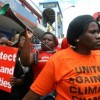
Draft Climate Deal Dubbed a “Death Sentence for Africa”
No one is happy late Friday at the very contentious U.N. climate talks that went into extra time on Saturday. As the lights flicker on a rainy night here, the partial power failure echoes the failure of the multilateral process, according to civil society and some countries.
Q&A: “By 2020 it Will be Too Late”
Despite the high risk, it remains difficult to convince politicians to take immediate action to prevent further climate change and make available the necessary funds to do so. Scientists have warned repeatedly of the effects of climate change - if governments do not act fast, they will cause an irreversible catastrophe.
MIDEAST: Saudi Warning Could Escalate Nuclear Arms Race
The world's nuclear powers - both declared and undeclared - have come primarily from Asia: China, India, Pakistan and possibly North Korea.Decent Work Key to Food Security
Basic income security and access to social services can improve food production and consumption in the developing world, which can be boosted by South-South cooperation.
Armed Societies, Another Tragedy for Women
Kairobis Arcia, 25, died from a bullet to her head shot by her husband, Oswaldo Mendoza, 32, who said he was blinded by jealousy in an argument fuelled by alcohol and drugs.
CLIMATE CHANGE: Following the Carbon Footprint to the ‘Emissions Reduction’ Fallacy
According to official figures, the European Union member countries have successfully reduced their emissions of greenhouse gases (GHG), especially of carbon dioxide (CO2), by more than 15 percent since 1990, thus more than fulfilling their commitments under the Kyoto protocol.
Kyoto Protocol – Hopes for Tangible Results Remain Slim
The last hours of the 17th United Nations climate change summit in Durban have begun. Since the arrival of almost 150 ministers and heads of state on Tuesday, negotiations have moved to the political level. They are expected to debate the way forward until late Friday night, or even Saturday morning.
Q&A: “Investing in the Fight against Hunger Brings Extraordinary Returns”
The man who played a key role in the design of Brazil's successful food security policies believes it is possible to eradicate hunger in the world, and intends to try by promoting "a simple idea."
Failure to Bridge the “Emissions Gap” Brings Economic Crisis
Countries at the United Nations climate change negotiations have publicly acknowledged their current pledges to reduce carbon emissions will not result in limiting global warming to less than two degrees Celsius.
At the Nexus of Agrofuels, Land Grabs and Hunger – Part 2
The forests in Africa absorb over 1.2 billion tonnes of carbon annually. With these diverse and natural forests, grasslands and prairie lands disappearing under investment schemes and the development of monoculture plantations for supposed "green" energy alternatives like agrofuels, not much else remains to absorb the shocks of hunger and climate change.« Previous Page — Next Page »


The Week with IPS

NEXT STOP - SDGs
Tracking global progress towards a sustainable world
