Languages
Saturday, November 14, 2026



News and Views from the Global South
Humanitarian Emergencies

ISDS Enables Making More Money from Losses
With the Covid-19 contagion from late 2019 spreading internationally this year, governments have responded, often in desperation. Meanwhile, predatory international law firms are encouraging multimillion-dollar investor-state dispute settlement (ISDS) lawsuits citing Covid-19 containment, relief and recovery measures.
We Must Prioritize Local Solutions to Global Problems
World Humanitarian Day is the perfect time to refresh our push to localize humanitarian aid for COVID-19 and all the challenges we face. Celebrating #RealLifeHeroes!
Enough Is Not Enough – Call for Urgent Change in Mexican Economic Policy
A group composed by women and men, called Nuevo Curso de Desarrollo (New Course for Development) based at the National University of Mexico recently published a document to propose a set of measures to change the current economic policy in Mexico. This proposal responds to a diagnosis of the current situation: at this point of the year, the serious social damage inflicted by the health and economic crisis can already be observed. As we know, in Mexico as in many other countries, there was a great economic disruption caused by COVID. Millions of people ceased to receive income from their work. However, the Mexican government has not carried out sufficient support measures to compensate for these losses. The result is easy to guess: many households have been rapidly impoverished. It is estimated that between 10 and 16 million people in April earned much less to the point of not being able to acquire the basic food basket , a situation that has continued for many of them during May, June and July. And while it is true that more and more workers are returning to their jobs, the losses caused have not been repaired.
No More Lost Generations: Global Fund Provides Education for Children in Crisis
15-year-old Humaira* sits on the mud floor of her hut in Ukhiya camp, Cox's Bazar, listening as the rain beats down on the tarpaulin roof.
Keeping Education within the Grasp of Refugee Children
“Not being able to go to school is not something I’d wish on any child in this world,” said 21-year-old Nujeen Mustafa, a young advocate for refugees who fled the Syrian war with her sister. Mustafa, who now lives in Germany, is also the United Nations Human Rights Council (UNHCR) high profile supporter.
Impending Food Crisis in Lebanon will Largely Affect Migrant Workers
Migrant workers and refugees in Lebanon will “inevitably” suffer the most as food insecurity threatens the nation following last week’s blast.
STRONGER TOGETHER IN CRISES’ – EDUCATION CANNOT WAIT REACHES 3.5 MILLION CHILDREN AND YOUTH IN HUMANITARIAN CRISES WORLDWIDE
Education Cannot Wait launched its ‘Stronger Together in Crises - Annual Results Report 2019’ today, reaffirming itself as the global fund for education in emergencies and protracted crises. Since the Fund’s inception in 2016, its investments have reached nearly 3.5 million children and youth in many of the world’s worst humanitarian crises.
COVID Crisis Challenges in People with Disabilities and Hansen’s Disease
Even during the best of times, unfortunately members of the global community who have special needs are marginalized and often treated as social outcasts. The COVID crisis which has been raging for over the better part of the year 2020 has posed additional barriers and challenges for these already disenfranchised individuals.
Where Do We Come From? What Are We? Where Are We Going?
COVID-19 has become a scourge affecting all levels of human society – morals, behaviour, human interaction, economy and politics. The pandemic has wrecked havoc on our way of being and its impact will remain huge and all-encompassing. It is not only affecting our globally shared existence, it is also changing what has been called ”the little life”, i.e. our own way of thinking and being, our personal life situation and the one of those close to us; people we love and depend upon – our friends and family.
Building Resilience in Pacific Education
School as we all know it hasn’t changed that much in over a century. However, in the face of new threats to health and wellbeing, the future of those familiar structures that bring teachers and students together is starting to be questioned.
COVID-19 – Some 23.8 Million More Children Will Drop out of School
Countries with low human development are facing the brunt of school lockdowns, with more than 85 percent of their students effectively out of school by the second quarter of 2020, according to a United Nations policy brief on the impact of COVID-19 on education.
Multilateral Bank Intermediation Must Help Developing Countries’ Recovery
International Monetary Fund (IMF) Managing Director Kristalina Georgieva has warned that developing countries would need more than the earlier estimated US$2.5 trillion to provide relief to affected families and businesses and expedite economic recovery.
Bangladesh Deals with Triple Disasters of Flooding, Coronavirus and Lost Livelihoods
With nearly 5.5 million people people across Bangladesh affected by severe flooding -- the worst in two decades -- humanitarian experts are concerned that millions of people, already badly impacted by COVID-19, will be pushed further into poverty.
The UN General Assembly: A 75-Year Journey Towards the Future We Want
The United Nations came into existence at a time of great despair, when the penholders of its founding document dared to imagine a better world, one that would be defined by peace and equality. Visionary world leaders chose hope over cynicism, empathy over indifference and partnership over distrust when they came together in San Francisco on 26 June 1945 to sign the Charter of the United Nations. They embarked upon a new, rules-based world order, with an Organization of unrivalled legitimacy at its core.
The New Poor Post-pandemic: Time for Cushioning the Most Vulnerable in Southeast Asia
After decades of impressive growth, for the first time, Southeast Asia is experiencing a drop in measured human development. The economic fallout from the COVID-19 pandemic will likely take months to reveal itself and years to put right. Yet, a legacy of mobilizing under constraints is leading Southeast Asia’s pandemic response.
Religion & the Pandemic: A Call Beyond the Here & Now
-- I have never been interested in religion or spirituality before, but I found myself tuning in to all sorts of on-line religion and spirituality related forums “in search of something.”
With Proper Investment in Youth, Kenya’s Potential for Progress Is Unlimited
Africa’s demographic boom has been hailed as its biggest promise for transforming the continent’s economic and social outcomes, but only if the right investments are made to prepare its youthful population for tomorrow’s world.
The Charter of the United Nations: Ideals for Shaping Our Reality
“Reconciling the requirements of the ideal with the possibilities of the real": this is how Georges Bidault, Minister for Foreign Affairs and head of the French delegation to the San Francisco Conference, summed up the objective pursued by the drafters of the Charter of the United Nations. On the still living ashes of the Second World War, the fathers of an Organization charged with developing friendly relations between nations, promoting human rights and economic and social progress were less utopian than visionary. They understood that the community of States should have a common constitution. It has been tested by conflict, crisis and upheaval, but its resilience and strength have shaped the very structure of contemporary international relations.
Southeast Asia Has a Chance to Build Back Better Post-Pandemic
Southeast Asia’s response to the coronavirus pandemic has been efficient, but some areas such as data privacy, measures to go back to normalcy after lockdown is lifted, and resources for migrant or transient populations will need addressing.
Only Governments Can Prevent Covid-19 Recessions Becoming Depressions
Covid-19 threatens economic life the world over. The most urgent and important need is for governments, businesses and families to survive. Governments must revive economies and livelihoods to prevent Covid-19 recessions from becoming protracted depressions. The Covid-19 crisis is clearly a ‘black swan event’, threatening both public health and livelihoods. Both the pandemic and containment efforts are not due to business operations and decisions, but nonetheless have compelling consequences for them.
Last Mile Teachers
“It has gotten really tough for us,” says James, a father in rural Liberia, of COVID-19 lockdown and school closures. “My son is trying but he is missing his friends and teachers. Children want to be in school.”« Previous Page — Next Page »


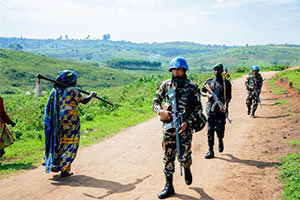 MONUSCO Peacekeepers and FARDC Soldiers Patrol Fataki Area. Credit: UN Photo/Jorkim Jotham Pituwa
Conflict, human rights violations, natural disasters, and famine have been at the forefront of concerns for humanitarian organizations. The escalation of humanitarian crises has led to over 239 million people in need of humanitarian assistance at the start of 2026, as estimated by OCHA’s Global Humanitarian Overview. The 2025 humanitarian appeal received only $12 billion, the lowest funding in over a decade, which has left 24 million fewer people reached in comparison to 2024. Conflict has remained the primary driver of crisis.
Humanitarian emergencies massively impact progress towards the Sustainable Development Goals (SDGs), adversely affecting economic development, inequality, education, planetary well-being, and poverty. Millions of people are faced with reduced access to essential services, including shelter, food, healthcare, and access to clean drinking water. UN Organizations such as UNHCR and the United Nations Children’s Fund (UNICEF) are committed to providing direct relief to affected communities when state governments cannot.
The United Nations 2024 Summit of the Future discussed measures that will be taken to reduce global inequality and promote peacekeeping efforts around the world. The recent UN Climate Change Conference (COP30) in Belém, Brazil, agreed to mobilize $1.3 trillion annually for climate action by 2035, operationalize the loss and damage fund, and triple adaptation finance. However, a fossil fuel transition commitment was not secured, despite climate change and the greenhouse effect being major contributors to humanitarian crises worldwide.
Countries across the world have also rallied to end humanitarian crises, as witnessed in conflicts such as Palestine and Ukraine. IPS is committed to providing relevant and in-depth reports of humanitarian emergencies around the world and their implications.

The Week with IPS

NEXT STOP - SDGs
Tracking global progress towards a sustainable world
Tracking global progress towards a sustainable world