Languages
Sunday, November 15, 2026



News and Views from the Global South
Labour

MAURITIUS: These Women Chose the Sea
She cannot swim, but Marie-Claite Hector is not afraid of the ocean. The 53-year-old pushes her small boat with all her strength towards the blue lagoon, starts the engine, and sets out to sea.
LABOUR-ICELAND: Centre Gives Leg Up to Listless Youth
For young Icelanders at a loose end the Fjolsmidjan (multi-workshop) can prove to be a turning point.INDIA: Hill Women Form Cooperative, Turn Entrepreneurs
Women in Uttarkashi district of the hill state of Uttarakhand in India, traditionally sidelined from the developmental processes, are forming their own cooperative and producing processed food items, giving big multinational brands a run for their money in local markets.WORLD SOCIAL FORUM: New and Old, US Groups Forge Broad Alliances
With civil society gearing up for the 2010 World Social Forum, and later this summer, the 2010 U.S. Social Forum in Detroit, Michigan, activists here say new alliances created at the first USSF in 2007 are going strong.DEVELOPMENT: China’s ‘Ant Tribe’: Between Dreams and Reality
Every day Yang Hongwei takes the bus home from work, staring silently at the European-style villas, luxury sedans and twinkling lights from the plazas that he sees through the window.RIGHTS-PAKISTAN: Not Quite a Happy Ending for Freed Fishermen
Tears streaming down his face, Abdul Karim, 40, stepped onto Pakistan soil for the first time in almost two years. He has just been released from prison for the crime of encroaching on India’s waters.SRI LANKA: ‘Job Losses Could Have Been Worse’ – Industry Sources
When the global financial crisis struck in 2008, expectations were high that the Sri Lankan economy would be severely affected. But as it turned out, the number of job losses was not as bad as anticipated.Q&A: ‘Small Government Equals More Personal Responsibility’
As president of an independent think tank advocating minimal government, Bienvenido Oplas, Jr. believes that a society will be more peaceful and dynamic if people will assume more individual and voluntary responsibilities over their lives, their families and their communities.BOLIVIA: Evo Morales, the Best Ally of the Middle Class
Just five years ago, an alliance between an indigenous leader and Bolivia's small but influential middle class seemed virtually impossible.DEVELOPMENT: Japan’s Rude Awakening: Poverty Hurts
Japan may be one the world' biggest economies, but it is not immune to poverty.URUGUAY: Forestry Industry Boom Brings Jobs and Challenges
"After work, when I'm on my own, I'm bored to death. If you want amenities, you have to bring them yourself," says young forestry worker Alejandro de Leiva, who works on a tree plantation in the western Uruguayan province of Paysandú, where he lives and works for 10 to 12 days in a row, with just two days off.DEVELOPMENT-FIJI: Amid Economic Slump, Children Face Bleak Future
Shonal Chand, 16, has ditched school to work full time to assist his financially struggling family. He sells pineapples, watermelons and other local seasonal fruits by the roadside six days a week.ECONOMY-MEXICO: A Tough Year Ahead
Steep price hikes for goods and services and higher taxes foreshadow a new year fraught with economic difficulties for most Mexicans.ENVIRONMENT-INDIA: Creeping Deserts and Crouching Hunger
It is just the beginning of the year, but M. Manju Laxmi already feels anxious. In four months or so, she will be back to her old routine: stuffing the wide chinks under her weathered closed doors and windows with her old saris.ECONOMY-BRAZIL: Going Up in the World
Brazil's economic achievements are being enthusiastically recognised abroad as never before. "Brazil takes off" was the Nov. 12 cover title of the British weekly The Economist.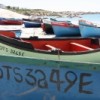
SOUTH AFRICA: Late Start For Crayfish Season
Long after the official opening of the crayfish season in South Africa on November 15, the boats lay idle on the beach in West Coast fishing villages like Paternoster. Fishing permits from the Marine and Coastal Managment unit (MCM) of the Department of Environmental Affairs and Tourism had not been issued.
SOUTH AFRICA: ‘They Haven’t Got a Choice: They Must Go to Sea’
Because of an unfair fishing quota system, more and more small South African fishing communities struggle to survive.MALAYSIA: Social Safety Nets Not Good Enough for Children
Malaysia may have been spared the worst effects of the economic slowdown due largely to its oil and gas reserves and other natural resources.
CLIMATE CHANGE: Doors Opening for Carbon Tax
With the chance for a global climate change treaty on hold, a tax on greenhouse gases could be an effective alternative for discouraging the activities that create emissions, say economists and environmentalists.CHINA: What Price Young Lives?
As more and more rural Chinese bid farewell to their impoverished home villages in their pursuit of a better life in bigger cities, leaving behind their young children in the care of relatives or aging parents seems only a small price to pay, especially in times of financial crisis.
MALI: Mobilising in Defence of Migrants
The number of migrants being deported and returned to Mali is increasing. Civil society has mobilised to support the returnees.« Previous Page — Next Page »


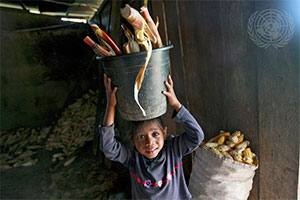 Timorese Girl with Fresh-Picked Corn. Credit: UN Photo/Martine Perret
A global common denominator is the need for a decent job. The economic realities of each country determine just how difficult it is to find one. Despite the labour movement's achievements, serious challenges persist: gender discrimination, child labour, worker migration, the digital divide and AI automation, evaporating pensions, unsafe workplaces, corporate pressure against union organising, negative impacts of trade agreements, and the precariousness of informal employment. The 2025 UN SDG Report identifies jobs and social protections as one of the six priority areas requiring urgent action, with progress either stalled or reversing in many developing nations.
In recent years, the fight to protect labour equality has taken on new dimensions with the rise of Environmental, Social and Governance standards. With the Social aspect aiming to promote equality and human rights, ESG principles have strengthened labour advocacy within corporate and governmental regulatory landscapes. In particular, ESG has become much more institutionalized in emerging economies such as Brazil and China. IPS follows the world’s workers as they confront these challenges - their setbacks and their successes.

The Week with IPS

NEXT STOP - SDGs
Tracking global progress towards a sustainable world
Tracking global progress towards a sustainable world
