Languages
Wednesday, November 18, 2026



News and Views from the Global South
Natural Resources
Chilean Miners Rescue May Mark a Watershed in Workplace Safety
"This country has to understand that changes must be made," said Mario Sepúlveda, the second Chilean miner -- of the group of 33 trapped 700 metres underground for over two months -- rescued in the early hours of Wednesday morning.
MALAWI: While the President Flies, the People Queue for Fuel
A public spat has developed between the Malawian government and organisations in the small south-eastern African country over foreign exchange being "wasted" on foreign trips undertaken by President Bingu wa Mutharika. The consequence has been repeated fuel shortages, organisations say.
ECONOMY: Electrifying African Interest in Renewable Energy
Various countries in East Africa are making gradual progress in moving from a solely carbon-based electricity network to a cleaner power grid.ARGENTINA: Environmentalists Welcome New Law to Protect Glaciers
Environmental organisations in Argentina are celebrating the passage of a law restricting the extraction of minerals, oil and gas near glaciers, in order to protect these vast freshwater reserves.Fatal Blast Puts Focus on Web of Gas Pipelines
A natural gas explosion in San Bruno, California that almost decimated an entire city earlier this month has fuelled concerns about the outdated, aging, and dangerous gas pipelines that underlie many U.S. cities.
MOZAMBIQUE: BHP Billiton Plans Six Month Bypass of Smelter Smokestack Scrubbers
Civil society groups are challenging a six-month authorisation granted aluminium giant BHP Billiton to emit potentially dangerous fumes from its Mozal smelter into the air without treating them first.
AFRICA: Liberalised Services Still Require Proper Regulations
With African countries' trade remaining inordinately dependent on natural resources exports, their economies could benefit from liberalisation of trade in services but only as long as proper domestic regulatory frameworks are put in place, some trade experts argue.
AFRICA: “Future Lies in a Free Trade Area From Cape To Cairo”
African governments’ ambitious plan for a tripartite free trade area (FTA), stretching from South Africa to Egypt, could be more realistic than getting existing ineffective regional customs unions on the continent to work.
TRADE: It’s the End of the Export-Led Growth Model, Says UNCTAD
While the recovery from the financial and economic meltdown remains fragile in especially the developed world, the outlook for Africa inspires optimism, according to UNCTAD. The agency also believes the crisis might be the death- knell for the export-led economic growth model -- especially African countries should leave it behind.OPEC – Fifty Years Regulating Oil Market Roller Coaster
Half a century after OPEC came into being, the world is very different, thanks partly to the actions of this organisation, the first to be formed in the developing South specifically to protect an export product.BP Report on Oil Spill Disaster Met with Scepticism
The report released Wednesday by energy giant BP of its internal investigation into the catastrophic explosion in April of the Deepwater Horizon oil rig and the subsequent spill from the Macondo oil well has been met with criticism by watchdog groups who question the company's motives.
LATIN AMERICA: Border Mining Projects Before Ethics Tribunal
Latin American activists who want to call attention to mining developments located in border areas will gather in Chile to "pass judgement" on projects they regard as detrimental to local communities, the environment and national security.Gulf of Mexico Oil Spill’s 30-Year Legacy
A surprisingly small number of scientists have studied the impacts of the oil spill resulting from the 1979 blowout at the Ixtoc I oil rig in the Gulf of Mexico. Wes Tunnell, who first studied the spill’s effects in July and August of 1980 and has returned many times since, is one of the few exceptions.
Environmental Forensics for BP Gulf Spill
Stealthy submarine gliders slide through the depths of the Gulf of Mexico with the precision of birds of prey. Robot-like rovers search for droplets of oil thousands of metres under the surface. Powerful computerised analysers send instant results to scientists on board the ship above. All of this to assess the impact of disaster.Environmentalists Push For Coal-ash Regulation
In what promises to be a contentious, high-profile series of debates, the forces of environmental protection will be lining up against those of the electric power industry over the future status of coal-ash.Geothermal: Getting Energy from the Earth
The heat in the upper six miles of the earth's crust contains 50,000 times as much energy as found in all the world's oil and gas reserves combined. Despite this abundance, only 10,700 megawatts of geothermal electricity generating capacity have been harnessed worldwide.MINING-CHILE: Make Good on Concern for Worker Safety, Say Unions
While efforts get underway to try to rescue the 33 miners who are trapped 700 metres underground in a mine in northern Chile, trade unions are calling on the country's political leaders to tackle the underlying problems of worker safety.ENERGY: Is Fracking Even Worse Than Drilling?
With cleanup of the Gulf of Mexico barely underway, energy companies are already assuming a crouching stance in anticipation of a no-holds-barred attack by environmentalists on what the industry says is the next major breakthrough in natural resource extraction.
Fish Kills Worry Gulf Scientists, Fishers, Environmentalists
Another massive fish kill, this time in Louisiana, has alarmed scientists, fishers and environmentalists who believe they are caused by oil and dispersants.
CHILE: Forestry Industry Sows Poverty, Study Says
The poverty rate in the districts of southern Chile where the logging industry is the main economic activity is nearly twice the national average, a new study shows.ENVIRONMENT-INDIA: Green Activists Gain Ground with Successive Victories
Green activists in India have chalked up a series of successes recently and feel heartened that the central government is heeding their call. A number of mega projects which would have displaced vulnerable communities or caused damage to the environment were recently scrapped by the government.« Previous Page — Next Page »


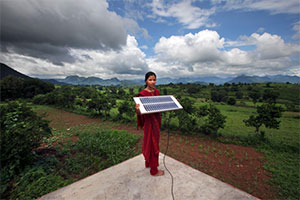 Bringing clean energy to rural India. Credit: Abbie Trayler-Smith / Panos Pictures / Department for International Development
Large reserves of oil, gas and minerals in developing countries generate opulent revenues. They could be used to stimulate economic growth and reduce poverty, but often result in environmental destruction and conflict, benefiting large companies and corrupt governments. Furthermore, competition over natural resources often manifests through geopolitical conflict. For example, before the US-Iraq war, Iraq’s domestic oil industry was nationalized. With US aggression came weakened Iraqi institutions and foreign intervention, thus eventually leading to the privatization of Iraqi oil, leaving the industry now largely dominated by Western companies. As another example, China’s rising investments within the lithium sector in South America are increasing the US-China rivalry across the Western Hemisphere. Notably, Bolivia has the largest reserves of lithium in the world, and the nation’s state-owned lithium extraction firm recently signed a contract with China’s CBC Consortium, while rejecting the entry of Western firms into the nation. In Bolivia’s case, rising Chinese investment in the nation’s lithium sector also raises concerns about environmental sustainability and the sociopolitical rights of Indigenous communities. More broadly, Sub-Saharan Africa holds nearly 30% of global reserves of critical minerals required for low-carbon technologies. Despite this, the region attracts less than 10% of global exploration investment, depicting a critical barrier to both the clean energy transitions and Sub-Saharan Africa’s economic development. Furthermore, resource wealth continues to fuel conflict like Sudan’s civil war, which has led to 9.1 million internally displaced people and is intensely connected to competition over gold, water, and agricultural land. IPS covers news about major oil, gas, and mining projects, their effects on the environment and local communities, and the ideas and actions of the interest groups involved.

The Week with IPS

NEXT STOP - SDGs
Tracking global progress towards a sustainable world
Tracking global progress towards a sustainable world
