Languages
Wednesday, November 18, 2026



News and Views from the Global South
Natural Resources
Sao Tome and Principe at Oil Bonanza Crossroads
With an estimated 10 billion barrels of oil in the Gulf of Guinea, the small archipelago of Sao Tome and Principe faces the possibility of benefiting from considerable oil revenues. However, a report released by Human Rights Watch (HRW) on Tuesday documents the difficulties in managing the revenues from the hydrocarbon business in an effective and transparent way.US: Govt Claims Slammed as “Final Kill” Looms for Gulf Oil Leak
Between April and August this year, 4.9 million barrels of oil were spilled into the Gulf of Mexico. How much remains today is not yet clear and is a hot topic of debate among academic and government scientists.
Mississippi Shrimpers Refuse to Trawl, Fearing Oil, Dispersants
The U.S. state of Mississippi recently reopened all of its fishing areas. The problem is that commercial shrimpers refuse to trawl because they fear the toxicity of the waters and marine life due to the BP oil disaster.
MEXICO: Oil Workers at Sea Without a Safety Net
The oil spill in the Gulf of Mexico has reawakened concerns about labour conditions on Mexican drilling platforms.US: Gulf Health Problems Blamed on Dispersed Oil
BP says it is no longer using toxic dispersants to break up the Gulf of Mexico oil spill. Gulf Coast residents claim otherwise, and say they have the sicknesses to prove it.INDIA: End to Fuel Subsidies Brings Damaging Diversions
While India's opposition parties are agitating against moves by the pro-reform government of Prime Minister Manmohan Singh to remove subsidies on petrol and other fuels, experts say the country has laboured too long under price distortions that have not benefited poorer people -- or the environment.
PERU: Transparency a Challenge for Mining and Oil
Peru is the only Latin American country that has made steps towards joining the international Extractive Industries Transparency Initiative (EITI), but has a difficult stretch ahead as it tries to overcome industry resistance to reporting profits and the government's own obstacles.Ecuador Signs Deal Not to Drill in Amazon Nature Reserve
"The trust fund that we have just established is historic, not only for Ecuador but for the entire world," said Rebeca Grynspan, associate administrator of the United Nations Development Programme (UNDP), after signing an agreement with the government of Rafael Correa to leave 846 million barrels of oil under the ground in a pristine Amazon jungle wildlife reserve.
Scientists Deeply Concerned About BP Disaster’s Long-Term Impact
Contrary to recent media reports of a quick recovery in the Gulf of Mexico, scientists and biologists are "deeply concerned" about impacts that will likely span "several decades".PERU: Adios, Doe Run
Peruvian President Alan García confirmed Wednesday that the permit of the U.S. mining and metallurgical company Doe Run to operate a major smelter complex was being cancelled because the firm missed the deadline for proving that it had the necessary financing to restart operations and complete an environmental cleanup.Ecuador Requires Oil Firms to Renegotiate Contracts
A new law gives private oil companies in Ecuador four to six months to renegotiate new service contracts.
AFRICA: “Free Trade in Natural Resources Bad for Development”
While some believe that restrictions on natural resource exports should be done away with, this could cause an increase in such exports that would be detrimental to the environment and bad for development.Obama-Cameron Meet Overshadowed By BP and Libya
British Prime Minister David Cameron’s visit to Washington, DC on Tuesday was supposed to be an opportunity for the Conservative Party leader to build a rapport with U.S. President Barack Obama.
CHINA-NIGERIA: New Refinery Planned for Lagos Free Trade Zone
Nigeria is a place where many more deals are announced than are ever completed. But July saw progress towards the construction of one of three new Nigerian refineries expected to reduce imports of refined petroleum products, a costly and ironic feature of the oil-rich nation's economy.China: Outsmarting the West in Africa
China's interest in Africa is frequently portrayed simply as that of a rising economic power seeking natural resources. Deborah Brautigam argues that this portrayal misses the full complexity of business relations between China and the continent.Civil Society Hails New Oil and Mining Transparency Standards
National and international civil society groups Thursday hailed the U.S. Senate's passage of a major financial reform act that includes a key anti-corruption provision requiring energy and mining companies to publicly disclose payments they make to governments around the world.
AFRICA: “Everything but Arms Deal Doesn’t Benefit Enough People”
The Everything but Arms trade initiative, which provides preferential treatment to poor countries, benefits only a limited range of people in the target populations. It should also be expanded to more countries, civil society organisations say.World Bank, NGOs Spar over Indonesian Mine Project
The World Bank's Board of Directors said studies for a potential mining project in Indonesia could move forward Tuesday but civil society groups, citing studies that have already been done, condemned the decision.
No Free Press for BP Oil Disaster
Last week, the U.S. Coast Guard, working in concert with oil giant BP, instituted new restrictions across the U.S. Gulf Coast that prevent the media from coming within 20 metres of booms or response vessels on beaches or water. But the insidiousness of the restrictions runs even deeper.ANGOLA: Drilling Ever Deeper, Hoping for the Best
While BP struggles to contain an oil spill that U.S. government estimates indicate is now the largest ever in the Gulf of Mexico, questions are being asked about how well prepared Africa's oil-producing countries are for a similar incident.
Gulf Spill Galvanises Activist Community
With the U.S .government and oil giant British Petroleum under fire for their handling of the more than two-month-old Gulf Coast oil spill disaster, environmental and community activists across the country are taking matters into their own hands.« Previous Page — Next Page »


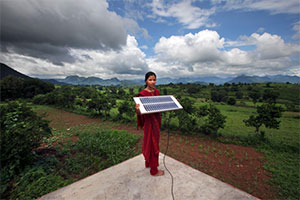 Bringing clean energy to rural India. Credit: Abbie Trayler-Smith / Panos Pictures / Department for International Development
Large reserves of oil, gas and minerals in developing countries generate opulent revenues. They could be used to stimulate economic growth and reduce poverty, but often result in environmental destruction and conflict, benefiting large companies and corrupt governments. Furthermore, competition over natural resources often manifests through geopolitical conflict. For example, before the US-Iraq war, Iraq’s domestic oil industry was nationalized. With US aggression came weakened Iraqi institutions and foreign intervention, thus eventually leading to the privatization of Iraqi oil, leaving the industry now largely dominated by Western companies. As another example, China’s rising investments within the lithium sector in South America are increasing the US-China rivalry across the Western Hemisphere. Notably, Bolivia has the largest reserves of lithium in the world, and the nation’s state-owned lithium extraction firm recently signed a contract with China’s CBC Consortium, while rejecting the entry of Western firms into the nation. In Bolivia’s case, rising Chinese investment in the nation’s lithium sector also raises concerns about environmental sustainability and the sociopolitical rights of Indigenous communities. More broadly, Sub-Saharan Africa holds nearly 30% of global reserves of critical minerals required for low-carbon technologies. Despite this, the region attracts less than 10% of global exploration investment, depicting a critical barrier to both the clean energy transitions and Sub-Saharan Africa’s economic development. Furthermore, resource wealth continues to fuel conflict like Sudan’s civil war, which has led to 9.1 million internally displaced people and is intensely connected to competition over gold, water, and agricultural land. IPS covers news about major oil, gas, and mining projects, their effects on the environment and local communities, and the ideas and actions of the interest groups involved.

The Week with IPS

NEXT STOP - SDGs
Tracking global progress towards a sustainable world
Tracking global progress towards a sustainable world
