Languages
Thursday, November 19, 2026



News and Views from the Global South
Trade & Investment

U.S. ‘Divestment’ Movement Gaining Momentum
A months-old national campaign to convince U.S. colleges, universities and city governments to withdraw investments from the world’s largest oil and gas companies has seen some notable initial successes.
Think Tank Urges “More Ambitious” U.S.-Mexican Agenda
The electoral and political stars are aligning in ways that offer the United States and Mexico major opportunities to substantially deepen their cooperation, particularly on trade, energy, and immigration, according to a report released here Wednesday by a special commission of the Inter-American Dialogue (IAD).
World Bank Unmoved on Auditor’s Criticism of Forest Policy
Officials at the World Bank are forcefully rejecting a new internal evaluation that is highly critical of the institution’s decade-long forest policy, expressing their “strong disagreement” with some assertions in the report.
New U.S. Biofuel Proposals Could Draw Heavily from Food Sources
New biofuel requirements proposed by the U.S. Environmental Protection Agency (EPA) are being met with concern by a spectrum of interest groups from environmentalists to the oil industry, with some warning that a gap between the proposal and existing law could force the government to draw on food-based alternative fuels.Missing Reform Deadline, IMF Nears “Credibility Cliff”
The International Monetary Fund (IMF) has announced that it will miss an internal deadline to agree on a new formula by which to apportion voting rights in the 188-member institution.
Building Angolan-Brazilian Ties on Infrastructure
Brazil has turned to large infrastructure as a unique way to globally expand its economy and build up its political influence, with the added bonus of furthering the development of small nations. But this strategy is not without its risks.U.S. Firms Stash Tens of Billions in Tax Havens, Govt Says
The research arm of the U.S. Congress is warning that U.S. corporations’ use of tax havens has risen substantially in recent years, with companies offering massively inflated profit reports from small countries with loose tax regulations.
The Bank Stops Here
Hindsight is a wonderful thing. Nonetheless, it is difficult to miss the irony in the following sentence from a news release, sent out by South Africa’s First National Bank on Jan. 17.
Q&A: Raising Tariffs “Common Sense” Not Protectionism
South Africa has denied that it is taking a protectionist stance to protect its own producers against foreign competition, but says it is justified in boosting tariffs where this is allowed under international trade agreements.A Fifth of Global Investing Considered “Sustainable”, Industry Reports
Nearly 22 percent of professionally managed assets around the world can be considered sustainable or responsible, according to a finance industry assessment, the first comprehensive look at the subject.
Debt Crises, a Damocles Sword
The issue of foreign debt has made a major comeback due to the crisis in Europe, in which many countries had to seek big bailouts to keep them from defaulting on their loan payments. Before this, debt crises have been associated with African and Latin American countries. In 1997-99, three East Asian countries also joined the indebted countries' club.
Latin America Flexes Muscles at Joint EU Summit
The nations of Latin America and the Caribbean strengthened their position with respect to Europe at the CELAC-EU summit held this weekend in the Chilean capital, reaching agreements that protect their natural resources from foreign investors and securing a joint condemnation of the United States’ trade embargo against Cuba.Dubious Awards Presented at Davos
Only a stone's throw from the Davos World Economic Forum meeting, a group of non-governmental organisations presented the annual Public Eye Awards this week to Goldman Sachs and Royal Dutch Shell.
Can Europe and Latin America Meet as Equals?
The European Union's serious economic and financial crisis stands in stark contrast to the relative stability and decade-long growth enjoyed by Latin America and the Caribbean and could put the two blocs on equal footing, giving the Southern region more leverage to further its demands and economic growth.
Controversy Brews Over Climate Change Adaptation Project
An ambitious programme of infrastructure works to overcome the risks of climate change in Cartagena de Indias, a city on the Caribbean coast in northern Colombia, has generated controversy, with authorities predicting benefits while parts of the affected population voice criticisms.
Summit of the Peoples Demands Solidarity and Sovereignty
More than 400 social organisations from Europe and Latin America and the Caribbean will gather on Jan. 25-27 at a Summit of the Peoples called as an alternative to the bi-regional meeting of heads of state and government to be held at the same time in the Chilean capital.
China-Mexico Ties Grow Thin
"We are completely 'clueless' when it comes to China." This statement by Enrique Dussel, director of the Centre for China-Mexico Studies of the National Autonomous University of Mexico, perfectly describes the currently stale state of relations between the two countries.
Malawi’s President Faces a Crisis of Confidence
She has taken a personal pay cut, promised reforms, resumed aid flows from Western donors and put her predecessor’s private jet up for sale.
Injustice Overshadows Growth in Chile
Chile's positive economic performance in 2012 is not enough to boost President Sebastián Piñera's waning popularity, as many Chileans believe the country's much-touted growth does nothing to compensate or solve decades of accumulated injustices, several analysts told IPS.
Investments Go Green in Peru
Peru’s economic growth is largely dependent on its wealth of natural resources, which provide over 50 percent of the country’s gross domestic product (GDP) and 80 percent of exports. In view of this fact, the government is developing a project for the valuation and protection of this natural bounty.
Peering into the Energy Crystal Ball
Trying to predict the future of the energy sector is like trying to predict the weather in London in an era of global warming. But delegates had a go at it during the three-day World Future Energy Summit that ended in Abu Dhabi on Jan. 17.« Previous Page — Next Page »


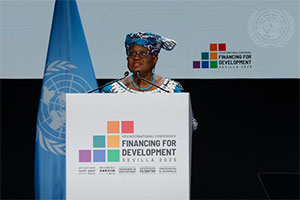 Opening of 4th International Conference on Financing for Development. Credit: UN Photo/Mariscal
International trade and investment are crucial elements of the world economy. While they can be powerful stimulators of development, they can also lead to global imbalances and dynamics of exploitation. In 2025, international trade entered a period of immense disruption, driven in part by a new wave of United States tariffs that reshaped global supply chains and investment flows. The increase in the US tariff rate, the highest since the 1930s, has forced bilateral renegotiations with global trading partners. Furthermore, the debt crisis in developing nations has accelerated while Official Development Assistance (ODA) has substantially dropped 7.3% in 2024.
In the 21st century, advancements in economic diversification in formerly colonized nations have propelled them into more central roles in the global economy. For example, both China and Mexico were able to develop their manufacturing sector and channel this development into booming export flows, thus advancing into the position of emerging economies. Foreign investment also plays an essential role in providing capital for developing countries, although they are oftentimes accompanied by social and environmental exploitation. For example, rising Chinese investments in natural resources in Latin America have often been met with tension as these investment projects fail to properly mitigate environmental risks and protect workers’ rights. In a more multifaceted vein, Sino-African relations have led to infrastructure development in Sub-Saharan Africa while also heightening the region’s economic dependency on China. IPS reports on global news in trade and investment, while shining a light on the nuanced nature of these endeavors.

The Week with IPS

NEXT STOP - SDGs
Tracking global progress towards a sustainable world
Tracking global progress towards a sustainable world
