Languages
Thursday, November 19, 2026



News and Views from the Global South
Trade & Investment

Mideast Energy Crisis Looks For Light at the End of the Tunnel
When Jordan's Queen Rania Al Abdullah took the podium to address world political and business leaders at a back-to-back energy and water summit here, she said she was representing a country that relies on imports for over 90 percent of its energy needs.
South Africa-Brazil Trade Partnership Hits Potholes
As the five members of the BRICS group of emerging economies – Brazil, Russia, India, China and South Africa – tighten ranks and seek to expand their global influence, the inevitable trade spats have begun.Cuban Sugar Sector Aims for Recovery in 2013
The Cuban sugar industry seems to be experiencing a rebirth thanks to an economic modernisation programme that has allowed for an injection of foreign capital as part of a strategy to strengthen and diversify this key sector.
China’s Rising Soybean Consumption Reshaping Western Agriculture
Global demand for soybeans has soared in recent decades, with China leading the race. Nearly 60 percent of all soybeans entering international trade today go to China, making it far and away the world's largest importer.
Pacific Island Wakes Up to Threat of Oil Spills
Coral reefs and marine ecosystems in the Milne Bay Province of the Pacific Island nation of Papua New Guinea are at serious risk of long-term environmental damage. The reason: an oil spill from a ship that ran aground on a reef on Kwaiawata Island on Christmas Eve, and authorities’ long delay in mobilising an appropriate response to the accident.
EU Trade Deal Offers Pakistan Some Respite
 Karachi, a sprawling city of 18 million, is the country’s economic hub. It accounts for 95 percent of Pakistan’s foreign trade and contributes 30 percent of national industrial production.

Asia Leaps Forward in Regional Economic Integration
As the United Nations continues to intensify the promotion of South-South cooperation among member states, Asia plans to take a great leap forward in regional economic integration during the next decade.What is China’s Policy Driver in Central Asia?
China is increasingly active in Central Asia, building pipelines and infrastructure projects, as well as expanding its diplomatic and cultural presence in the region.
The Rise of Ethiopia’s Sole Rebels
Innovative Ethiopian footwear manufacturer Sole Rebels will open its second retail outlet in Taiwan this year. With ambitions to open 30 more franchise stores across the world in countries like the United States, Australia, Italy and Japan, Sole Rebels, the largest African footwear brand, is now fast becoming a global competitive brand.Thai-EU FTA Raises Alarm for People With AIDS
Days before leaders of the European Union (EU) arrived in Norway to collect this year’s Nobel Peace prize, Thai public health activists sent a letter to the northern powerhouse, warning that the EU’s 2012 accolades face a credibility test in this Southeast Asian country.Bolivia Takes the Leap into the Big Pond of Mercosur*
To go down fighting in the Andean Community (CAN), with a combined market of 92 million consumers, or move up to the big leagues of Mercosur, with 275 million? This was the dilemma faced by Bolivia’s foreign trade strategists when it came to pursuing full membership in the bloc formed by its neighbours to the south.
U.N.’s Last Stand on Arms Trade Treaty
Amidst a politically divisive debate on gun control in the United States following a rash of mass shootings, the United Nations will meet in March to finalise an Arms Trade Treaty (ATT) after nearly two decades of negotiations.
Increasing Uganda’s Cotton and Coffee Production
Cotton was once one of Uganda's key cash crops but a collapse in world prices in the 1980s led to a slump in the market and production. However, cotton production doubled in the 2010/2011 season and brought in 48 million dollars in export earnings.

The Rise of Uganda’s Tobacco Production
Over the years with the demise of cotton production, tobacco has become one of Uganda's key exports.
Six years after British American Tobacco set up regional headquarters in this East African nation, it has become a key tobacco producer for the company.

BRICS Seeks New Dialogue with Africa
South Africa plans to boost links between Africa and its partners in the Brazil, Russia, India and China alliance at a landmark summit, which will be held in this country in March, Xavier Carim, deputy director general at the Department of Trade and Industry, told IPS.
Sierra Leone’s Waters of Life
A coastal city, Sierra Leone's capital, Freetown, is an area where people have relied on the ocean for food and employment for as long as they have lived there.
Kenya’s Growing Luxury Housing Market Not for Locals
Despite the development boom in state-of-the-art luxury homes in Kenya, the country’s upper class has fallen on hard times and can no longer afford them, according to economic experts here. Instead, Kenya’s formerly wealthy have now become part of the continent’s growing middle class.
Africa – Rising Investments, Rising Middle Class
Rising investments in Africa's service sector, the unlocking of its vast natural resources and the sound economic policies pursued by African countries in the last two decades are spurring the rise of the continent's middle class at a faster rate than population growth.
Q&A: Will the BRICS Bury IBSA?
China’s presence in the leading developing nations alliance of Brazil, Russia, India and China has given the bloc an advantage that another developing nations club, India, Brazil and South Africa, has hitherto been lacking, according to Peter Draper, one of South Africa’s leading experts on international relations and trade.
Africa Cashes in on Mineral Wealth
Many of the fastest-growing countries in the world are in Africa, the poorest continent on the planet, but the potential for recently-discovered resources to generate broad-based inclusive development opportunities is massive and remains under-exploited.

Funding Shortage Thwarts Reconstruction Efforts
The landscape in northern Sri Lanka’s former war zone can change abruptly from the ordinary to the surreal.« Previous Page — Next Page »


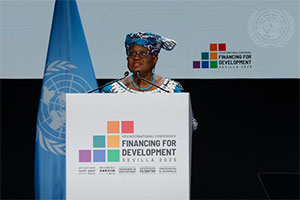 Opening of 4th International Conference on Financing for Development. Credit: UN Photo/Mariscal
International trade and investment are crucial elements of the world economy. While they can be powerful stimulators of development, they can also lead to global imbalances and dynamics of exploitation. In 2025, international trade entered a period of immense disruption, driven in part by a new wave of United States tariffs that reshaped global supply chains and investment flows. The increase in the US tariff rate, the highest since the 1930s, has forced bilateral renegotiations with global trading partners. Furthermore, the debt crisis in developing nations has accelerated while Official Development Assistance (ODA) has substantially dropped 7.3% in 2024.
In the 21st century, advancements in economic diversification in formerly colonized nations have propelled them into more central roles in the global economy. For example, both China and Mexico were able to develop their manufacturing sector and channel this development into booming export flows, thus advancing into the position of emerging economies. Foreign investment also plays an essential role in providing capital for developing countries, although they are oftentimes accompanied by social and environmental exploitation. For example, rising Chinese investments in natural resources in Latin America have often been met with tension as these investment projects fail to properly mitigate environmental risks and protect workers’ rights. In a more multifaceted vein, Sino-African relations have led to infrastructure development in Sub-Saharan Africa while also heightening the region’s economic dependency on China. IPS reports on global news in trade and investment, while shining a light on the nuanced nature of these endeavors.

The Week with IPS

NEXT STOP - SDGs
Tracking global progress towards a sustainable world
Tracking global progress towards a sustainable world
