
Saturday, November 14, 2026



News and Views from the Global South
IPS UN: Inside the Glasshouse

Freezing & Reversing North Korea’s Nuclear Advances
For most of the past year, North Korea’s provocative long-range missile launches and a high-yield nuclear test, combined with the reckless threats of “fire and fury” and “preventive war” from the White House, have raised tensions and increased the threat of a catastrophic conflict in the region. Some of us warned that nuclear war was closer than at any point since the Cold War.
“Fake News” a Growing New Threat to Press Freedom
When a Malaysian politician of a bygone era was asked about the “leading newspapers” in his country, he shot back: “We don’t have any leading newspapers in our country because all our newspapers are misleading.”
Myanmar Unlikely to Resolve Rohingya Problem Without International Help
The lead-up to the Australia-ASEAN Summit in Sydney on 16-18 March 2018 was characterised by widespread and well-publicised protests in Sydney against human rights abuses occurring in several ASEAN member countries – namely Cambodia, Myanmar and Vietnam.
From Declaration to Action: Improving Immunization in Africa
Inviolate Akinyi, a 46-year-old grandmother, is certain that her grand-daughter needs to get all her vaccines for her to grow up healthy and strong. She uses a mix of private and public clinics in Kibera, one of the largest informal settlement in Nairobi, to get the 15-month-old the shots she needs.
Illicit Trade in Oil & Fuel: an Emerging Global Policy Challenge
Illicit trade in any of its forms—alcohol, tobacco, pharmaceuticals, diamonds, timber, ivory and oil—sits at the nexus of two social-economic disorders that challenge global stability.
Authoritarian Govts Tighten Grip on Press Freedom
The 25th celebration of World Press Freedom Day will be led by UNESCO and the government of Ghana in Accra on May 2-3. The theme is “Keeping Power in Check: Media, Justice and The Rule of Law,” covering the issues of media in respect to the judicial system and transparent political processes.
Improving Our Anti-money Laundering Operations Will Help Prevent Great-Power War
Interest is growing in illicit finance because great-power competition is playing out in boardrooms, stock markets, trade wars, and compliance departments. The US anti-money laundering (AML) regime needs an update that enhances national security and sets an example for the rest of the world.
Boutros Boutros-Ghali, Democratic Multilateralism
“If we don’t do everything possible to democratize globalization, globalization will pervert national democracies”, said the former Secretary-General of the United Nations, as President of the “International Panel on Democracy and Development” set up by UNESCO and chaired by the man who had worked so hard, at a global scale, in favour of giving voice to the peoples -as required in the first sentence of the Charter of the United Nations- to allow constant participation from citizenship as should be the rule in a genuine democracy.
Another Debt Crisis for Poor Countries?
When the world’s finance ministers and central bank governors assemble in Washington later this month for their semi-annual IMF meeting, they will no doubt set aside time for yet another discussion of the lingering debt problems in the Eurozone or how impaired bank debt could impact financial stability in China.
A Child of War Dedicates Herself to Peace
“I was so angry, I felt like I wanted to blow up the whole world, but I didn’t. I decided I wouldn’t be pushed to become evil. I would choose peace.” Dalia Al-Najjar has crammed a great deal into her short life. At 22, the Palestinian refugee has already lived through three wars and has spent every spare moment between siege and ceasefire studying, volunteering, working, blogging, on the daily struggle to live in Gaza – and planning how to change the future.
Middle East: a Threat to World Peace & Security, Warns UN Chief
The situation in the Middle East is in chaos — to such an extent it has become a threat to international peace and security. The region is facing a true Gordian knot – different fault lines crossing each other and creating a highly volatile situation with risks of escalation, fragmentation and division as far as the eye can see with profound regional and global ramifications.
UN Cracks Down on Peacekeeping Troops over Human Rights Abuses
The United Nations, whose peacekeepers have come under increased scrutiny because of widespread charges of sexual abuse and human rights violations, claims it is now committed to ensuring that all personnel serving with the UN meet the “highest standards of conduct, competence and integrity, including respect for and commitment to human rights.”
Caribbean Eyes Untapped Potential of World’s Largest Climate Fund
The Caribbean Community Climate Change Centre (CCCCC) also known as the 5Cs, is looking for ways to boost the region’s access to the Green Climate Fund (GCF).
The UN tells private enterprise leaders that “Business as Usual Won’t Work”.
As global citizens face an array of issues from unemployment to discrimination, affecting their livelihoods and potential, a UN agency called upon businesses to employ a new, sustainable, and inclusive model that benefits all.
UN’s Zero Hunger Goal Remains a Daunting Challenge
The United Nations, which is battling some of the world’s worst humanitarian crises in Asia, the Middle East and Africa, still remains focused on one of its equally daunting undertakings: how to achieve Zero Hunger by 2030.
International Community Ramps Up Action on Venezuela Crisis
One year into the most recent series of protests and a humanitarian crisis with no end in sight, international groups have called for action to help protect Venezuelans. A complex political and economic crisis in Venezuela has left millions without access to basic services and resources, prompting UN agencies and human rights groups like Human Rights Watch to speak up and urge action.
Freedom of Speech Guaranteed, Says Aliyev, as Azerbaijan Blocks News Websites
President Ilham Aliyev claims that in Azerbaijan the internet is free and press freedom is guaranteed. But ahead of the April 11 snap elections, authorities have systematically silenced critical voices online through amending laws and blocking news websites, and hackers have attacked independent news outlets.
UN Development Goals Cannot be Achieved if Bombs Keep Falling From the Sky
I am honoured to pay a visit to the Non-Aligned Movement (NAM) to address this Ministerial Meeting. I would like to use this opportunity to commend the role of the Non-Aligned Movement in promoting peace, security and development around the world. I also want to start by acknowledging the commitment of Venezuela, as Chair of the Non-Aligned Movement. I also thank Azerbaijan for welcoming us all to Baku, as the host of this conference.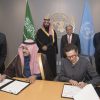
“International Solidarity” at Yemen Donor Conference
The international community has pledged over two billion dollars towards urgently needed humanitarian assistance to Yemen during a UN event.
Bolton: Is He the Walrus –Goo goo g’joob?
President Trump’s nomination of John Bolton as his National Security Advisor highlights the deep irrationality of this White House’s global agenda. Apparently, the world has hitherto been spared Bolton’s robust sabotage only because the President has an eccentric visceral antipathy to his mustache, but so far could not find another, clean-shaven, candidate in the rapidly draining pool of applicants for White House jobs.
How Citizen Power Ignited Seoul’s Energy Innovations
In a bid to reduce its nuclear energy dependence, Seoul embarked on a massive energy reduction initiative—shaped by citizen participation—in 2012.« Previous Page — Next Page »


It was dubbed "The Glass House" by U.S. ambassador James Wadsworth in 1966. Half a century later, the United Nations has gradually expanded its role as agent of peace and protector of the world's vulnerable populations, while simultaneously facing internal pressures to become more inclusive, increase transparency and maintain legitimacy in the post-Cold War political and economic order. Highlighting the local impacts of global policies on economic development, environment, health and human rights, IPS's coverage goes beyond the edicts of the Security Council to illuminate the power struggles, successes and shortcomings of the 193-member institution as it grapples with crises like climate change, armed conflict, poverty and HIV/AIDS.

The Week with IPS
