
Friday, July 24, 2026



News and Views from the Global South
Women in Politics

POLITICS-MALAWI: The Bold and the Beautiful
The reigning Miss Malawi, Peth Msiska, has hit the campaign trail, not seeking another crown but to be voted into Parliament in her country’s general elections in May 2009.POLITICS-GHANA: The Steep Price of Getting Elected
Mawusi Awity and her husband were willing to jeopardize his military career for her dream of running for parliament in Ghana but there was another price to pay that she could not afford.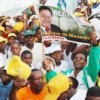
SÃO TOMe AND PRINCIPE: A Retro Approach to Politics?
It is lonely at the top – especially when you are one of only two women among 53 men at the National Assembly.POLITICS-SENEGAL: Ms. Mayor, Ms. Prefect
The Sicap Baobab neighborhood, one of the prettiest in the Senegalese capital, stands out, but not for the most obvious reasons. Not for its well-paved roads, or the number of naturalised immigrants from Cabo Verde, Togo or Benin, not for the hustle and bustle of the formal and informal economies.MADAGASCAR: A Difficult Step For Women
The northern region of Diana is known for the beautiful beaches of the Nosy-Be district and the scent of fields of ylang-ylang flowers. But the political landscape of Diana is as extraordinary as its geography: the region's administrative head is a woman, Anjara Mantasara.POLITICS-KENYA: Broken Bodies, Unbroken Spirit
It was a sad occasion, and an occasion to rejoice. Sad, said Dr Ludeki Chweya, introducing Flora Terah's new book, because her heart-wrenching story shows that physical abuse and torture are a weapon of choice to deter women's participation in electoral politics in Kenya.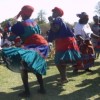
POLITICS-NAMIBIA: Gender Equality – Making The Numbers Count
Namibian gender activists applaud the goal of a 50/50 split of women and men in government by 2015, but warn that the real work is only just beginning.
POLITICS-GUINEA: "Sheep Who Vote?" Women Say No
Long absent from the top posts in the civil service and under-represented in political parties, Guinean women are calling for changes during legislative elections planned for December.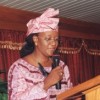
POLITICS-SIERRA LEONE: The Ups And Downs Of Zainab Bangura
Her reputation as a fiery orator is enhanced whenever she takes the podium, her punch softened by her broad smiles and gorgeous attires in West African style.
POLITICS-SWAZILAND: Struggling Against Tradition
The crowd ululated, whistled and danced. Their candidate had won! Last Sunday, the people of Mbabane East returned Esther Dlamini to Swaziland's House of Assembly for a second term.
POLITICS-ANGOLA: Boys’ Club No Longer
Something looked very different at the inauguration of Angola’s newly elected parliament, held Tuesday at the Talatona Convention Centre in Luanda, the capital - this is not a boys' club any longer.SOUTH SUDAN: Growing Women's Power in Government
When Sabrina Dario Lokolong, the Speaker of South Sudan's Eastern Equatoria State Assembly, enters or leaves Parliament, all the other members of parliament must stand up.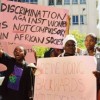
POLITICS-ZIMBABWE: Now To Share Power With Women
The ink was barely dry on the power-sharing agreement signed by Zimbabwe’s main political parties on Sep. 15 when women activists demanded a fair share of power.
POLITICS-ZIMBABWE: Blazing a Trail For Women Politicians
You could spot her easily in the evening newscasts: the only woman among the grey-suited men daily accosted by reporters as they emerged, tense and tight-lipped, from the closed-door meetings.
RIGHTS: Swazi Law And Custom Under Pressure
When the women's movement in the southern African kingdom of Swaziland took to the streets in August to challenge what they called extravagance by the royal family, Swazi traditionalists were livid.
RIGHTS-SOMALIA: Building Women’s Leadership
The moderator raps her pen on the table to hush the boisterous assembly of Somali women gathered in Bagamoyo, on the Indian Ocean coast of Tanzania. Their voices drop for a moment before the sound level rises again to a heated crescendo.RIGHTS-ZIMBABWE: Towards Parity For Women In Politics
In a highly contested election marred by violence and held under very difficult economic conditions, Zimbabwean women politicians defied the odds to participate as candidates in the March 29th elections.
POLITICS-ANGOLA: Ambitious Plans For Women's Participation
Nearly a third of candidates in Angola's upcoming parliamentary elections are female, thanks to a new quota imposed by the government. The 30 percent rule was designed to bring more women into the country's parliament, but as campaigning gets under way, women continue to stay in Angola's political shadows, barely visible at rallies and with few holding senior party positions.
POLITICS-SIERRA LEONE: Women Candidates Progress, But Not Enough
Official results from the July 2008 local council elections in Sierra Leone have been announced by the chairperson of the country's National Electoral Commission. Despite numerous reports of harassment and intimidation, more women were elected to councils than in polls four years ago. But results fell short of the 30 percent representation set by gender activists.
SIERRA LEONE: Activists Angered By Poor Results for Women
Sierra Leone’s women’s advocacy group "50/50" has expressed disappointment at the poor showing of women in the July 5 local council elections.RIGHTS-ZIMBABWE: Women Bear Brunt of Violence
"We are too familiar with the violence that was meted upon numerous of us from 1890 when the colonialists came into our country right up to the most recent elections. Chief among these forms of violence is sexual violence, and it concomitant implication, HIV infection. Zimbabwean women now have the lowest life expectancy world wide because of HIV & AIDS - 34 years."« Previous Page — Next Page »


In societies throughout the world, women’s participation in political and leadership roles is limited. Underrepresented as voters and position holders, women are restricted at local and at global levels. A variety of obstacles bar women’s political participation. Reduced access to education in many countries, as well as weaker political connections make it more difficult for women to enter the political stage. In addition, there are many discriminatory laws that severely reduce the opportunity for women to gain leadership positions. As has been seen, there are many individuals who have overcome these obstacles with great success. There have been great strides to increase women’s political participation. In the last 20 years, the percentage of women in parliamentary positions has nearly doubled. This promising, albeit slow progress, is necessary to empower women and reduce gender inequality. These articles look at various aspects of women’s participation politics.

The Week with IPS

Tracking global progress towards a sustainable world
