Languages
Wednesday, October 7, 2026



News and Views from the Global South
Projects

Ecstasy as Zimbabwe’s Smallholder Farmers Secure European Pineapple Market
In her wildest dreams, smallholder farmer Sarudzai Sithole never imagined that her pineapples could someday stock the produce section of Europe’s finest supermarkets.
Why Does Yangtze River Have its Own Protection Law?
The new Yangtze River Protection Law (YRPL), which came into effect on March 1, 2021, is China’s first legislation on a specific river basin. The Yangtze River is China’s longest and largest river system, stretching over 6,300 kilometres and has over 700 tributaries. With a drainage basin covering more than 1.8 million square kilometres, approximately one-fifth of China’s total land area, the river basin is home to over 40% of the country’s population.
Sugarcane Gas Opens New Horizons for Energy Agriculture – Video
 Nothing is wasted from sugarcane, one can conclude from the biomethane production process at the Cocal plant, a Brazilian company that produces sugar, ethanol, electricity and other by-products from sugarcane agro-industrial waste.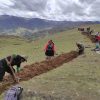
Rural Women in Peru Seed Water Today to Harvest It Tomorrow
"When I was a little girl we didn't suffer from water shortages like we do now. Today we are experiencing more droughts, our water sources are drying up and we cannot sit idly by," Kely Quispe, a small farmer from the community of Huasao, located half an hour from Cuzco, the capital of Peru's ancient Inca empire, told IPS.
Green Gas: Energy as a By-Product of Sugarcane in Brazil
First came sugar. For four centuries, it was the main sugarcane product in Brazil. But since the 1970s sugarcane has grown and diversified as a source of energy: ethanol, electricity and biogas.
We Must Rise to the Occasion, Now.
In 2021, COVID-19 continued to plague the world – a world already burdened by armed conflicts, climate-induced disasters and forced displacement. Communities, nations and people struggled to maintain normalcy in the midst of the abnormal. This was especially notable in the education sector – a sector that is the very foundation for achieving all human rights and all Sustainable Development Goals.
Covid-19 Has Accelerated New Agtech Development and Adoption in Asia-Pacific!
While the COVID-19 impact has been predominantly negative, the pandemic appears to have sparked increased interest in developing agricultural technology (agtech) to improve the efficiency of food systems, from input supplies through farming and processing to delivery and retail.
The Future of an Entire Generation Hangs in the Balance
COVID-19 has upended our world, threatening our health, destroying economies and livelihoods, and deepening poverty and inequalities. It also created the single largest disruption to education systems that the world has ever seen.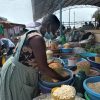
High Yield Seeds Could Address Food Shortages and Place Africa on Track to Zero Hunger – Experts
Rahab Munene’s shoe selling business crumbled at the height of COVID-19 in 2020. She traded the enterprise for a mobile grocery along the Thika Superhighway, Kiambu County.
Energy Inequality in Latin America Exacerbated by Pandemic, High Prices
The effects of the covid-19 pandemic and high energy prices have had an impact on the consumption of polluting fuels in Latin America and the Caribbean, exacerbating energy poverty in the region.
Cool Scheme to Reduce Food Waste in Nigeria
Food spoilage forced smallholder farmers out of pocket and out of business – until an entrepreneur came up with a cool idea.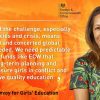
ECW Interviews UK Special Envoy for Girls’ Education, Helen Grant
Helen Grant became actively involved in politics in 2006 and was elected as Member of Parliament for the Kent constituency of Maidstone & The Weald at the 2010 General Election.
ECW Joins Call to Action on Protection from Gender-Based Violence in Emergencies: Global Community Urged to Orange the World and End Gender-Based Violence Now
The statistics are dire: One in three women have experienced a form of gender-based violence in their lifetime, be it sexual violence, physical violence, or child marriage. The message is clear: Women and girls deserve a safer, brighter future – free from gender-based violence.
A Nuclear-Weapons-Free-Zone in the Middle East— & the Elephant in the Room
Israel’s nuclear presence in the Middle East is best characterized as “the elephant in the room” -– an obvious fact intentionally ignored with deafening silence.
Act to Save Children Living Precarious Lives in Cameroon’s Forgotten and Neglected Conflict
Education is under attack in Cameroon. As one of the most complex humanitarian crises in the world unfolds, Education Cannot Wait’s director Yasmine Sherif and the Secretary-General of the Norwegian Refugee Council, Jan Egeland, say the children are pawns for grown men in a political conflict.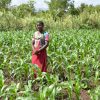
High Global Fertiliser Prices Overshadow Malawi’s Farm Subsidy Programme
Ellena Joseph, a small-scale maize farmer in Chiradzulu District in Southern Malawi, finished preparing her field early in October.
School Meals Coalition Hopes to Provide a Meal to Every Child
Meals at schools not only give each child a nutritious meal but increase enrolments, among other benefits.
From Fruit Waste to Gourmet Grub
When Bonolo Monthe’s neighbours discarded bucketsful of fallen ripe morula fruit from their backyard, she saw food and fortune going to waste.
Time Honoured Food Traditions, Pleasing for Palate and Planet
Balance is the absolute key, says Alia Chughtai, a journalist who started a catering service with filmmaker Akhlaque Mahesar, by the name of Aur Chaawal (And Rice), two years ago.
Double Solution to Ongoing Food and Climate Crises
For the last ten years, Angeline Wanjira’s food stall at Kirigiti Market in Kiambu County has featured the same foods, cabbages, potatoes and carrots, keeping with the community’s most preferred food types.
Politicians Subsidise Fossil Fuel with Six Trillion Dollars in Just One Year
It sounds incredible: while politicians have been cackling about the climate emergency and profiling in empty promises to halt it, they have spent six trillion US dollars from taxpayers' money to subsidise fossil fuels in just one year: 2020. And they are set to increase the figure to nearly seven trillion by 2025.« Previous Page — Next Page »





The Week with IPS

NEXT STOP - SDGs
Tracking global progress towards a sustainable world
Tracking global progress towards a sustainable world
