Languages
Monday, November 23, 2026



News and Views from the Global South
Africa
ZIMBABWE: Small-Scale Farmers Gearing Up to Take Cotton Buyers on
Zimbabweans like to believe that there is strength in numbers, which is the idea behind a local non-governmental organisation’s attempt to organise small-scale rural cotton farmers in cotton producer associations.
MALAWI: High-Risk Sex Among Those Who “Do Not Exist”
A study on men having sex with men (MSM) in Malawi shows that, as elsewhere in the developing world, this vulnerable group is at greater risk of contracting HIV and AIDS than the general population. Moreover, their risk status is exacerbated as governments fail to target them for health services or information to stem HIV transmission.
RIGHTS-UGANDA: Women Score Victory Against Gender-Based Violence
Women are celebrating a hard-won victory for gender rights after intense public protests led to today’s re-arrest of the country’s police boss – a self-confessed wife-killer.
ANGOLA: Teenage School Programme Gives Drop Outs Second Chance at Education
Free primary education for all is an Angolan government policy, but unfortunately this has not translated into a reality that sees all children receiving education.EGYPT: Union Eyes the Silver Bullet
Property tax collectors from across Egypt gathered last week in Cairo to protest fresh attempts by the official state trade union to undermine their independent syndicate.COTE D’IVOIRE: Communities Determined to Preserve Tanoe Swamps Forest*
When a major agribusiness company began clearing the rich reservoir of biodiversity of southeast Côte d'Ivoire's Tanoé Swamps Forest for an oil palm plantation, ecologists and local communities demonstrated in favour of preserving it.HEALTH-AFRICA: South Sudan At Risk from Blindness
In the war-devastated South Sudan, a region with a population of over eight million people, Yeneneh Mulugeta is the only permanent ophthalmologist.
RIGHTS-AFRICA: Elusive Justice for Victims of Gender-Based Violence
Florence Mukambi will always bear the brunt of the country’s post-election violence.NIGER: Foreign Investments in Uranium Polluting Politics
The reform of Niger's constitution to allow president Mamadou Tandja to remain in power beyond his original mandate and even become president for life, was motivated by the hundreds of millions of dollars flowing into the West African country as a consequence of opaque foreign, especially French, investments in the local uranium mines.Q&A: EPAs Will Provide Africa With "Better Export Opportunities"
The European Union has pressurised Ghana to sign an economic partnership agreement (EPA) despite civil society concerns being raised about the detrimental effects further trade liberalisation will have on development in the West African country.MOROCCO: The Berber Dance Is Over
The satellite receiver has speeded up the process of wiping out the cultural heritage of Morocco's Berbers. Old traditions are now dying out under the influence of television imams.
ZIMBABWE: No Water, Just a Bill
City council turns off the water. National minister in charge says turn it back on. Domestic and commercial users alike dispute their unpaid bills. The shadow of a cholera epidemic looms over it all. Must be Harare.EGYPT: Israel Gas Deal Inflames Opposition
Opposition figures and political activists have slammed a new deal to sell Egyptian liquefied natural gas (LNG) to Israel at what they say are vastly reduced prices.AFRICA: UNCTAD Recommends Privatisation to Mali
How can an African country define its own policy without getting lost in dozens of treaties and international commitments and the jungle of studies prepared by foreign donors and so-called experts, compounded by policy interference by international financial institutions and governments in the North?
HEALTH: Go Away With Your Spray
Zinaldina dos Reus, Zizi for her friends, is washing clothes by a stream near the airport in São Tomé. Her toddler plays nearby. Zizi, 21, can't remember the last time she or her husband had malaria, years ago. She credits the free bed nets and anti-mosquito home spraying regularly supplied countrywide since 2004.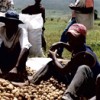
U.S.-AFRICA: Clinton Backs Agricultural Development
U.S. Secretary of State Hillary Clinton is using her trip to Africa to promote agricultural development as an approach to food aid which she has described as a "signature element" of the new Obama administration’s foreign policy.
NIGERIA: Slow Start for Niger Delta Amnesty
Nigeria’s president Umaru Yar’Adua is embarking on an ambitious move to end armed insurgency in the country’s oil-rich Niger Delta region.
RIGHTS-SOUTH AFRICA: Women Want Land to Call Their Own
In 1956, twenty thousand women marched to parliament to protest discriminatory pass laws. The march, commemorated as Women’s Day in South Africa on Aug. 9 each year, has become iconic of women’s quest for equality.US: Clinton Pledges Military Aid to Somalia and Other African Countries
On Aug. 6, U.S. Secretary of State Hillary Clinton met with Somali President Sheikh Sharif Ahmed in Kenya and pledged to provide more military aid and training to the Somali Transitional Federal Government (TFG).
AFRICA: Raising the Profile of Gender-Based Violence
Imagine you are a journalist; you get a tip for a story about a sexual assault on a ten-year-old girl, and pitch it to your editor.
DEVELOPMENT-AFRICA: Women in Pursuit of Knowledge
While Africa is still far from having adequate capacity for scientific innovation, women are more and more present in the field of research for the continent's sustainable development.« Previous Page — Next Page » *#*

The Week with IPS

NEXT STOP - SDGs
Tracking global progress towards a sustainable world
