Languages
Monday, November 16, 2026



News and Views from the Global South
Global
Do Not GM My Food!
Attempts to genetically modify food staples, such as crops and cattle, to increase their nutritional value and overall performance have prompted world-wide criticism by environmental, nutritionists and agriculture experts, who say that protecting and fomenting biodiversity is a far better solution to hunger and malnutrition.
U.S. Accused of Forcing EU to Accept Tar Sands Oil
Newly publicised internal documents suggest that U.S. negotiators are working to permanently block a landmark regulatory proposal in the European Union aimed at addressing climate change, and instead to force European countries to import particularly dirty forms of oil.Public Stockholding Programmes for Food Security Face Uphill Struggle
Framing rules at the World Trade Organization for maintaining public stockholding programmes for food security in developing countries is not an easy task, and for Ambassador Jayant Dasgupta, former Indian trade envoy to the WTO, “this is even more so when countries refuse to acknowledge the real problem and hide behind legal texts and interpretations in a slanted way to suit their interests.”
International Reform Activists Dissatisfied by BRICS Bank
The creation of BRICS’ (Brazil, Russia, India, China and South Africa) own financial institutions was “a disappointment” for activists from the five countries, meeting in this northeastern Brazilian city after the group’s leaders concluded their sixth annual summit here.
Zarif and Kerry Signal Momentum on Nuclear Pact
As the negotiations on the Iranian nuclear programme approach the Jul. 20 deadline, both U.S. Secretary of State John Kerry and Iranian Foreign Minister Mohammad Javad Zarif have signaled through their carefully worded statements that they are now moving toward toward agreement on the two most crucial issues in the talks: the level of Iranian enrichment capability to be allowed and the duration of the agreement.
BRICS Build New Architecture for Financial Democracy
The BRICS alliance (Brazil, Russia, India, China and South Africa) launched the New Development Bank (NDB) and Contingency Reserve Arrangement (CRA) during its sixth summit, institutionalising a new financial architecture for the emerging powers.
What Selfies Have in Common with the SDGs
"My cousin was a very successful and distinguished student. She said that she finished high school with excellent grades and enrolled in college, but a month later, her parents forced her to leave school and burned all her books and studying material. So, the girl set fire to herself."
Big Business Opportunities Seduce BRICS Entrepreneurs
The growing vitality of the group of countries made up of Brazil, Russia, India, China and South Africa (BRICS), which is beginning to formalise its institutions even as it tries to bridge very disparate realities, seems to be partly cemented by increasing links between its companies.
U.N.’s New Development Goals Must Also Be Measurable for Rich
The United Nations is on the verge of releasing a new set of Sustainable Development Goals (SDGs) - perhaps 17 or more - to replace the eight Millennium Development Goals (MDGs) which will run out by the end of 2015.
New BRICS Monetary Fund May Reproduce Inequalities
The first common institutions to be set up by Brazil, Russia, India, China and South Africa – the BRICS – are financial, and have arisen as a result of reforms to an international system that continues to largely ignore the growing influence of emerging countries.
Ever Wondered Why the World is a Mess?
While the Third World War has not been formally declared, conflicts throughout the world are reaching levels unseen since 1944.
Scepticism as “Green Goods” Trade Talks Begin
Formal negotiations began this week around the increasingly significant global trade in “environmental goods”, those technologies seen as environmentally beneficial, including in combating climate change.
Reproductive Rights to Take Centre Stage at U.N. Special Session
As the United Nations continues negotiations on a new set of Sustainable Development Goals (SDGs) for its post-2015 development agenda, population experts are hoping reproductive health will be given significant recognition in the final line-up of the goals later this year.
World’s Poorest Nations Seek Presence in Post-2015 Agenda
The 48 least developed countries (LDCs), described as the poorest of the world's poor, want to be an integral part of the U.N.'s post-2015 development agenda currently under discussion.
Amid Scepticism, U.N. Trumpets Successes in Cutting Poverty
With 17 months before the Millennium Development Goals (MDGs) reach their targets by the December 2015 deadline, the United Nations is trumpeting its limited successes - but with guarded optimism.
OPINION: Fighting Killer Diseases Is Essential in the Post-2015 Agenda
Undeniably, the Millennium Development Goals (MDGs) helped lift specific health concerns onto the global agenda.
Illicit Drug Deals Multiply on the Dark Net
In its two years of operation, the online marketplace Silk Road raked in 1.2 billion dollars in revenue and amassed an estimated 200,000 registered users – a success story that would be any start-up's dream.
Gun Lobbyists, Minus Weapons, Gather at World Body
When the United Nations hosted its biennial review meeting on the illicit trade in small arms last month, the conference room was overflowing both with pro-gun and anti-gun lobbyists.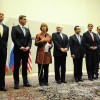
U.S. Demand for Deep Centrifuge Cut Is a Diplomatic Ploy
With only a few weeks remaining before the Jul. 20 deadline, the Barack Obama administration issued a warning to Iran that it must accept deep cuts in the number of its centrifuges in order to demonstrate that its nuclear programme is only for peaceful purposes.
After Losing Vote, U.S.-EU Threaten to Undermine Treaty
The United States and the 28-member European Union (EU) have assiduously promoted - and vigourously preached - one of the basic tenets of Western multi-party democracy: majority rules.IMF Issues “Revolutionary” Warning on Corporate Tax Avoidance
The staff at the International Monetary Fund (IMF) has issued an unusually stark warning over the lack of harmonised global tax policies, pointing out that these gaps are allowing for widespread tax gaming by corporations with particularly negative impacts for developing countries.« Previous Page — Next Page »


The Week with IPS

NEXT STOP - SDGs
Tracking global progress towards a sustainable world
Tracking global progress towards a sustainable world
