Languages
Thursday, October 22, 2026



News and Views from the Global South
India

Water Bodies Central to Urban Flood Planning
“The rain was our nemesis as well as our saviour,” says Kanniappan, recalling the first week of December 2015 when Chennai was flooded.
India and China, a New Era of Strategic Partners?
Despite bilateral dissonances and an unresolved boundary issue, India and China -- two of the world's most ancient civilisations -- are engaged in vigorous cooperation at various levels. The Asian neighbours' relationship has also focussed global attention in recent years on Asia's demographically dominant, major developing economies engaged in common concerns of poverty alleviation and national development.
Migrant Labour Fuels Tensions in Mauritius
They come from Bangladesh, China, India and Madagascar, mainly to run the machines in the textile industry here. But they do all kinds of other jobs too, from masons to bakers, house cleaners and gardeners.
India’s New Maternity Benefits Act Criticised as Elitist
The passage of the landmark Maternity Benefits Act 1961 by the Indian Parliament, which mandates 26 weeks of paid leave for mothers as against the existing 12, has generated more heartburn than hurrahs due to its skewed nature.
Indian Jails Slammed as Purgatory for the Poor
A media frenzy ensued in New Delhi last month when a popular television channel highlighted the horrific living conditions of women inmates in ward number six of Tihar Jail, South Asia's largest prison.
“Non-lethal” Pellet Guns Maim Hundreds in Kashmiri Protests
Hospitals in Kashmir’s summer capital are packed to capacity these days, their wards overflowing with pellet gun victims injured during violent clashes with government forces.
Chronic Hunger Lingers in the Midst of Plenty
In a fraught global economic environment, exacerbated by climate change and shrinking resources, ensuring food and nutrition security is a daunting challenge for many nations. India, Asia's third largest economy and the world's second most populous nation after China with 1.3 billion people, is no exception.
Climate Migrants Lead Mass Migration to India’s Cities
Deepa Kumari, a 36-year-old farmer from Pithoragarh district in the Himalayan state of Uttarakhand, lives in a one-room tenement in south Delhi's Mongolpuri slum with her three children. Fleeing devastating floods which killed her husband last year, the widow landed up in the national capital city last week after selling off her farm and two cows at cut-rate prices.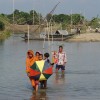
Indian Climate Activist Ponders the ‘Unthinkable’
For acclaimed Indian novelist and essayist Amitav Ghosh, the future of humankind as global warming impact events spread worldwide looks grim. So grim that the 60-year-old pamphleteer has titled his new book of three climate-related essays "The Great Derangement."BETWEEN THE LINES – Quality of journalism
When l was studying in a journalism school abroad, l was told by my professor that a news story should be like a skirt: long enough to cover the subject and short enough to be attractive. Over the years, the story has assumed the shape of pontification and inevitably padded.
Yoga Unites the UN for Sustainable Development
The word yoga means "unite" in Sanskrit, and the Indian government hopes that the ancient practice will help United Nations member states to work together to achieve the Sustainable Development Goals (SDGs).
Children of a Lesser God: Trafficking Soars in India
Sunita Pal, a frail 17-year-old, lies in a tiny bed in the women’s ward of New Delhi’s Ram Manohar Lohia Hospital. Her face and head swathed in bandages, with only a bruised eye and swollen lips visible, the girl recounts her ordeal to a TV channel propped up by a pillow. She talks of her employers beating her with a stick every day, depriving her of food and threatening to kill her if she dared report her misery to anybody.
Banking on the Milk of Human Kindness
The recent launch of Amaara, New Delhi's first human milk bank, has been greeted with much cheering. The initiative endorses the long-term goal of reducing infant mortality and addresses the critical issue of lack of mothers' milk for physically fragile newborns in India's capital city.
A Precarious Fate for Climate Migrants in India
After the sea swallowed up her home and family in the Bangladeshi coastal district of Bhola along the Bay of Bengal, farmer Sanjeela Sheikh was heartbroken. Stripped of all her belongings, her fields swamped and her loved ones dead, she contemplated suicide.
Climate Change Leaves Kashmir’s Economy High and Dry
Trudging barefoot on his two-acre piece of land, 57-year-old Mukhtar Ahmad has little hope of growing any crops this year due to the sudden dry spell that has struck Kashmir’s winter.
Indian Women Worst Hit by Water Crisis
A staggering 330 million Indians, making up a quarter of the country's population (or roughly the entire population of the United States), are currently reeling under the effects of a severe drought, resulting in an acute drinking water shortage and agricultural distress.
Global Renewable Energy Investments a Win-Win Scenario
The Paris climate change agreement adopted at the end of 2015 has put renewable energy at the heart of global energy system with investments expected to grow further even amidst the decline in fossil fuels.
The Lesson from Davos: No Connection to Reality
The rich and the powerful, who meet every year at the World Economic Forum (WEF), were in a gloomy mood this time. Not only because the day they met close to eight trillion dollars has been wiped off global equity markets by a "correction". But because no leader could be in a buoyant mood.
Activists Accuse India of Violating UN Convention on Child Rights
Civil rights groups and child welfare activists have strongly protested against the enactment of a new Juvenile Justice Act by the Indian parliament, lowering the age of a legally defined juvenile for trial from 18 to 16- years old in heinous crimes cases.
India’s Children: Plagued by Preventable Diseases from Poor Sanitation
Though the state of Karnataka in India counts for a higher Human Development Index of 0.478 against the national average of 0.472 in the subcontinent, the continued deficit in water and sanitation continues and the children there are bearing the brunt of the lack of infrastructure.
India Needs to “Save its Daughters” Through Education and Gender Equality
Women constitute nearly half of the country's 1.25 billion people and gender equality -- whether in politics, economics, education or health -- is still a distant dream for most. This fact was driven home again sharply by the recently released United National Development Programme’s Human Development Report (HDR) 2015 which ranks India at a lowly 130 out of 155 countries in the Gender Inequality Index (GII). India trails behind most Asian countries, including lesser developed Bangladesh and Pakistan which rank 111 and 121 respectively, and fares not much ahead of war-ravaged Afghanistan at 152.« Previous Page — Next Page »





The Week with IPS

NEXT STOP - SDGs
Tracking global progress towards a sustainable world
Tracking global progress towards a sustainable world
