Languages
Tuesday, August 4, 2026



News and Views from the Global South

Latin America to Redouble Its Climate Efforts in New York
The countries of Latin America will flock to sign the Paris Agreement, in what will be a simple act of protocol with huge political implications: it is the spark that will ignite actions to curb global warming.Fighting the Chotoo Gang
A group of notorious gangsters has apparently brought the Punjab police toitsknees.A2,200-strong police force has retreated after losing several men since the operation against the Chotoo gang in the southern Punjab district of Rajanpur began earlier this month. The army is now being dragged into yet another law and order issue that the civilian agencies should have been able to deal with.
OPINION: Breaking the Grip of Rimbunan Hijau over Papua New Guinea
James Sze Yuan Lau and Ivan Su Chiu Lu must be extremely busy men. Together, they are listed as directors of some 30 companies involved in various activities and services related to logging or agribusiness in Papua New Guinea (PNG). The former is the managing director of Rimbunan Hijau (RH) PNG and son-in-law of RH’s founder Tiong Hiew King; the latter is executive director of RH PNG Ltd.. All but two of these 30 companies have the same registered address at 479 Kennedy Road, in the national capital, Port Moresby–the headquarter of the RH group in the country.
When Only Men Make the News
On the onset, it seems women are everywhere in the media. You switch on the TV, there is inevitably an attractive woman luring you into buying a product. On the radio, there is the 'young new thing' vivaciously flirting with her male co-host while shuffling through songs; and in print, the entertainment pages would simply not sell without a titillating image of a female celebrity and a scoop on her latest rendezvous. But take a closer look, beyond the objectified and stereotypical images of women, being manufactured and mass consumed ad nauseam, and where are the women, really? Take a look at the news media, for instance. Where are the women in the newsrooms, in the bylines on the front and back pages, in the column spaces of our opinion pages, in the talk shows, not simply as hosts, but as commentators on so-called hard issues such as politics and foreign affairs? Where are the women in our news (discounting the PM and her alter-ego), except as wailing victims of violence, natural disasters and such and as muses of our male photographers during cultural festivals?
Deep Discord at United Nations over Global Drug Policy
International drug conventions ultimately aim to ensure the health and welfare of humankind, UN Deputy Secretary-General Jan Eliasson said here Tuesday at the opening of a special three-day session on drugs known as UNGASS.
Arsenic Threat Looms Large in India: Well Switching Provides the Way Forward
An Indian Govt. Parliamentary Committee on Estimates on “Occurrence of High Arsenic (As) content in Groundwater” in December, 2014 stated that more than 70 million people in 96 districts in India is under threat due to As occurrence in groundwater.
Champions of Hygiene
Lydia Abuya, a tenant living in the Kaptembwa informal settlement west of Nakuru town, leaves one of the six on-plot toilets. She returns with a pail of water to splash away the waste.
UN Chief Seeks Fast-Paced Ratifications for Climate Change Treaty
Over 150 countries are expected to sign the Paris climate change agreement on April 22 but the historic treaty will not come into force until it has been ratified by 55 countries.
Opinion: The Empire’s New Clothes? Conjuring Growth from the TPP
While the main US motivation for the Trans Pacific Partnership (TPP) has been to counter China’s influence in the region, it has also been used to undermine the Doha ‘Development’ Round of trade negotiations to better advance politically influential US corporate interests. Hence, it has become all the more necessary to legitimize the TPP in terms of its ostensible benefits. Touted as a ‘gold standard’ 21st century trade deal, it is nonetheless necessary to ascertain what gains can really be expected and whether these exceed its costs.
Developing countries left out of global tax decisions
Over one hundred developing countries continue to be left out of global tax cooperation negotiations despite leaks such as the Panama papers showing the high cost of tax avoidance.
No Easy Outcomes in Brazil’s Political Crisis
Brazilian President Dilma Rousseff would appear to be, as she herself recently said, “a card out of the deck” of those in power, after the crushing defeat she suffered Sunday Apr. 17 in the lower house of Congress, which voted to impeach her. But Brazil’s political crisis is so complex that the final outcome is not a given.A Cash-Strapped Nation on a Splurging Spree
In our student days there was a commonly used Sinhala phrase – “clean suit empty pocket”. That succinctly conveyed the image of a well-clad individual without a cent on his person.
Climate Change and the Middle East (II)
No Water in the Kingdom of the Two Seas—Nor Elsewhere
There is an oil producing country situated in the Gulf region, made of a cluster of islands. It is small, surface and population wise. But it holds the dubious privilege of ranking top of the list out of the 33 countries most likely to be water-stressed in the year 2040.

Matrix of Biometrics
Biometrics is the science of using physical (and behavioural) features for identification purposes. The most ubiquitous biometrics we encounter is 'the face'. Every individual has a distinct face, which is used by others to identify/ recognise him or her. Human beings also start recognising voices from the age of three months. Handwriting recognition is part of behavioural biometrics. The most versatile and reliable biometric data possibly comes from human genes.
A World Drowning in Oil
Thanks to tensions between Saudi Arabia and Iran, major oil producers couldn’t come to an agreement in Doha to freeze their output to January levels to raise oil prices. The current low oil prices have a lot to do with the grim outlook for global economic growth while supply is growing. China, the second largest economy in the world, is slowing down. Not surprisingly, global oil demand is much lower at 94.8 million barrels a day vis-à-vis supply of 96.3 million barrels a day in the first quarter of 2016 according to the International Energy Agency.
Climate Change (I)
Will the Middle East Become ‘Uninhabitable’?
This is not about any alarming header—it is the dramatic conclusion of several scientific studies about the on-going climate change impact on the Middle East region, particularly in the Gulf area. The examples are stark.
Innovations Boost Income for Women Rice Farmers
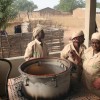
Salabanya Tabaitou no longer squints from the irritating wood smoke each time she has to parboil her rice paddy. Now Tabaitou feeds logs into a chute of a specially designed brick stove with a chimney that draws away the smoke. The stove with a stainless steel parboiling vessel cooks her rice in 20 minutes - something she would have spent two hours doing using the traditional method.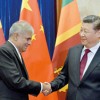
No Free Chinese Takeaway but Chinese Takeover on the Menu
There is no such thing as a free Chinese takeaway; and, if the visiting Lankan high powered delegation led by Prime Minister Ranil Wickremesinghe fancied otherwise, the Chinese hosts made pretty certain the guests got the message crystal clear when the fortune cookie, opened after the diplomatic feast of niceties was over, revealed the thumping bill of fare.Historic Victory for Investigative Journalism
The world was shaken up this week with the leaks of the ‘Panama Papers’ exposing the financial shenanigans of world leaders, past and present. They showed how such leaders of men, women and nations and their business side-kicks hid their embezzled wealth in tax havens around the world and thereby avoided paying taxes in their respective countries. They enjoyed the good life with their monies stacked in offshore banks, some using shell companies with front-men as the account holders, while their fellow countrymen and women were asked to pay their taxes.
Maquilas Help Drive Industrialisation in Paraguay
“There were cases of people who stopped coming to work after receiving their first wages and then came back a few days later to ask if there was more work,” because they were used to casual work in the informal economy, said Ivonne Ginard.Home is School
The paradox of education in Pakistan is that the children of the poor are not getting enough of it, while the offspring of the rich get a surfeit. Neither is good for the child.« Previous Page — Next Page »


The Week with IPS

NEXT STOP - SDGs
Tracking global progress towards a sustainable world
Tracking global progress towards a sustainable world
