Tuesday, September 1, 2026



News and Views from the Global South
Q&A: "The Presence of Women in Local Councils Is in Itself a Revolution"
Interview with Honorine Attikpa
- As local elections in Benin draw closer, activists are pushing ahead with efforts to have more women voted into local government. Just 45 of the 1,189 councilors currently in office are women.
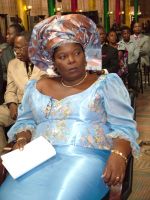
Honorine Attikpa champions the effort to put more women in local government. Credit: Gontran Hounsounou
The ballot will take place under a system of proportional representation, which allocates seats to political parties according to their share of the vote. The seats are then awarded to persons on party lists, with those highest on the lists being picked first.
Independent candidates are also allowed to run – although amendments to electoral legislation now require them to be grouped together on a list of their own: an added burden that some believe has been introduced by legislators to push candidates into running on party lists.
However, this isn't discouraging G/PIFeD co-ordinator Honorine Attikpa, as she told IPS correspondent Reine Azifan.
IPS: What exactly is G/PIFeD doing to have more women elected to local government during the upcoming elections?
Honorine Attikpa (HA): G/PIFeD is carrying out many activities, including lobbying decision-makers, who are the supporters and guardians of our traditions. We have started to sensitise them, because our tradition does not allow a woman to achieve the same standing as a man; a woman must be submissive…she is not meant to be a leader. We have started with the traditional chiefs, the religious leaders, the high ranking persons at local level, so that they understand that with progress, a woman has something to do other than keep house.
At the national level we are lobbying heads of parties, as they do not generally place women (on party lists)…When we make enough noise for a while they place them, but at the bottom of the list. We are also doing sensitisation through radio and television spots to encourage them to place enough women in good positions, as when a person is not well positioned she doesn't stand a chance of being elected.
Concerning the women themselves, who don't seem to appreciate their (own) abilities, we are sensitising them so that they understand that they don't only have to be supporters (of candidates) or campaigners for votes, but that they can lead as well…
With the sensitisation of the population, we are also trying to show why the presence of women is important in the management of local affairs…So, there's a variety of activities that we are carrying out; we are doing everything to enable women to decide (to run for office), and to be well positioned.
IPS: Are you providing particular assistance to women who choose to run as independents?
HA: The first, major (form of) support that we provide to women candidates in general is this campaign that started several months ago where we simply call on people to vote for women. Every woman candidate benefits from this campaign. As soon as women decide to run in elections, we train them in how to set up a campaign account, how to run a campaign, the issues of decentralisation and the role of elected women.
We also help them in the preparation of their candidacy applications, with advice – but we aren't funding any of their activities, as we're apolitical and the law prevents us from involving ourselves in politics. Many women expect financial support from us, but the law does not allow it, and we don't have the resources, besides…Our support is limited to assistance, to advice to lift their morale so that they don't become discouraged at the first insults, at the first mudslinging. This technical support is available to all women candidates, whether they are independents or on a party list.
IPS: Has the approach of G/PIFeD changed since the 2002 local elections? Were lessons learned then that can lead to more effective strategies?
HA: In 2002, some months before the elections we were already training women who told us they were going to be candidates. But, experience showed that (some of) those we trained didn't end up being candidates. This is why this time, to be more effective, we decided to wait for candidacies to be confirmed before training them (women aspirants)…
We are doing sensitisation, lobbying, but the law does not oblige anyone to place women; this is why now, we are increasing our pressure on the president of the republic through his political movement – the Cauris Forces for an Emerging Benin – to obtain a quota. While we're waiting, many parties have promised us to position women well; we are waiting to see if this happens.
We have evaluated the first term in office of (women) councilors to see how they performed, but the conclusions of this evaluation have not yet been assessed.
Concerning the training, we will perhaps change the modules a little bit, taking into account the new law on elections. Before, we didn't help elected women. This time, we will help them throughout their term in office. They will benefit from…advice and from training until the end of their term in office.
IPS: I understand that the training of elected women is to enable them to carry out their responsibilities well because if they fail, this will disadvantage other women seeking election later. What will you focus on in the training?
HA: Women in office did not fail more than men…We are sometimes agreeably surprised to see that certain women have performed well…The real problem is that they do not occupy important positions of responsibility in local councils.
As our laws are written, if you are not a mayor you do not have enough power, you do not have autonomy. We have a total of four women mayors out of 77…They have some power to influence decision making during meetings of the local council…
Most of the elected women have measured up to the task. Some of them have, with their own means, set up infrastructure in their areas, even though the law does not allow this…
IPS: To what extent have women in local government changed the face of local politics since the last elections? Have they raised issues that would not otherwise have been dealt with?
HA: We must first ask if the local councils, men and women both, have been able to change things. We are waiting for the evaluation report to assess this better. But, the presence of women in local councils is in itself a revolution, as it shows that women can also be in power. They have certainly been able to influence things positively.
Everywhere that we have gone, people tell us that when women start to demand something during the council meetings, there's no peace until they're satisfied. It's certain that they have changed something, but this change…is difficult to see. In most cases, they have directed social affairs commissions. So, problems related to health, the education of girls, well being in general, have often been raised.
IPS: Are women who win in local elections better placed to succeed in national polls? Do local politics constitute a good entry point to national politics?
HA: Local elections and national elections are two different things. It's easy to win local elections because (they take place in) a geographical area that is reasonably manageable. On the national level, it's a jungle…But, the change of mentalities (caused by having women contest locally) can lead many more women to win at national level.
It's good to start preparing oneself, to apprentice at local level, but the fact is that you cannot say a woman elected at local level necessarily has chances of succeeding at the national level. Women fight (for recognition) in parties, but given that there is not a lot of democracy in parties, people don't remember them during the distribution of posts.
To these problems, are now added the new clauses of the electoral law; they're so tough that women have difficulties. Before, someone could be an independent candidate in her constituency without conditions; now, the law requires that an independent candidate find other independent candidates in all the districts of the constituency. It's a way of ensuring that there are no more independent candidacies.
Women must not become discouraged, they must rather fight to take up the challenge of participating in decision making bodies and in development.
 Print
|
Print
|