
Thursday, October 8, 2026



News and Views from the Global South
Q&A: "As a Woman Politician in Kenya, You Need to Think Out of the Box"
Interview with Esther Murugi Mathenge
- A coalition cabinet for Kenya was sworn in Thursday amidst mingled relief and exasperation on the part of those living in the East African nation: relief at the possibility of Kenya now being able to rebuild in earnest after post-election violence, and exasperation at the price tag attached to this hope.
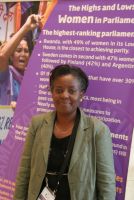
Esther Murugi Mathenge, Kenya's new minister for gender and children. Credit: Miriam Mannak/IPS
Hopes are that Kibaki and Odinga – now Prime Minister – will work within a government of national unity to address the social tensions that fuelled the violence. But, with the cabinet having been enlarged from 34 to 42 ministers to accommodate both camps, there are concerns that it will drain resources from a country already struggling to meet the needs of its citizens.
More positively, Kenya now has seven women in its cabinet, the highest number ever; under the previous administration, which marked Kibaki's first term in office, the number of female ministers never exceeded three.
Esther Murugi Mathenge has taken charge of the portfolio for gender and children. IPS reporter Miriam Mannak spoke to her about the new post, at the 118th assembly of the Inter Parliamentary Union, which concluded Friday in Cape Town, South Africa.
IPS: Was it difficult to secure a position in government?
Esther Murugi Mathenge (EM): Yes, it was very difficult, as it is for any Kenyan woman who is running for parliament or cabinet. It took me three attempts before I eventually ended up where I am now.
The reasons why it was difficult vary. First and foremost, Kenyan society is very traditional and male dominated. Here, politics are regarded as a man's domain, and women with political aspirations are not very welcome. During last year's elections, there were several cases of violence against women who ran for parliament. A few were beaten up. They never made it into parliament.
Secondly, the financial aspect makes it difficult for women to run for government, as campaigning is a very capital intensive affair. Apart from that, you need people to help you. It is practically impossible to campaign on your own. That – getting people involved – can be problematic in a society where one is not keen on or used to women politicians.
Last but not least, from my experience at least, voters too tend to be conservative. In my country, women with political aspirations can't automatically count on the support of female voters.
IPS: How did you manage to overcome these obstacles?
EM: I was determined to get the women voters behind me, as they form a large and important part of the electorate. Therefore, I strongly focused on issues that affect them and their children. I also told them not to see me solely as a woman, but as a leader. As a woman politician in Kenya, you need to think out of the box to reach your goal. That was the core of my strategy and it worked.
I tackled the financial obstacle by mobilising friends and family. Some of them donated their time and expertise, while others gave petrol or lent me their vehicles to drive to rural areas to campaign.
Luckily my family was very supportive, which helped. Not being married was also a bonus, as I had the freedom to be my own master and control my funds.
IPS: Why is it important for women to participate in politics?
EM: Women are the heart of the home and heart of the country, so therefore they should be represented in government. Besides, African women know what their female counterparts struggle with and what they need. Women know how it feels or must feel when you have to walk 25 kilometres to the nearest medical facility to give birth. Women are aware of the challenges that are attached to not having running water nearby. Men cannot understand this: They do not give birth and neither are they in charge of fetching water.
IPS: Are you satisfied with the number of women in Kenya's cabinet and parliament?
EM: There is still a lot of work that needs to be done. Initially, women who ran for parliament aimed to have at least 50 female members of parliament. Eventually, we only got 21 of 222 seats. That is less than 10 percent. I do have to emphasise that this is an increase of three seats, so it is a slight improvement. The real beauty of the elections is that now, seven of 42 ministers are female. Previously, there were only three women filling ministerial posts.
Still, the best scenario would be a 50-50 distribution.
IPS: How did the post-election violence affect you?
EM: To me, it was a massive anti-climax. There was no time to celebrate or to relax. Together with other MPs (members of parliament), we went into the countryside to preach peace. Luckily things have calmed down, although two members of parliament have been shot since the parliament was sworn in, in January this year. We still have no idea what the motive was behind the murders.
I have the feeling that we should do more to address the cause of the violence. The elections were not the sole reason of what happened; there is more we should look at. The tension had been building up for a while before the situation exploded – land distribution for instance. Land in Kenya is poorly distributed, which is an important cause of friction.
IPS: Given the shooting of the two MPs, did you ever fear for your own safety?
EM: After the murders the government made it compulsory for politicians to have security; that means that I am being protected. But, I have made arrangements about when and where I am under supervision of security personnel. I like to have my own life too.
 Print
|
Print
|




