
Wednesday, September 9, 2026



News and Views from the Global South
RIGHTS-JAPAN: Calls for Peace Echo at Children's Forum
Lynette Lee Corporal
- In a fittingly solemn gesture of peace and renewal, children and adults belonging to different faiths offered flowers and prayers, Monday, for the thousands of people who became the first ever victims of a nuclear bombing in this city 63 years ago.
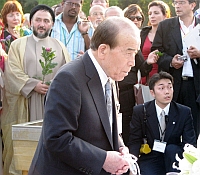
Rev. Takeyasu Miyamoto leads prayers at the A-Bomb victims' Memorial Monument, Hiroshima. Credit: Lynette Lee Corporal/IPS
The forum brought together more than 1,300 adults from different religious affiliations who renewed their commitment to help the children be free from the problems of violence, poverty and environmental degradation.
At the Interfaith Prayer for Peace earlier, representatives from different faiths – Baha'i, Buddhist, Christian, the Federation of New Religious Organisations of Japan, Hindu, Islam, Jewish, Sectarian Shinto, Shrine Shinto, and Sikh – offered their prayers, for children and the rest of the world, before an appreciative international audience.
The closing ceremonies of 'Dialogue with Global Leaders’ became a venue for impassioned appeals by children and adults alike to world leaders.
An eloquent child representative Anam Wasey, from New Delhi, said that education is the key to eradicating the problems children face daily. She also left the audience with an environmental choice – "pollute to perish or conserve to flourish".
Former Tanzanian street child-turned-GNRC Africa advocate Isaac Lukumari Peter made an emotional appeal for developed countries "to please stop producing bombs", and instead produce more food for the world's hungry children.
"We must stop all violence and protect the environment but if we want to do this, we must start with ourselves," he said.
In a similar manner, Ven. Gijun Sugitani, former president of the Tendai Buddhist denomination, denounced the production and sale of weapons by countries which could eventually maim or kill a child.
"Countries that are the largest producers and exporters of arms are betraying our goals for peace and the formation of values," said Sugitani, adding that education is a very important tool to solve the problems that affect the world's children.
United Nations deputy secretary-general Asha-Rose Migiro reiterated her call for countries to redouble efforts in meeting the Millennium Development Goals (MDGs), now at the halfway mark to the 2015 deadline.
Migiro also called on the international community to help improve the lives of children. "It's not about theory, it's what can be done," she said.
Ann Veneman, U.N. Children’s Fund (UNICEF) executive director, cited the common goals shared by both the GNRC initiatives for children and the MDGs, noting that it was also in 2000 that world leaders agreed upon the MDGs. "Human progress requires investing in children. Religions and faith-based groups have the moral obligation to address the widespread violence against children," she said.
Veneman particularly condemned what she referred to as abhorrent traditional practices such as female genital mutilation and the forced marriage of girls as young as nine.
Former UNICEF deputy executive director Kul Chandra Gautam enjoined upon both Migiro and Veneman to spread the word on GNRC initiatives to world leaders.
"We hope that you will impress upon the leaders attending the Tokyo International Conference on African Development summit in Yokohama next week and at the G8 summit in Hokkaido that, as they discuss issues of trade and aid, development and climate change, that they will keep in mind the special needs of the world's children and of the tremendous potential of religious and interfaith institutions including the GNRC," he said.
The three-day event, which revolved around the theme "Learning to Share: Values, Action, Hope" is the third forum sponsored by the Arigatou Foundation since the GNRC was established in 2000. It is the only global interfaith network exclusively dedicated to securing the rights and well-being of children and young people everywhere.
The highlight of the forum was the launch of a manual for educators and youth leaders entitled 'Learning to Live Together: An Intercultural and Interfaith Programme for Ethics Education' that proponents believe will break down barriers of mistrust and misunderstanding among young people of various faiths.
Representatives from different regions including Africa, Arab States, Central Asia and the Caucasus, Europe, Israel, Latin America and South Asia. Each region reviewed r progress and to planned future initiatives in line with the GNRC's three imperatives of eradicating poverty, violence and environmental damage.
At the end of the conference, participants presented a 'Hiroshima Declaration of the Global Network of Religions for Children' that affirmed the GNRC's goal of having a faith-based contribution that will help give back a child's "right to attain physical, mental, spiritual, moral and social development as recognised by the U.N Convention of the Rights of the Child".
A 'World Day of Prayer and Action for Children', to be held every year on Nov 20, the International Children's Day, was launched as well. On this day, religious institutions and communities will reaffirm the world's commitment to children via prayers and practical support for them.
According to Gautam, the GNRC and the UNICEF are also collaborating with secular and religious organisations in preparing a booklet "that will encompass all the world's religions" offering child-friendly policies consistent with the world's religious teachings.
For Arigatou Foundation representative and Myochikai chairman Rev Keishi Miyamoto, the GNRC has reached a new level and he is looking at the further development of their network. "We will strengthen ties with the U.N. in the promotion of ethics education. We'd also like to develop cooperative relations with civil society groups and economic circles," said Miyamoto in his closing remarks.
 Print
|
Print
|



Pictures for this story
This story includes downloadable print-quality images -- Copyright IPS, to be used exclusively with this story.


