Tuesday, September 8, 2026



News and Views from the Global South
PHILIPPINES: Hungry for Rice, Unwilling to Invest
Prime Sarmiento
- When the price of rice nearly doubled to about 90 US cents per kilo, two months ago, Liza Valino put cheaper substitutes like bananas and sweet potatoes on the table to feed her family of ten. But no one was satisfied.
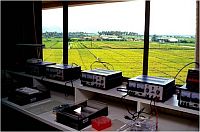
Experts say Manila must invest more in rice research and irrigation to satisfy its population. Credit: International Rice Research Institute
Rice is a staple in the Philippines with the national daily consumption of the grain at 33,000 tonnes, accounting for 20 percent of the daily household budget, on an average. Apart from being the main source of carbohydrates, rice creates what anthropologists refer to as "the physiological sensation of satiety". For most Filipinos, no meal is complete without rice.
The Valinos are among thousands of Filipino families that have had to cut down on their food spending to cope with rising prices. A nationwide survey conducted in July by Pulse Asia revealed two in three Filipino households saying they are consuming less or spending less on food, and one in four households talking about cutting down on rice consumption.
As the country enters the third quarter of the year, the traditional lean season, the demand for rice has turned urgent with escalating prices of the staple turning into a highly emotional and politically charged issue.
Philippine government officials are now scrambling for means to alleviate this rice hunger, mainly through expensive imports and administrative measures.
Over the past two months, President Gloria Macapagal-Arroyo’s government has imported two million tonnes of rice, sold subsidised rice at P 25 (0.55 cents) a kilo, cracked down on rice hoarders, issued a moratorium on agricultural land conversions and urged fast-food restaurants to offer half-portions of rice.
But these measures have apparently failed to mollify a frustrated populace. Arroyos’s net satisfaction rating tumbled to 21 percent according to the second quarter 2008 Social Weather Survey. This is the lowest rating that any Philippine president got since 1989.
Turning unpopular, however, is only one of Arroyo’s worries. The Philippines is now the world’s largest rice importer, and for the past ten years has been procuring between one million to two million tonnes each year – equivalent to ten percent of its total consumption.
But the government cannot afford to continuously rely on imports to satisfy a basic need of its people. As Jessica Reyes Cantos, lead convenor of the advocacy group Rice Watch and Action Network (R1), notes: ‘’We can’t rely on rice imports because what will happen to us if rice exporters decided not to sell? Can we force them to sell rice to us?"
This is because the global rice market is thin with only seven percent of harvested rice traded. Exporters like Thailand, Vietnam and China also have rice eating populations and will not hesitate to cap exports to protect their domestic consumers. Indeed, early this year, Cambodia, Egypt, India, Pakistan and Vietnam stopped exports as tight supply threatened food security.
Several factors crimped rice supply and spiked prices to a 20-year high of 1,000 dollars a tonne. These include widespread diversion of paddy lands to cash crops and/or residential sites; bad weather conditions which damaged rice crops in Southeast Asia; rising wheat prices which pushed some major bread consumers to shift to rice and higher demand from the fast growing Chinese and Indian economies.
Philippine agriculture secretary Arthur Yap recently vowed that the country will be self-sufficient in rice by 2010. But his predecessors had made similar pronouncements, but never been able to achieve that goal thanks to geographical factors.
"The Philippines is fighting a battle against nature that its (rice) exporting neighbours are spared," according to the report published by the Philippines-based International Rice Research Institute, in 2006. An archipelagic country with a limited land base, the Philippines can only spare four million hectares for rice cultivation. It is located in the eastern edge of the Asian continent, making the Philippines part of the typhoon belt and rice farming a risky venture.
Compared to that, Thailand and Vietnam have a clear geographical advantages. They have far more arable land, are not located in the typhoon belt and can draw on the Mekong river to sustain their rice fields.
In an online discussion held last month, World Bank economist Will Martin noted that "improvements in production technology can play a big role in reducing the problem (of rice shortage in the Philippines) and generally appear to have very high returns that can raise economic growth’’. Other experts say that unless the government funds and implements policies in favour of improved irrigation and scientific farming, self-sufficiency will remain a dream.
Investing agricultural infrastructure is vital. Trinidad Domingo, president of the National Coalition of Rural Women, believes that irrigation will be a big help to rice farmers as this will allow them to plant rice even in the dry season. Rainfed agriculture can only produce a single harvest a year, she points out. "Instead of spending a lot of money to import rice the government should us it to support Filipino farmers,’’ Domingo says. The Philippines is expected to import 2.7 million tonnes of rice this year and R1 has estimated that for this year’s rice imports the government has to spend P 58.7 billion (roughly 1.3 billion dollars).
The Philippines has 3.1 million hectares of irrigable lands but of this only 46 percent is irrigated, according to the National Irrigation Administration.
"Investments for rural infrastructure development and other support services have dwindled from 0.24 percent of the country’s gross value added agriculture (GVA) in 1995-1999 to a mere 0.07 percent in 2000-2005. This is particularly true for irrigation which contributes about 25 percent of rice production increase. This meagre investment in the rice sub-sector has affected its production performance and weakened its competitive position in the world market vis-à-vis the other Southeast Asian countries," says a research paper published 2006 and prepared by Arsenio M. Balisacan, director of the Philippines-based Southeast Asian Regional Center for Graduate Study and Research in Agriculture (SEARCA), and Leocadio S. Sebastian, former executive director of the Philippines Rice Research Institute (PRRI).
Fermin Adriano, a Manila-based economist who has done several studies on the Philippine farm sector, estimates that the government needs to spend at least P 40 billion (884 million dollars) each year on building new irrigation facilities and maintaining existing ones. Current spending on this head is less than half that amount.
Given the scarce resources, R1’s Cantos proposes that the agriculture department avoids investing in mega projects such as dams. ‘’It can just repair and rehabilitate existing facilities or spend on small-scale communal irrigation systems."
Another worthwhile measure is investment in research and development. "There is strong evidence that the returns from investments in research and development in developing country agriculture are extremely high. R and D can help improve farmers’ incomes, while helping hold down the price of staple foods to consumers," according to the Bank’s Martin.
Balisacan and Sebastian’s study showed that for the past ten years investments in agricultural research only accounted for 0.1 percent of the country’s GVA. "This is far below the one percent level recommended for developing countries and very much lower than the two to three percent observed in many countries,’’ the study said. The authors recommended that more funds are needed to conduct research on developing high quality and improved seeds, integrated crop management, crop management practices and expanded outreach work to disseminate new knowledge and technologies.
The Philippine government cannot afford to give up trying to boost rice production if it is to feed its over 80 million population, which is expanding at an alarming 2.3 percent per year. ‘’The government needs to take charge because rice is strategic to the life of the nation," Adriano says. Government intervention means putting money into infrastructure and research and such investments will assure farmers that they have the support they need to continue planting rice, he added.
 Print
|
Print
|