Languages
Sunday, September 27, 2026



News and Views from the Global South
Active Citizens

Missing Women in Peru – Pain that Never Ends
"They mustn’t stop looking for her," said Patricia Acosta, mother of Estéfhanny Díaz, who went missing on Apr. 24, 2016, along with her five-year-old and eight-month-old daughters, after attending a children's birthday party in Mi Perú, a town in the coastal province of Callao, next to the Peruvian capital.
How to Stop the ‘Hunger Pandemic’ During COVID-19
Johnny, living in the United States (US), goes to his school and gets free breakfast and lunch there. There may not be enough food for dinner at home. But he knows that he can get fed at school. Sadly, however, after the pandemic, schools were closed, which meant no breakfast and no lunch for him.
Youth must be Equal Partners in Digital Decision Making – ITU Youth Summit
"50 percent of the present, but 100 percent of the future," was the refrain at the first-ever Generation Connect Global Youth Summit.
Meaningful Dialogue Amplifies Youth Issues, Leads to Change
Young people are often the first to rebuild their communities. However, youths' diverse challenges cannot be addressed without meaningful dialogue, says Klaus Beck, Regional Director of UNFPA APRO ai.
Poor Families Clash over Water with Real Estate Consortium in El Salvador
Alex Leiva woke up at 4:00 a.m. to perform a key task for his family’s survival in the Salvadoran village where he lives: filling several barrels with the water that falls from the tap only at that early hour every other day.
Over Two Decades of Impunity for Environmental and Health Disaster in Peruvian Village
"We are not asking for money, but for our health, for a dignified life," is the cry of the people of Choropampa, which lawyer Milagros Pérez continually hears 22 years after the environmental disaster that occurred in this town in the department of Cajamarca, in Peru´s northern Andes highlands, on the afternoon of Jun. 2, 2000.
Rivers Have no Borders: The Motto of Their Defenders in Peru
"Water is part of our culture, it is intrinsic to the Amazon," said José Manuyama, a member of a river defense committee in his native Requena, a town located in the department of Loreto, the largest in Peru, covering 28 percent of the national territory.
Employee-run Companies, Part of the Landscape of an Argentina in Crisis
"All we ever wanted was to keep working. And although we have not gotten to where we would like to be, we know that we can," says Edith Pereira, a short energetic woman, as she walks through the corridors of Farmacoop, in the south of the Argentine capital. She proudly says it is "the first pharmaceutical laboratory in the world recovered by its workers."
Former Child Labourer, now Lawyer, Passes Light of Freedom to Others
Amar Lai’s first memories are working alongside his parents and siblings in a quarry, breaking rocks. He was aged four. Now chatting to Lai, a confident 25-year-old human rights lawyer, it is hard to believe he was once a child labourer.
How Collective Action Can Move the Needle on Gender Equality
During this year’s sixty-sixth session of the Commission on the Status of Women (CSW66), we are eager to see the global community pivot towards more inclusive approaches to advocacy. It's imperative to put the spotlight on women’s rights and youth-led organizations in communities that are often left out of key discussions. By handing the mic over to advocates across all backgrounds and ages, we can shift to a model that enables all advocates to take a lead role in policy-making and ultimately translate promises and rhetoric into real impact and accountability.
Youths Trailblazing Paths in Sexual and Reproductive Health Ahead of ICFP Family Planning Conference
Travelling in northern Nigeria, Peace Umanah noticed teenage girls with multiple children – they would be walking with one strapped to their back, holding another by hand and with a protruding belly.
Changing a System that Exploits Nature and Women, for a Sustainable Future
"Pachamama (Mother Earth) is upset with all the damage we are doing to her," says Hilda Roca, an indigenous Peruvian farmer from Cusipata, in the Andes highlands of the department of Cuzco, referring to climate change and the havoc it is wreaking on her life and her environment.
Struggle in Guatemala Offers Hope for Latin America’s Indigenous People
A struggle for the defense of their territories waged by indigenous Maya Q'eqchi' communities in eastern Guatemala could set a historic precedent for Latin America's native peoples because it would ensure not only their right to control their lands but also their natural resources, denied for centuries.
Youth Have the Spirit to Change Trajectory of Leprosy, says Yohei Sasakawa
Yohei Sasakawa said the youth have the power to change the world, and their participation in removing the stigma and myths about leprosy is crucial to the campaign to end the disease.
Activism will be Key to Overcoming the Covid-19 Crisis
As the Omicron surge overwhelms the world, it is clear to people everywhere that the actions which leaders so far have taken in response to the Covid-19 crisis have not been sufficient to overcome it.
Journalists Who Faced Relentless, Targeted Attacks: 293 Imprisoned in 2021
This past year, uncertainty blanketed our world. The COVID-19 pandemic, the rapidly advancing climate crisis, the pervasive nature of new technologies, and encroaching authoritarianism have all shown that our world is changing fast and in ways that fundamentally affect how we live.
Rural Women in Peru Seed Water Today to Harvest It Tomorrow
"When I was a little girl we didn't suffer from water shortages like we do now. Today we are experiencing more droughts, our water sources are drying up and we cannot sit idly by," Kely Quispe, a small farmer from the community of Huasao, located half an hour from Cuzco, the capital of Peru's ancient Inca empire, told IPS.
The Global Assault on Human Rights
Human rights are under global assault. In 2021, the escalation of the worldwide siege on human rights included clampdowns on civil society organisations, attacks on minorities, the undermining of democratic institutions, and violence against journalists.
The Age of Discontent: What Drives the Rising Wave of World Protests?
In recent years, the world has been shaken by protests. From the Arab Spring to the social uprisings in Chile and Latin America, the world has seen a dramatic rise in protests. In a polarized world, the COVID-19 pandemic has only accentuated feelings of outrage and discontent.
Homeless Camps, a Reflection of Growing Inequality in Chile
Camps made up of thousands of tents and shacks have mushroomed in Chile due to the failure of housing policies and official subsidies for the sector, aggravated by the rise in poverty, the covid-19 pandemic and the massive influx of immigrants.
APDA Young Leaders Devise Solutions for the Future
Whether you look at society, the environment, or technology – the world is changing rapidly. Global organizations strive to adapt to this change. The United Nations, for example, has developed the Sustainable Development Goals as a blueprint for human development.« Previous Page — Next Page »


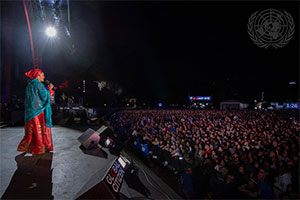 Global Citizen Festival in New York. Credit: UN Photo/Eskinder Debebe
Active citizens are committed to social change because they know that it is achievable. However, major political challenges face active citizens across the world. For example, in authoritarian regimes in Latin America where the hegemonic party has been in power for decades on end, protestors and human rights activists face enormous repression and struggle to materialize their advocacy into concrete results. The same can be said for Africans, where a shift towards elected government in recent decades has yet to translate into an effective voice in decision-making. Now, the Strengthening Citizen Demand for Good Governance, which uses evidence-based approaches – funded by DFID's Governance and Transparency Fund – seeks to raise their voices.
In 2025, the CIVICUS Monitor’s People Power Under Attack report revealed that civic freedoms are severely limited in 122 of 198 countries and territories, and only 7.2% of the global population now lives in countries where civic space is open. Through partnership with the Overseas Development Institute (ODI) and CIVICUS, IPS reporters across the continent will seek to define the extent and limits of state capability, government accountability and the responsiveness of leaders to the needs of citizens.

The Week with IPS

NEXT STOP - SDGs
Tracking global progress towards a sustainable world
Tracking global progress towards a sustainable world
