Languages
Friday, September 25, 2026



News and Views from the Global South
Active Citizens

Journalists, Under Threat, Need Safe Refuge Through Special Emergency Visas
“This woman sitting next to me, Maria Ressa, is a Nobel laureate and a convicted criminal,” said barrister Amal Clooney, who co-leads the international legal team representing Ressa. The founder of news website Rappler, Ressa has been targeted with a barrage of legal charges intended to stop her journalism in the Philippines.
Korean Slums: The Shadows of Society, or the New Light for the Future?
Have you watched Parasite? In 2021, everyone seemed to be watching it. But I wonder how many of them paid attention to the old man who found a little shelter in a hidden basement behind the kitchen of a mansion. However hidden it was, that's where he could meet his basic needs. That was his little slum.
Deadly Smoke: Feeding Children Kills Cafeteria Staff
During my summer break this year, I read a news article about five school cafeteria workers who had died of lung cancer. Due to these incidents, a union of cafeteria workers, wearing their aprons and holding their lunch trays, held a protest in front of the President’s office on a scorching summer day. And it made us think about the devastating working conditions for the school lunch employees. Isn’t it so disheartening that we eat our school lunch at the expense of their health?
Civil Disobedience – How to Make Enemies and Influence People
Blocking metros and highways in rush-hour traffic to stop commuters getting to work. Vandalizing petrol pumps to put them out of use. Halting sporting events such as the French Open and the British Grand Prix. Disrupting bemused art lovers by gluing oneself to priceless masterpieces.
Guatemalans Fight Extractive Industries
The majority of the Guatemalan population continues to oppose mining and other extractive projects, in the midst of a scenario of socio-environmental conflict that pits communities defending their natural resources against the interests of multinational corporations.
Peruvian Trans Women Fight for Their Right to Identity
"Without recognition of your identity by the State and society, there is no exercise of citizenship or rights," said Leyla Huerta, director of Féminas Perú, an organization that has been working since 2015 to empower transgender women in the face of the highly vulnerable situation they find themselves in.
A Plea for the Creation of a UN Youth Assembly
There are many ways the UN can have a sizeable role in promoting the engagement and participation of youth and helping them becoming a central pillar of a new way of doing policy-making.
There’s no Stopping Renewable Power in Chile, but Community Energy Is Not Taking Off
Renewable energies, especially solar and wind power, are growing inexorably in Chile, driven by large companies. But community generation of alternative energy is not taking off, despite a law promoting it.
ECW Interviews Three Inspiring #Youth4EiE Advocates on International Youth Day
On this International Youth Day, ECW interviewed three inspiring #Youth4EiE Advocates – Nataly Rivas, Angela Abizera, and Jean-Paul Saif. Nataly, Angela, and Jean-Paul are three Global Youth for Education in Emergencies panel members.
‘Aid Organizations Must Include the Youth Voice’ August 12, 2022—International Youth Day
Today marks International Youth Day, a global celebration of the transformative power of young people. Introduced by the United Nations General Assembly in 1999, the event was inaugurated not only to observe the power of the youth voice, but to serve as a promise from those in power to activate the power of youth across the development sector.
Unprecedented Threats Against “Right to Protest” on the Rise World-wide
The French writer and philosopher Voltaire (1694-1778), once famously remarked: "I disagree with what you have to say, but I will defend unto death, your right to utter them.” But that political axiom hardly applies to multiple governments in Asia, Africa, Europe and Latin America—including Greece, UK, Thailand, Hong Kong, India, Myanmar, Chile, France, Democratic Republic of Congo and Cyprus – where the right to protest, along with freedom of speech, are increasingly in jeopardy.
U.S.-Latin America Immigration Agreement Raises more Questions than Answers
The immigration agreement reached in Los Angeles, California at the end of the Summit of the Americas, hosted by U.S. President Joe Biden, raises more questions than answers and the likelihood that once again there will be more noise than actual benefits for migrants, especially Central Americans.
Drones To Help Fishers Avoid Border Conflicts on Lake Victoria
It is exactly two years since George Omuodo’s brutal confrontation with fishers from Uganda, an encounter that left him hospitalized with a broken arm and bruised ribs. After listening to his ordeal, one wonders where he gets the courage to go back to the lake every day.
Migrant Workers from Mexico, Caught Up in Trafficking, Forced Labor and Exploitation
Eduardo Reyes, originally from Puebla in central Mexico, was offered a 40-hour workweek contract by his recruiter and his employer in the United States, but ended up performing hundreds of hours of unpaid work that was not authorized because his visa had expired, unbeknownst to him.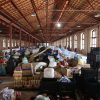
Mobilizing Against Hunger in Brazil, Where It Affects 33.1 Million People
A campaign against hunger, a problem that affects 15.5 percent of the Brazilian population, seeks to mobilize society once again in search of urgent solutions, inspired by a mass movement that took off in the country in 1993.
Why We Need a Digital Safe Space for LGBTQ Youth – Thoughts from Asian Teens
Recently, I watched a documentary titled Why We Can’t See Disabled People [in Korea].
Smelter Finally Closes Due to Extreme Pollution in Chilean Bay
A health crisis that in 20 days left 500 children poisoned in the adjacent municipalities of Quintero and Puchuncaví triggered the decision to close the Ventanas Smelter, in a first concrete step towards putting an end to a so-called "sacrifice zone" in Chile.
Sharing Minds Can Change the World
Parasite, a Korean black comedy film directed by Bong Joon-ho, shows the story of a poor family who infiltrated the household of an affluent family by getting employment by pretending to be highly qualified persons.
Five Takeaways from the 2022 State of Civil Society Report
2022 is halfway through. It’s clear this is a year of immense disruption, mayhem and contestation. Horrendous war crimes are taking place in Ukraine. The conflict is spurring soaring living costs, impacting the most vulnerable people, already faced with the adverse impacts of the pandemic and extreme weather caused by climate change.
Transgender People Gain Their Place in Argentine Society
"At the age of 35, with a document that says who I really am, I went back to school and finished my studies, which I had left at 14 because I could no longer bear the bullying and mistreatment," said Florencia Guimaraes, a transgender woman whose life was changed by Argentina's Gender Identity Law.
Missing Women in Peru – Pain that Never Ends
"They mustn’t stop looking for her," said Patricia Acosta, mother of Estéfhanny Díaz, who went missing on Apr. 24, 2016, along with her five-year-old and eight-month-old daughters, after attending a children's birthday party in Mi Perú, a town in the coastal province of Callao, next to the Peruvian capital.« Previous Page — Next Page »


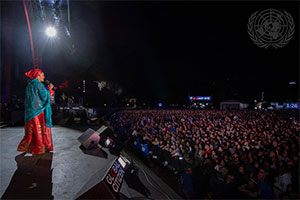 Global Citizen Festival in New York. Credit: UN Photo/Eskinder Debebe
Active citizens are committed to social change because they know that it is achievable. However, major political challenges face active citizens across the world. For example, in authoritarian regimes in Latin America where the hegemonic party has been in power for decades on end, protestors and human rights activists face enormous repression and struggle to materialize their advocacy into concrete results. The same can be said for Africans, where a shift towards elected government in recent decades has yet to translate into an effective voice in decision-making. Now, the Strengthening Citizen Demand for Good Governance, which uses evidence-based approaches – funded by DFID's Governance and Transparency Fund – seeks to raise their voices.
In 2025, the CIVICUS Monitor’s People Power Under Attack report revealed that civic freedoms are severely limited in 122 of 198 countries and territories, and only 7.2% of the global population now lives in countries where civic space is open. Through partnership with the Overseas Development Institute (ODI) and CIVICUS, IPS reporters across the continent will seek to define the extent and limits of state capability, government accountability and the responsiveness of leaders to the needs of citizens.

The Week with IPS

NEXT STOP - SDGs
Tracking global progress towards a sustainable world
Tracking global progress towards a sustainable world
