Languages
Thursday, September 24, 2026



News and Views from the Global South
Active Citizens

Social Movement Voices Fall on Deaf Ears of Governments at COP26
One element that runs through all social movement climate summits is their rejection of the official meeting of the United Nations Framework Convention on Climate Change (UNFCCC) and the low ambition of its outcomes - and the treaty's 26th Conference of the Parties (COP26) was no exception.
Combating Energy Poverty in Chile with Community Inclusion
More than 90 percent of Chile's 17.5 million people have access to electricity. But many live in energy poverty because they do not have access to hot water, have unsafe connections, houses without thermal insulation and with indoor pollution, or can't afford to pay the monthly bill.
COP26: the Heat is On, But Climate Leadership is Off, Warns UN Report
When over 100 political leaders meet in Scotland next week for the UN Climate Change Conference, the very future of our planet seems to hinge on the outcome of the summit which is scheduled to take place October 31-November 12.
COP26: Rich Nations Have Not Shown Leadership in Their Fair Share of Emission Cuts
It is well-known that all the Nationally Determined Contributions (NDCs) added together, even those that have been updated, will not help to place the world on a 1.5 degree C pathway.
We Heard Public Development Banks, but Will They Have the Guts to Deliver?
Public development banks have committed to ramp up action to tackle climate change, to protect biodiversity, to promote human rights, to align their investments with the SDGs and the Paris Agreement, and to create spaces of dialogue with civil society, farmers, indigenous peoples, and communities affected by the projects that they, as banks, finance.
COP26: Building Climate Resilience Will Require a Focus on Those Furthest Behind
As the United Nations Climate Change Conference, also known as COP26, approaches (31 October -12 November in Glasgow, Scotland), climate action is more urgent than ever. Yes, we need climate change mitigation.
We Will Never Give Up the Slavery Reparations Fight, say Caribbean Rastafarians
The Rastafarian organizations in the Caribbean are determined that the issue of slavery reparations will emerge from the eclipse of COVID-19. As the world deals with the impacts of efforts to contain the virus’ spread and regional governments tackle vaccine hesitancy and a wave of misinformation, issues not directly related to COVID-19 have had to be temporarily shelved.
Table Banking Helping Women in Kenya to Put Food on the Table
Pascaline Chemutai’s five acres of land located in the country’s breadbasket region of Rift Valley recently produced 115 bags of maize, each weighing 90 kilograms. She tells IPS that of these, 110 bags will be transported to traders in Nairobi and neighbouring Kiambu County at a negotiated price of $23 per bag.
Argentina’s Small Farming Communities Reach Consumers Online
"The biggest problem for family farmers has always been to market and sell what they produce, at a fair price," says Natalia Manini, a member of the Union of Landless Rural Workers (UST), a small farmers organisation in Argentina that has been taking steps to forge direct ties with consumers.
Rural Water Boards Play Vital Role for Salvadoran Farmers
After climbing a steep hill along winding paths, you reach a huge water tank at the top that supplies peasant farmer families who had no water and instead set up their own community project on this coastal strip in central El Salvador.
Why Do Organizations Fail to Keep Workplace Harassments in Check
“Sexual harassment is not about sexual attraction, it is about power. If an individual uses power plays to subjugate other people, when we have such dynamics going on in the workplace, what we need is a system that fights back against it, which unfortunately a lot of workplaces, they allow it to persist,”, says Adrienne Lawrence, anchor and legal analyst in an interview given to me here.
Solar Energy Revitalises Indigenous and Farming Communities in Chile
Communities in Arica y Parinacota, the region in the extreme north of Chile, are using solar energy and are being empowered by projects for shrimp and trout farming, the production of yarn from camelid wool, the production of tomatoes and cheese, and even the sale of surplus solar power to the national electric grid.
‘Proud of Being Able to Speak the Truth’: Journalist Nidhi Razdan on her Cyber Attack
Earlier in January, Indian journalist Nidhi Razdan found out she was a victim of one of the most sophisticated and elaborate cyber attacks. Razdan wrote in a piece that it was all an attempt to access her bank account details, personal data, emails, medical records, passport and access to all her devices, including computer and phone.
Olympian Turned Volunteer Keeps Traffic Running in Busy Lagos
Bassey Etim Ironbar is a rare example of an Olympian that transformed from an athlete to a volunteer who does menial jobs like sweeping the streets and clearing debris from open sewers.
Why we Need to Build Economies– not Walls– to Stop Migration
If you speak to farmers in El Salvador, many will tell you about the time they were driven to head north across Central America towards the US. The routes to the border are many, but the origins are so often the same: desperation and hope that better employment opportunities can be found elsewhere.
Water Harvesting Strengthens Food Security in Central America
At the school in El Guarumal, a remote village in eastern El Salvador, the children no longer have to walk several kilometers along winding paths to fetch water from wells; they now "harvest" it from the rain that falls on the roofs of their classrooms.
Time to End Generational Injustice with a ‘Global Blue New Deal’ to Protect Oceans
Increasingly, youth are rising up to declare that they've had enough of the cyclical exploitation of the environment that jeopardizes their own future.
Sowing Water by Restoring Ancient Ditches in the Peruvian Highlands
In the highlands near the capital of Peru, more than 3,000 metres above sea level, ageold water recovery techniques are being used to improve access to water for 1,400 families, for household consumption and for crops and livestock.
People Power: Why Mobilisations Matter Even in a Pandemic
It has been one year since the police murder of George Floyd, an outrage that resonated around the world. The killing forced people to the streets, in the USA and on every inhabited continent, to demand respect for Black lives and Black rights, proving that protest was essential even during the pandemic.
– Mining giant Rio Tinto Face Environmental, Human Rights Complaint in Papua New Guinea –
On the occasion of World Environment Day, 5 June 2021, drawing from IPS’s bank of features and opinion editorials published this year, we are re-publishing one article a day, for the next two weeks. The original article was published on January 4 2021

Myanmar: Protestors Plea for International Help as Analysts Fear Full Military Might
Myanmar activists have called on the international community for help as security forces loyal to the military continue their draconian sweep against the civil disobedience campaign that has brought the country to a standstill since the Feb. 1 coup. The pleas come as analysts, commentators and diplomats who know Myanmar fear that more bloodshed is almost inevitable.« Previous Page — Next Page »


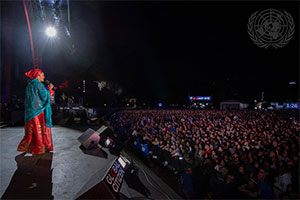 Global Citizen Festival in New York. Credit: UN Photo/Eskinder Debebe
Active citizens are committed to social change because they know that it is achievable. However, major political challenges face active citizens across the world. For example, in authoritarian regimes in Latin America where the hegemonic party has been in power for decades on end, protestors and human rights activists face enormous repression and struggle to materialize their advocacy into concrete results. The same can be said for Africans, where a shift towards elected government in recent decades has yet to translate into an effective voice in decision-making. Now, the Strengthening Citizen Demand for Good Governance, which uses evidence-based approaches – funded by DFID's Governance and Transparency Fund – seeks to raise their voices.
In 2025, the CIVICUS Monitor’s People Power Under Attack report revealed that civic freedoms are severely limited in 122 of 198 countries and territories, and only 7.2% of the global population now lives in countries where civic space is open. Through partnership with the Overseas Development Institute (ODI) and CIVICUS, IPS reporters across the continent will seek to define the extent and limits of state capability, government accountability and the responsiveness of leaders to the needs of citizens.

The Week with IPS

NEXT STOP - SDGs
Tracking global progress towards a sustainable world
Tracking global progress towards a sustainable world
