Languages
Wednesday, October 21, 2026



News and Views from the Global South
Active Citizens
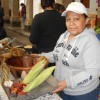
Traditional Mexican Recipes Fight the Good Fight
In a clay pot, Araceli Márquez mixes tiny Mexican freshwater fish known as charales with herbs and a sauce made of chili peppers, green tomatoes and prickly pear cactus fruit, preparing a dish called mixmole.
OPINION: Central America, Still Caught Up in the Arms Race
The recent announcement of the Nicaraguan government’s 80-million-dollar purchase of 50 Russian tanks caught the attention of the press in Latin America and caused alarm in the international community.
Prickly Pears Drive Local Development in Northern Argentina
Family farmers in the northern Argentine province of Chaco are gaining a new appreciation of the common prickly pear cactus, which is now driving a new kind of local development.
Indigenous Peoples Inclusion at United Nations Incomplete
The United Nations Indigenous Forum is one of the UN's most culturally diverse bodies yet its inclusion within the overall UN system remains limited.
Climate Change Compounds Humanitarian Crises in Global South
As the Global South works to overcome a history of weak institutions, armed conflict and poverty-driven forced exodus, key causes of its humanitarian crises, developing countries now have to also fight to keep global warming from compounding their problems.
A Latin American Humanitarian Emergency Invisible to the World
“This is a humanitarian crisis,” said Bertha Zúñiga Cáceres, referring to the generalised violence in Mexico and in Honduras and other countries of Central America, which has claimed hundreds of thousands of lives and is a product of transnational crime, but is invisible to the international community.
Justice for Berta Caceres Incomplete Without Land Rights: UN Rapporteur
The murder of Honduran Indigenous woman Berta Caceres is only too familiar to Victoria Tauli-Corpuz, the UN’s Special Rapporteur on the Rights of Indigenous Peoples.
Deadly Algal Bloom Triggers Social Uprising in Southern Chile
A ban on harvesting shellfish in Chiloé due to a severe red tide outbreak sparked a social uprising that has partially isolated thousands of local residents of the southern Chilean archipelago and revived criticism of an export model that condemns small-scale fishing communities to poverty and marginalisation.
Why Peacebuilding is Part of the Sustainable Development Agenda
We tend not to worry when things are going well. If people can take care of their daily business and send their kids to school without fear of violence, resolve disputes through a functioning justice system when the need arises, express their views both in private discussions and in public processes, feel they can truly contribute to decisions that affect their lives, and know effective institutions are in place to deliver basic services to their families and communities without interruption or the need for bribes, chances are they will be broadly content with the way their society is managed.
Mexico Needs to Improve Control of Toxic Chemicals
A recent explosion at a petrochemical plant in southeast Mexico highlighted the need to strengthen monitoring of hazardous substances, step up inspections of factories and update regulations in this country.
Is the System Broke or Broken?
Though the upcoming World Humanitarian Summit may seem timely, a debate ensues on an important question: is the world humanitarian system broke or broken?
The Family Garden Going Out of Style in Cuban Countryside
In the past, all rural homes in Cuba had gardens for putting fresh vegetables on the dinner table. The local term for these gardens is “conuco”, a word with indigenous roots that is still used in several Caribbean nations.
Grilled for a Retweet: Press Freedom in Kenya
In early January, Judith Akolo, a journalist with the Kenya Broadcasting Corporation, found herself in unfamiliar territory when she was summoned and grilled by the Directorate of Criminal Investigations for retweeting a Twitter message.
Black Colombian Activists Continue Our Struggle For Rights
While Colombia’s peace talks continue in Havana, Cuba, back home in the region of North Cauca, Black Colombians have found their cries for access to their ancestral lands met with tear-gas and rubber bullets.
Media Freedom in Africa Remains Under Attack
Imagine a world without the media, where we have no verified information about what’s going on around us. Where everything is hearsay and gossip, where there are no trusted sources of information. It would be hard to operate in a world like that: to make decisions about what to do about the things that affect our lives.
West Papuans Turn to Africa for Support in Freedom Bid
For more than half a century, the indigenous people of West Papua, located on the western side of the island of New Guinea, who are related to the Melanesians of the southwest Pacific Islands, have waged a resistance to governance by Indonesia and a relentless campaign for self-determination.
“Together, Civil Society Has Power”
When Tamara Adrián, a Venezuelan transgender opposition legislator, spoke at a panel on inclusion during the last session of the International Civil Society Week held in Bogotá, 12 Latin American women stood up and stormed out of the room.
Why we need to stand united against governments cracking down on dissent
Last month, after receiving threats for opposing a hydroelectric project, Berta Caceres, a Honduran indigenous and environmental rights campaigner, was murdered. A former winner of the Goldman Environmental Prize for her opposition to one of Central America’s biggest hydropower projects, Berta was shot dead in her own home.
Playing Ping Pong with Disability
Despite formally adopting progressive laws, such as Law Number 4, and ratifying the UN Convention on the Rights of People with Disability, Palestinian authorities still struggle to get beyond rhetoric when it comes to supporting the 7 to 11 per cent of the population that is affected by disability.
Musicians Champion LGBT Rights
In a recently released music video by a Kenyan artist, a young gay and lesbian couple hold hands on separate dates at a park in Nairobi. The progress of their love from kisses to more graphic bedroom scenes are threaded with past images of anti-gay headlines and protests mainly from Uganda and Kenya.
Abortion Saga: Morality vs Choice
Malawi considers itself ‘a god fearing nation’ so much that any act ‘out of the ordinary’ is said to be either satanic, a sin or demonic. Even a drink or a walk could be satanic in the country if you are not careful!« Previous Page — Next Page »





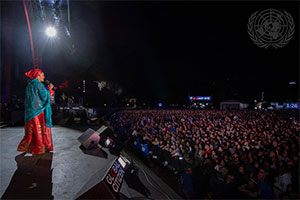 Global Citizen Festival in New York. Credit: UN Photo/Eskinder Debebe
Active citizens are committed to social change because they know that it is achievable. However, major political challenges face active citizens across the world. For example, in authoritarian regimes in Latin America where the hegemonic party has been in power for decades on end, protestors and human rights activists face enormous repression and struggle to materialize their advocacy into concrete results. The same can be said for Africans, where a shift towards elected government in recent decades has yet to translate into an effective voice in decision-making. Now, the Strengthening Citizen Demand for Good Governance, which uses evidence-based approaches – funded by DFID's Governance and Transparency Fund – seeks to raise their voices.
In 2025, the CIVICUS Monitor’s People Power Under Attack report revealed that civic freedoms are severely limited in 122 of 198 countries and territories, and only 7.2% of the global population now lives in countries where civic space is open. Through partnership with the Overseas Development Institute (ODI) and CIVICUS, IPS reporters across the continent will seek to define the extent and limits of state capability, government accountability and the responsiveness of leaders to the needs of citizens.

The Week with IPS

NEXT STOP - SDGs
Tracking global progress towards a sustainable world
Tracking global progress towards a sustainable world
