Languages
Thursday, October 22, 2026



News and Views from the Global South
Active Citizens
Organised Civil Society Increasingly Hemmed In by Global Elites
Collusion, according to the dictionary, means “secret or illegal cooperation or conspiracy, especially in order to cheat or deceive others.” That is what the world’s political and economic elites engage in, according to Danny Sriskandarajah, secretary general of the international civil society alliance CIVICUS.
Harvesting Rainwater to Weather Drought in Northeast Argentina
In a semiarid region in the northeast Argentine province of Chaco, small farmers have adopted a simple technique to ensure a steady water supply during times of drought: they harvest the rain and store it in tanks, as part of a climate change adaptation project.
Ecosystem Conservation Gives Hope to a Vulnerable Community
42 year-old Saraswati Subedi still remembers the night she almost died in a flash flood. “I heard the cries of my neighbours and ran out of the room with my two children. There was water all around and I thought we were going to die, so I started to pray,” says the mother of the three in Karki Tahara – a village by the river Harpan Khola in Nepal’s Kaski district.Female Engineers Defy the Odds
Nearly every aspect of modern life is a result of the work done by engineers; from running water to the internet, sky-scrapers to smartphone apps that people use for dating. Sadly, in Tanzania this profession attracts only a few women due to prevalent attitudes that it is a man’s job.
Saving Beira
Mozambique’s second largest city, Beira, is heading for climate change-induced disaster. Cyclones, floods, storm surges and the rising sea level are threatening to annihilate this important Indian Ocean coastal city; a city which is strategic for landlocked countries like Zimbabwe and Zambia.
Balancing Economic Potential of Marine and Social Life
When Africa’s oldest protected marine area, Tsitsikamma -- the largest in the world, incorporating 80 km of rocky coastline, bustling with marine life, much of it endangered -- was opened as a pilot for public fishing on December 15, 2015, there was a big outcry.
Women Benefit From Simple Economic Ventures
Angelina Chiziane starts her day by getting her husband ready for work in a small village in the southern province of Gaza, Mozambique, some 216 kilometers away from the capital, Maputo.
Heavy Rains Once Again Scatter the Poor in Asunción
Néstor Colman, 69, remembers the river overflowing its banks nine times in Bañado Sur, the poor neighourhood in the Paraguayan capital where he was born and has lived all his life. “A record,” he jokes.
Benefits of Backpack Biogas
Billions of dollars of aid has been pumped into Africa. Yet effective change too often remains an elusive outcome, leading to a vicious cycle: more needs, more aid but still little change. How to resolve this seemingly intractable dilemma?
Press Freedom in Peril
A single phone call from an irate security official is enough to shutdown a newspaper in Sudan. Security agents sometimes employ unorthodox methods: they storm the premises of a newspaper or a printing press and confiscate print runs in full view of employees. No reasons are provided. And there is no legal recourse.
Challenges of Polio Vaccination
Pakistan and Afghanistan, the two remaining polio-endemic countries, have joined forces to eradicate poliomyelitis by vaccinating their children in synchronised campaigns.
Quake Fear Stalks Kathmandu
Early evening, there is a play of light and shadow over Kathmandu’s famous Durbar Square. The rising monuments, damaged by the April 2015 earthquake, appear as dark silhouettes while large flash lights streak through in between them.
The PELIS Factor
Peter Wainaina’s focus is on the fresh Irish potatoes he has just harvested. He assembles them into a 90-kilogramme bag while sorting out the unmarketable ones like sliced and tiny tubes. He lives on a small plot of land in Njabini, 600 metres away from a farm in Aberdares forest, west central Kenya, where he has been growing this fast-maturing crop for the past three months.
Water Crisis in Zimbabwe
A narrow dirty trail snakes through what used to be a small dam in Mpudzi Resettlement Scheme south of the eastern border city of Mutare. And what remains of this once perennial dam is just a small puddle of mudded water; the dirty water is completely covered with thick green algae.
Are Indigenous Women Key to Sustainable Development?
"We, indigenous women want to be considered as part of the solution for sustainable development, because we have capabilities and knowledge, " said Tarcila Rivera, a Quechua journalist and activist for the rights of indigenous people in Peru, at a press conference on the Empowerment of Indigenous Women.
Corruption Threat to Pacific Island Forests
The vast rainforests of Papua New Guinea (PNG) and the Solomon Islands in the southwest Pacific Ocean are crucial for environmental sustainability, survival of indigenous peoples and the wider goal of containing climate change. But forest degradation, driven primarily by excessive commercial logging, most of which is illegal, is a perpetual threat.
Rural Costa Rican Families Flourish in the Shade
Before they got involved in farming, Luis Diego Murillo and Xinia Solano paid their bills and put food on their table with Luis’s salary as a foreman on construction sites, an unstable job that kept him on the move.
Tribute to a Slain Environment Activist
Berta Isabel Cáceres Flores, was in her early 20s when she co-founded the Council of Popular and Indigenous Organisations of Honduras (Cophin), a group that campaigned for the rights of indigenous communities in the Central American nation.
Clean Clothes – Fashion Free of Slave Labour in Argentina
In Argentina, there are now 20 brand names that guarantee that their garments are produced by workers in decent working conditions, thanks to the Clean Clothes network, aimed at eradicating slave labour in the garment industry, which illegally employs some 30,000 people in sweatshops around the country.
Enriching Education in Bangladesh
About a year ago, seven year-old Afroza Khatun dropped out of school as her mother could not continue supervising her homework. The interruption in her grade II lessons was soon noticed by a teacher of an information education centre known as ENRICH, a state-funded programme which aims at supporting children who drop out to continue their education from the primary level (up to grade II).
Repressive NGO Act
Nearly two weeks after controversially winning a fifth term, it has emerged that Uganda’s President Yoweri Museveni has signed another repressive law which restricts the operations of thousands of NGOs working in the country.« Previous Page — Next Page »





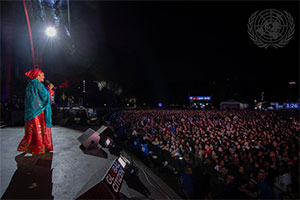 Global Citizen Festival in New York. Credit: UN Photo/Eskinder Debebe
Active citizens are committed to social change because they know that it is achievable. However, major political challenges face active citizens across the world. For example, in authoritarian regimes in Latin America where the hegemonic party has been in power for decades on end, protestors and human rights activists face enormous repression and struggle to materialize their advocacy into concrete results. The same can be said for Africans, where a shift towards elected government in recent decades has yet to translate into an effective voice in decision-making. Now, the Strengthening Citizen Demand for Good Governance, which uses evidence-based approaches – funded by DFID's Governance and Transparency Fund – seeks to raise their voices.
In 2025, the CIVICUS Monitor’s People Power Under Attack report revealed that civic freedoms are severely limited in 122 of 198 countries and territories, and only 7.2% of the global population now lives in countries where civic space is open. Through partnership with the Overseas Development Institute (ODI) and CIVICUS, IPS reporters across the continent will seek to define the extent and limits of state capability, government accountability and the responsiveness of leaders to the needs of citizens.

The Week with IPS

NEXT STOP - SDGs
Tracking global progress towards a sustainable world
Tracking global progress towards a sustainable world
