Languages
Monday, September 21, 2026



News and Views from the Global South
Active Citizens

U.S. Urged to Ramp up Aid for Agent Orange Clean-Up Efforts in Vietnam
A key senator and a D.C.-based think tank are calling for Washington to step up its aid in cleaning up toxic herbicides sprayed by the United States in Vietnam during the war that ended 40 years ago.
Rome March Celebrates Pope’s Call for Urgent Climate Action
People of faith, civil society groups, and communities affected by climate change marched together in Rome Sunday Jun. 28 to express gratitude to Pope Francis for the release of his Laudato Si encyclical on the environment, and call for bolder climate action by world leaders.
Ghosts Of War Give Way to Development in Sri Lanka
It is an oasis from the scorching heat outside. The three-storey, centrally air-conditioned Cargills Square, a major mall in Sri Lanka’s northern Jaffna town, is the latest hangout spot in the former warzone, where everyone from teenagers to families to off-duty military officers converge.
Fracking Expands Under the Radar on Mexican Lands
“People don’t know what ‘fracking’ is and there is little concern about the issue because it’s not visible yet,” said Gabino Vicente, a delegate of one of the municipalities in southern Mexico where exploration for unconventional gas is forging ahead.Billions Pledged for Nepal Reconstruction – But Still No Debt Relief
A major donor conference in Nepal’s capital, Kathmandu, came to a close on Jun. 25 with foreign governments and aid agencies pledging three billion dollars in post-reconstruction funds to the struggling South Asian nation.
Helping People with Disabilities Become Agents of Change
Participation, political and economic empowerment, inclusion, accessible technology and infrastructure as well as indicators for meaningful implementation are among the key issues persons with disabilities want to see reflected in the Sustainable Development Goals (SDGs).
Journalists Pay the Price in Egypt’s Crackdown on Dissent
The Egyptian government is holding a record number of journalists in jail, a press freedom group said Thursday, despite promises to improve media freedoms in the country.
Heat Wave Picking Off Pakistan’s Urban Poor
Over 950 people have perished in just five days. The morgues, already filled to capacity, are piling up with bodies, and in over-crowded hospitals the threat of further deaths hangs in the air.
The U.N. at 70: United Nations Disappoints on Its 70th Anniversary – Part Two
While member states, weakened in the neoliberal era, have pulled back from the U.N. and cut its budgets, a charity mentality has arisen at the world body. Corporations and the mega-rich have flocked to take advantage of the opportunity. They have looked for a quietly commanding role in the organisation’s political process and hoped to shape the institution to their own priorities.Women’s Groups Say Gender Equality is a Must for Sustainable Development
On the eve of negotiations on the political declaration for the United Nations Summit to adopt the Post-2015 Development Agenda, the Women’s Major Group (WMG) calls on governments to define a transformative agenda to ensure just, sustainable and rights-based development.
Costa Rican Women Try to Pull Legal Therapeutic Abortion Out of Limbo
The lack of clear regulations and guidelines on therapeutic abortion in Costa Rica means women depend on the interpretation of doctors with regard to the circumstances under which the procedure can be legally practiced.
Bougainville Election Intensifies Hopes for Independence
A referendum on independence within the next five years dominated campaigning in the recent general election held in Bougainville, an autonomous region of 300,000 people in the east of Papua New Guinea (PNG), which emerged from a decade-long civil war 15 years ago.
On Kenya’s Coast, a Struggle for the Sacred
Travel into the heart of Kenya’s southern Coast Province, nearly 500 km from the capital city of Nairobi, and you will come across one of the planet’s most curious World Heritage Sites: the remains of several fortified villages, revered by the indigenous Mijikenda people as the sacred abodes of their ancestors.
Smart Phones New Tool to Capture Human Rights Violations
The widespread use of digital technology – including satellite imagery, body cameras and smart phones – is fast becoming a new tool in monitoring and capturing human rights violations worldwide.
Young People Lend a Hand to Trinidad’s Ailing Watersheds
Starting in 1999, the Water and Sewerage Authority (WASA) of Trinidad and Tobago began a 10-year effort to map the country’s water quality. They started to notice a worrying trend.
Critics of World Bank-Funded Projects in the Line of Fire
For an entire month beginning in February 2015, a group of between 40 and 50 residents of the Durgapur Village in the northern Indian state of Uttarakhand would gather at the site of a hydroelectric power project being carried out by the state-owned Tehri Hydro Development Corporation (THDC).
U.N. Names Winners of First Nelson Mandela Prize
The winners of the first-ever United Nations Nelson Rolihlahla Mandela Prize were announced Monday by General Assembly President Sam Kutesa, 25 years to the day that Mandela addressed the U.N. General Assembly to denounce apartheid in his home country of South Africa.
Democracy on the Retreat in Over 96 of the 193 U.N. Member States, Says New Study
Democracy is on the retreat and authoritarianism is on the rise in more than 96 of the U.N.’s 193 member states, according to a new report released here.
Opinion: Pope Francis’ Timely Call to Action on Climate Change
On June 18, Pope Francis issued Laudato Si, the first ever encyclical about ecology, which promises to be a highly influential document for years to come. The encyclical, which is the most authoritative teaching document a Pope can issue, delivered a strong message addressing the moral dimension of the severe ecological crisis we have caused with our “throwaway culture” and general disregard for our common home, the Earth.International Cooperation is Key to Effective Public Services
“Civil service excellence can only be achieved if countries have access to an international forum where they can exchange innovative approaches and initiatives,” Patrick Keuleers, Director of the Governance and Peacebuilding Team of the United Nations Development Programme (UNDP), said Friday.
Take Good News on Afghanistan’s Reconstruction With a ‘Grain of Salt’
Since 2002, a year after it invaded Afghanistan, the United States has poured over 100 billion dollars into developing and rebuilding this country of just over 30 million people. This sum is in addition to the trillions spent on U.S. military operations, to say nothing of the deaths of 2,000 service personnel in the space of a single decade.« Previous Page — Next Page »


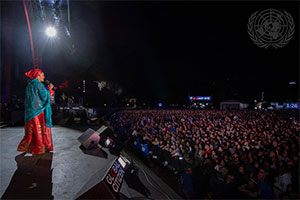 Global Citizen Festival in New York. Credit: UN Photo/Eskinder Debebe
Active citizens are committed to social change because they know that it is achievable. However, major political challenges face active citizens across the world. For example, in authoritarian regimes in Latin America where the hegemonic party has been in power for decades on end, protestors and human rights activists face enormous repression and struggle to materialize their advocacy into concrete results. The same can be said for Africans, where a shift towards elected government in recent decades has yet to translate into an effective voice in decision-making. Now, the Strengthening Citizen Demand for Good Governance, which uses evidence-based approaches – funded by DFID's Governance and Transparency Fund – seeks to raise their voices.
In 2025, the CIVICUS Monitor’s People Power Under Attack report revealed that civic freedoms are severely limited in 122 of 198 countries and territories, and only 7.2% of the global population now lives in countries where civic space is open. Through partnership with the Overseas Development Institute (ODI) and CIVICUS, IPS reporters across the continent will seek to define the extent and limits of state capability, government accountability and the responsiveness of leaders to the needs of citizens.

The Week with IPS

NEXT STOP - SDGs
Tracking global progress towards a sustainable world
Tracking global progress towards a sustainable world
