Languages
Sunday, September 20, 2026



News and Views from the Global South
Conferences
The Silent War Before COP30: How Corporations Are Weaponising the Law to Muzzle Climate Defenders
As the world prepares for the next COP30 summit, a quieter battle is raging in courtrooms. Strategic Lawsuits Against Public Participation (SLAPPs) are the fossil-fuel industry’s new favourite weapon, turning justice systems into instruments of intimidation.
Turning Indigenous Territories From ‘Sacrifice’ Zones to Thriving Forest Ecosystems
A report by the Global Alliance of Territorial Communities (GATC) and Earth Insight paints a stark picture of how extractive industries, deforestation, and climate change are converging to endanger the world’s last intact tropical forests and the Indigenous Peoples who protect them.
Power-Sharing —Boomers and Gen Z Face Off at the ICSW
The message is clear: today’s youth are not “wishy-washy.” They are not just the future—they are the present, full partners in shaping it, and “power-sharing” is the new mantra. The veterans of activism are being reminded not merely to listen but to hear and to leave their egos at the door.
Rajagopal PV’s Blueprint for Another World: Peace
"If nations can have defense ministries, why not peace ministries?" asks Rajagopal PV, the soft-spoken yet formidable founder of Ekta Parishad. "We are told to see issues through a gender lens—why not a peace lens? Why can’t we imagine a business model rooted in non-violence or an education system that teaches peace?”
Challenging Elites, Defending Democracy: Oxfam’s Amitabh Behar Speaks Out
Speaking to IPS on the sidelines of the International Civil Society Week in Bangkok (November 1–5), Amitabh Behar, Executive Director of Oxfam International and a passionate human rights advocate, highlighted his concerns about rising inequality, growing authoritarianism, and the misuse of AI and surveillance. Yet, he expressed optimism that, even as civic spaces shrink, young people across Asia are driving meaningful change. He also shared his vision of a just society—one where power is shared, and grassroots movements lead the way.
As Civil Society Is Silenced, Corruption and Inequality Rise
From the streets of Bangkok to power corridors in Washington, the civil society space for dissent is fast shrinking. Authoritarian regimes are silencing opposition but indirectly fueling corruption and widening inequality, according to a leading global civil society alliance.
From Slogans to Systems: Five Practical Steps for Turning Social Development Commitments into Action at Doha and Beyond
Thirty years ago, world leaders gathered in Copenhagen and made a promise: people would be at the center of development. This November, Heads of State and Government will meet again in Doha, Qatar, for the Second World Summit for Social Development or WSSD2.
Global Forest Loss: Far Off Track From Global Commitments
The Forest Declaration Assessment 2025 warns that global forest loss remains alarmingly high, with little sign of improvement.
They Have Known Nothing but War—The Plight of Syria’s Out-of-School Children
The war has deprived thousands of Syrian children of their right to education, especially displaced children in makeshift camps. Amidst difficult economic conditions and the inability of many families to afford educational costs, the future of these children is under threat.
Wealthy Nations Urged to Curb Climate Finance Debt For Developing Countries
In recent years, international climate financing has declined sharply, leaving billions of people in developing nations increasingly vulnerable to natural disasters and unable to adapt effectively. With major cuts in foreign aid, these communities are expected to face the brunt of the climate crisis, while wealthier nations continue to reap economic benefits.
Beijing+30: A Culmination of International, Intergenerational Dialogue
Thirty years since the UN Fourth World Conference on Women in Beijing, the resolve that defined and united the world toward a global agenda for gender equality make it just as relevant in 2025.
Climate Finance Will Be the First Casualty of Rising Militarism: Ali T. Sheikh Warns Ahead of COP30
As the COP30 approaches amid darkening geopolitical clouds—marked by rising rightwing extremism, corporate backtracking and rising militarism—Ali T. Sheikh, Pakistan’s leading expert on sustainable development and climate change, views the world’s largest diplomatic gathering with a mix of apprehension and caution.
Loss and Damage at COP30: Indigenous Leaders Challenge Top-Down Finance Models
As climate-induced disasters continue to devastate the Global South, nations are steadily mounting pressure at the United Nations for wealthier countries to deliver on long-promised climate reparations through the Loss and Damage Fund. For Indigenous peoples, whose territories are often the most ecologically intact yet most damaged by climate change, these negotiations define survival, sovereignty and recognition as rights-holders in global climate governance.
AfDB Commits 11 Billion Dollars To Support Early Warning Systems, Food Security in Rural Africa
As increasingly frequent droughts and devastating floods are affecting agricultural productivity, leaving millions of people food insecure in Africa amid a lack of climate finance, the African Development Bank (AfDB) has committed USD 11 billion to support various climate-resilient and infrastructure projects in rural areas.
Inside Africa’s Big Bet on Youth to Feed the Continent and Who’s Actually Getting Funded
Winnie Wambui leans forward on the panel stage, microphone in hand, scanning the room until she spots a raised hand.
Banks Embed Climate Risk, Gender and Sustainability in Finance Products
As climate shocks intensify across East Africa, from failed rains in Kenya’s arid north to devastating floods in Tanzania’s coastal belt, the region’s banks are emerging as unlikely but powerful players in the resilience race.
Aid Funding Crisis Means Parliamentarians’ Visionary Leadership Even More Crucial
As funding for sexual and reproductive health rights was on a “cliff edge,” parliamentarians now needed to play a “visionary” leadership role because “financing strong, resilient health systems for all their people rests with governments,” said Dr. Alvaro Bermejo, Director General of the International Planned Parenthood Federation (IPPF).
Fiji’s Truth and Reconciliation Commission Aims To Restore Trust and Peace After Decades of Political Crises
Fiji, a nation located west of Tonga in the central Pacific, is renowned for its natural beauty and beach resorts. But for 38 years it has endured a political rollercoaster of instability with four armed coups that overturned democratically elected governments and eroded human rights.
Bending the Curve: Overhaul Global Food Systems to Avert Worsening Land Crisis
Current rates of land degradation pose a major environmental and socioeconomic threat, driving climate change, biodiversity loss, and social crises. Food production to feed more than 8 billion people is the dominant land use on Earth. Yet, this industrial-scale enterprise comes with a heavy environmental toll.
UN Chief Hails Turkmenistan’s Quiet Diplomacy as Launchpad for Landlocked Solidarity
In the glass-panelled hallway straddling Buildings 2 and 3 at the Awaza Congress Centre, two smartly dressed young Turkmens stood behind an ornate national pavilion—anxious, alert, and surprisingly eloquent.
Equal Footing: Building Pathways for Landlocked Developing Countries to Participate in Global Economy
Heads of State, ministers, investors and grassroots leaders are gathered in Awaza on Turkmenistan’s Caspian coast for a once-in-a-decade UN conference aimed at rewiring the global system in support of 32 landlocked developing countries whose economies are often ‘locked out’ of opportunity due to their lack of access to the sea.« Previous Page — Next Page »


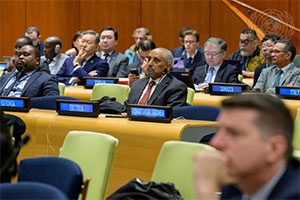 General Assembly Meets to Hear Briefing on UN80 Initiative. Credit: UN Photo/Manuel Elías
Global development conferences are continuing to produce critical frameworks for South-South cooperation and multilateral reform. In January of 2024, the 3rd Global South Nexus (GSN) International Conference was held in Odisha, India, with its theme being “Creating Responsible Professionals for Advancing SDGs: Inputs from Global North and South.” The 2025 UN SDG Report provided a midpoint assessment of the 2030 Agenda, with only 35% of targets on track and 18% having reversed. The 2025 UN Climate Change Conference (COP30) in Belém, Brazil, agreed to mobilize $1.3 trillion annually for climate action by 2035, operationalize the loss and damage fund, triple adaptation finance, and launched the Belém Mission to 1.5°C. In 2025, the Partnership for Economic Policy (PEP) convened its annual Policy Conference in Nairobi, Kenya, addressing the issue of “Financing and Inclusivity in Green Energy Transition in the Global South.” As the Global South advocates increasingly for a South-South framework alongside North-South cooperation, international conferences on sustainability aim to bridge economic and social divides between developed and developing countries in achieving the UN SDGs. Furthermore, to mark the UN’s 80th anniversary, the UN80 Initiative was launched to reshape how the UN system works so that every mandate, dollar, and decision creates greater impact for the global system.

The Week with IPS

NEXT STOP - SDGs
Tracking global progress towards a sustainable world
Tracking global progress towards a sustainable world
