Languages
Tuesday, November 17, 2026



News and Views from the Global South
Civil Society

Shifting Sands: How Rural Women in India Took Mining into their Own Hands
Thirty-seven-year-old Kode Sujatha stands in front of a hut with a palm-thatched roof, surrounded by a group of men shouting angrily and jostling one another for a spot at the front of the crowd.
U.S. Provides Cover for Use of Banned Weapons in Yemen
The United States is providing a thinly-veiled cover virtually legitimising the use of cluster bombs – banned by an international convention – by Saudi Arabia and its allies in their heavy fighting against Houthi rebels in Yemen.
Opinion: Mexico’s Gruesome War Against Migrants
“Pray for me.” Those are the last words Eva Nohemi Hernández Murillo told her mother, Elida Yolanda, through a patchy phone line on the evening of Aug. 22, 2010.
The Future Tastes Like Chocolate for Rural Salvadoran Women
Idalia Ramón and 10 other rural Salvadoran women take portions of the freshly ground chocolate paste, weigh it, and make chocolates in the shapes of stars, rectangles or bells before packaging them for sale.
Global Web Movements Lift Democratic Decision-Making to a New Level
In recent years, online activism platforms have multiplied to the degree that they are starting to have a significant real world impact in areas like environmental protection, human rights and public policy.
Islamic Declaration Turns Up Heat Ahead of Paris Climate Talks
Following in the footsteps of Pope Francis, who has taken a vocal stance on climate change, Muslim leaders and scholars from 20 countries issued a joint declaration Tuesday underlining the severity of the problem and urging governments to commit to 100 percent renewable energy or a zero emissions strategy.
Native Protest Camp in Argentine Capital Fights for Land and Visibility
The indigenous camp installed six months ago in the Argentine capital is virtually invisible to passersby who drive or walk quickly around it. The protesters are demanding the return of their land in the northeastern province of Formosa, which has not been fully demarcated and is caught in a web of conflicting economic interests.
Time to Work Out a Plan C for Greece
Just over a month ago, Greek citizens were asked to go to the polls for a referendum that posed the country with an unprecedented existential dilemma and challenged the EU with the possibility of its collapse.
Egypt’s Terror Law Violates “Fundamental Freedoms”
Egyptian authorities are already holding a record number of journalists behind bars, and a draconian new anti-terror law signed by President Abdel Fattah al-Sisi on Sunday will further broaden the crackdown on dissent, press freedom groups warn.
Latin America Should Lead in Protecting the Planet’s Oceans
Latin America should assume a position of global leadership by adopting effective measures to protect the oceans, which are threatened by illegal fishing, the impacts of climate change, and pollution caused by acidification and plastic waste.
Kashmir: Where a Pilgrimage Threatens a Delicate Ecosystem
As he struggled to find a section of the stream clean enough to rinse off his muddy shoes, Mohan Kumar, a Hindu pilgrim on his way to the holy Amarnath shrine in Indian-administered Kashmir, gazed with despair over the filth that lay thick on the landscape.
The U.N. at 70: Leading the Global Agenda on Women’s Rights and Gender Equality – Part Two
The efforts of the United Nations and the global women’s movement to promote the women’s rights agenda and make it a top international priority saw its culmination in the creation of U.N. Women, by the General Assembly in 2010.
Nuclear Deal Could Offer Glimmer of Hope for Jailed Journalist in Iran
As Iranian-American journalist Jason Rezaian awaits his verdict, human rights advocates and press freedom groups continue to condemn the trial and call for his immediate release.
Clan Wars Increase Displacement, Hinder Development in Papua New Guinea
The charred foundations are all that is left of the homes that made up Kenemote village in the mountainous Eastern Highlands Province of Papua New Guinea in the southwest Pacific Islands.
The U.N. at 70: Leading the Global Agenda on Women’s Rights and Gender Equality – Part One
If there is any idea and cause for which the United Nations has been an indispensable engine of progress globally it is the cause of ending all forms of “discrimination and violence against women and girls, ensuring the realization of their equal rights and advancing their political, economic and social empowerment.
Zimbabwe’s Forest Carbon Programme Not All It Seems
The efficacy of attempts to sustainably manage forests and conserve and enhance forest carbon stocks in Zimbabwe is increasingly coming under scrutiny as new research warns that the politics of access and control over forests and their carbon is challenging conventional understanding.
New Label Defends Family Farming in Argentina
It’s pouring rain in the capital of Argentina, but customers haven’t stayed away from the Bonpland Solidarity Economy Market, where family farmers sell their produce. The government has now decided to give them a label to identify and strengthen this important segment of the economy: small farmers.
Tiny Island Nation Pleads for Global Moratorium on New Coal Mines
The tiny island of Kiribati in the Central Pacific, with a population of about 103,000, has long been identified as one of the U.N. member states threatened with physical extinction due to sea-level rise triggered largely by climate change.
HRW to Honour Six Human Rights Defenders
Governments around the world are obliged to promote and protect all human rights and fundamental freedoms, regardless of their political, economic and cultural systems, according to the Vienna World Conference on Human Rights. But reality is far removed from international covenants.Impressive Relief Effort Alleviating Hardship in Flood-Affected Myanmar
With the rainy season still far from over, flood-affected communities in the Sagaing Region and other parts of northern and western Myanmar are preparing for more hardships, while the government continues what the United Nations has called an “incredible” relief effort.
U.N. to Unleash “Power of Education” to Fight Intolerance, Racism
The United Nations is planning to launch a global campaign against the spread of intolerance, extremism, racism and xenophobia -- largely by harnessing the talents of the younger generation.« Previous Page — Next Page »


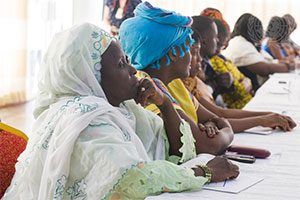 Representatives of Civil Society, Sierra Leone. Credit: UN Photo/Eskinder Debebe
Civil society faces mounting threats worldwide, even as it remains essential for democratic accountability, especially in countries struggling with economic instability and social inequality. However, at the same time, nations with weak democratic governance structures also systemically suppress the power of civil society. Human rights activists across the Global South frequently challenge issues such as political persecution and gender oppression, but in return face state-sanctioned punishment for their advocacy. Imprisonment and exile are common mechanisms of punishment that seek to erode the strength of civil society. The 2026 World Press Freedom Index has reached its lowest level in 25 years, with more than half of the world’s countries now falling into the "difficult" or “very serious” category for press freedom. IPS seeks to highlight the work of civil society across the Global South as well as the challenges that they face.
Updated by Yilan Batista and Shuli Wong August 2026

The Week with IPS

NEXT STOP - SDGs
Tracking global progress towards a sustainable world
Tracking global progress towards a sustainable world
