Languages
Monday, October 19, 2026



News and Views from the Global South
Aid

Threat of Famine Looms in Yemen
Millions of Yemenis could soon face widespread famine if no action is taken to improve food access through humanitarian or trade means, an early warning system has said.
Food Insecurity: An Agent for Violent Conflict
Up to two billion people live in countries affected by violence, conflict and fragility. Often, such political instability goes hand in hand with food insecurity. “Conflicts have pushed over 56 million people either into crisis or emergency levels of food insecurity”, Kimberly Flowers, Director of the Global Food Security Project, said at this years’ John McGovern Lecture held at the Food and Agriculture Organization of the United Nations (FAO). The number continues to grow with the escalation of conflicts and violence in countries like Syria, Yemen or South Sudan.
Resilient People & Institutions: Ecuador’s Post-Earthquake Challenge
No one is really prepared for an emergency until they’ve had to live through one. And the 16 April earthquake in Ecuador put us to the test.
Ending AIDS Needs Both Prevention and a Cure
Eighteen million people, just slightly under half of the people living with HIV and AIDS globally, are now taking life-saving medication, but global efforts to end the disease still largely depend on prevention.
“Bonn Has Become an Insider Tip on the International Stage”
With around 320,000 inhabitants on 141 square kilometres, no other relatively small city has played such a historically critical role like the City of Bonn.
Kenya’s Youth Unemployment Challenge Presents Opportunities
Consider this paradox. Every year 1 million young people join the job market in Kenya, yet Kenya has the largest number of jobless youth in East Africa. As the government puts in place measures for addressing the issue of high youth unemployment and poverty, The private sector needs to join forces to sustainably grow its business and markets. Businesses and the societies that they operate in are symbiotic and it is now an established maxim that business cannot succeed in societies that fail.
Options Lacking to Help Developing Countries Avoid Debt Crises
Despite many developing countries facing a very real risk of falling into debt crisis - the current options available to assist countries to manage their debts are surprisingly lacking.
Beyond Calais: A Perspective on Migration, Agriculture and Rural Development
Migration is part of the process of development. It is not a problem in itself, and could, in fact, offer a solution to a number of matters. Migrants can make a positive and profound contribution to the economic and social development of their countries of origin, transit and destination alike. To quote the New York Declaration, adopted at the UN Summit on Refugees and Migrants on 19 September, “migrants can help to respond to demographic trends, labour shortages and other challenges in host societies, and add fresh skills and dynamism to the latter’s economies”.
President of UNGA Disillusioned by Unsustainable Development
Development should be about more than building roads or buying air conditioners, the President of the UN General Assembly, Peter Thomson told IPS in a recent interview.
Int’l Effort to Help Ethiopia Shoulder Its Refugee Burden
A concerned-looking group of refugees gather around a young woman grimacing and holding her stomach, squatting with her back against a tree. But this is no refugee camp, rather the Jesuit Refugee Service (JRS) compound just off a busy main road leading to Sidist Kilo roundabout in the Ethiopian capital.
Learning from Past Mistakes: Rebuilding Haiti After Hurricane Matthew
As Haiti reels from another disaster once again, many are questioning the humanitarian system and looking for long-term solutions with Haitians at the heart of response.
Wage and Fiscal Policies for Economic Recovery
The new US census data released in late September show that 3.5 million people in the US climbed out of poverty, as the tepid economic recovery continues. Employers are finally creating more jobs and paying higher wages than seven years after the Great Recession started following the 2008 financial crisis.
The UN’s Blind Spot for Conflict Prevention
As the world struggles to respond to conflicts and the people fleeing them, UN insiders are also struggling to advance a ‘shift in mindset’ to help prevent these crises from happening in the first place.
Pensions for All
October 1st is the International Day of Older Persons. Just another day? Perhaps, but it should remind us that the world’s population is ageing, brought about by the combined effects of declining mortality and fertility rates and longer longevity. By mid-century, one out of five people will be over 65 compared to over one in ten now.
Providing Practical Support for UN Projects
From electrifying hospitals in Somalia to providing waste management services in Sri Lanka, the UN Office for Project Services works in over 80 countries to provide practical support to help meet the UN’s 17 Sustainable Development Goals.
Ending Lingering Hunger in a World of Plenty
With malnutrition continuing to afflict one in nine people globally, the UN has appointed 29 global leaders to help tackle the problem head on.
Global South Address Sustainable Development Challenges
On Friday, a group of 134 developing nations, known as the Group of 77 (G77), came together for a meeting to address challenges and solutions in achieving sustainable development. In attendance were G-77 Foreign Ministers, the President of the General Assembly, the UN Secretary-General and other UN senior officials.The Right to Development at 30 Years
It’s had a very useful if sometimes controversial past and it will have great relevance for many more years ahead. That’s the sense one has about the Declaration on the Right to Development as it is commemorated 30 years after its adoption by the United Nations General Assembly in 1986.Caribbean: Rethinking Progress in Sustainable Development Era
Caribbean countries make a special case for development. The high and increasing exposure to hazards, combined with very open and trade-dependent economies with limited diversification and competitiveness portray a structurally and environmentally vulnerable region, composed, in the most part, of middle income countries.
Building Bridges: Sheikh Mohamed bin Zayed of the Emirates at the Vatican
As the rise of religious racism and Islamophobia sweeps across Europe, the United Arab Emirates (U.A.E) is increasing their emphasis on the message for peaceful tolerance across all nations.
Rich Countries Should Take Development Goals Seriously Too
The UN’s new Sustainable Development Goals apply to all 193 UN member states, yet one year in some say that rich countries aren’t taking their critical role quite as seriously as they should be.« Previous Page — Next Page »





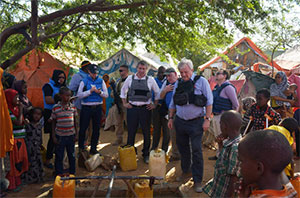 UN Emergency Relief Coordinator Visits Somalia. Credit: UN Photo/Tobin Jones
In recent years, conflicts have broken out across the world with no sign of slowing down or stopping. In times like this, millions of people globally are in dire need of humanitarian aid. Famine, warfare, natural disasters, and economic decline plague a host of nations, including Palestine, Sudan, Chad, Lebanon, and Haiti, to name a few. Humanitarian aid provides millions of people with critical services including healthcare, food, clean drinking water, psychosocial support, housing, and access to education. UN agencies such as the UNDP, UNICEF, the World Food Programme (WFP), UNHCR, UNRWA, and UNEP work with the UN Office for the Coordination of Humanitarian Aid (OCHA) and local organizations to come up with the best possible strategies to support affected communities. At the same time, humanitarian aid and those working on the frontlines are consistently threatened by both actors directly involved in conflict as well as those who are meant to contribute to the international humanitarian regime at large. The near-collapse of United States international aid structures in 2025, including the termination of 83% of USAID’s 6,300 global initiatives, has left millions of people without access to vital humanitarian assistance. 98 million people in 2025, only 65% of people targeted for humanitarian assistance, received the help they needed. In contrast, 123 million people received some form of humanitarian assistance in 2024, and OCHA’s 2026 Global Humanitarian Overview estimates that 239 million people are in need of assistance in 2026. IPS is well-positioned to discuss current initiatives to provide aid and relief through in-depth reporting and opinion content.

The Week with IPS

NEXT STOP - SDGs
Tracking global progress towards a sustainable world
Tracking global progress towards a sustainable world
