Languages
Wednesday, September 9, 2026



News and Views from the Global South
Education

Social Distance, Science and Fantasy
In these times of COVID isolation, social distance get on the nerves of several of us and the effects may be long-lasting, even endemic. Many schoolchildren have interacted and still meet with their teachers through computer networks, while the same phenomenon applies to their contact with others. Technical devices are with an ever-increasing scope becoming an integral part of all communication, teaching, and entertainment, in short – of social interaction. When it comes to education, given all the poor and even harmful educators we are forced to encounter during our lifetime, mechanization of education might be perceived as a step forward. Nevertheless, too much dependence on the internet might undoubtedly have its pitfalls; contributing to an abstraction of our existence where real adventures and life-changing encounters with other human beings become all the rarer. The world may be demystified, losing its wonder and magic.
Act to Save Children Living Precarious Lives in Cameroon’s Forgotten and Neglected Conflict
Education is under attack in Cameroon. As one of the most complex humanitarian crises in the world unfolds, Education Cannot Wait’s director Yasmine Sherif and the Secretary-General of the Norwegian Refugee Council, Jan Egeland, say the children are pawns for grown men in a political conflict.
Partnering with Persons with Disabilities Toward an Inclusive, Accessible and Sustainable Post-COVID-19 World
As the world observes the International Day of Persons with Disabilities today, we honour the leadership of persons with disabilities and their tireless efforts to build a more inclusive, accessible and sustainable world. At the same time, we resolve to work harder to ensure a society that is open and accommodating of all.
Clean Energy Alone Won’t Uplift Impoverished Nations — We Must Invest in People
Last month, at the COP 26 climate conference in Glasgow, a consortium of philanthropies, led by The Rockefeller Foundation, announced a massive program to fund renewable electricity projects for impoverished people in developing countries.
How to Tackle the Femicide Epidemic
Since the start of the Covid-19 pandemic, the increase in domestic violence rates has led the United Nations to declare a ‘shadow pandemic’ of gender-based violence. In the most brutal cases, the violence has led to murder – or ‘femicide’, as the World Health Organisation calls the killing of women specifically because of their gender.
School Meals Coalition Hopes to Provide a Meal to Every Child
Meals at schools not only give each child a nutritious meal but increase enrolments, among other benefits.
Gender, Education and Drop Outs
While COVID 19 is keeping the world and news media in its constant grip and national politics often come to the forefront, it might be easy to forget urgent and nevertheless related matters. One is how global education has suffered and how children and youngsters have been forced to cope with a different reality. This aspect like so many other of human existence is gendered and while addressing education it is relevant to talk about changing gender roles as well.
Ongoing Pandemic Push Africa’s Children Out of School
Kenya’s secondary schools’ administration has been in the eye of a storm since schools reopened in October 2021. Since then, students have set on fire 35 schools and counting, forcing the government to announce an unscheduled break from school – ahead of the planned December 23 closing.
Children Address Unequal Access to Education During Pandemic
In the whirl of effort nations are making to combat COVID-19, the powerful role that children and young people can play in overcoming the harmful effects of school closures is too easily overlooked.
Push for Civil Registration Set to Hit Key Milestone in Asian and Pacific Countries
Most countries in the Asia-Pacific region are on track to reach universal birth registration by 2030: an incredible achievement and a significant milestone in realizing human rights and equality. However, as the COVID-19 pandemic has exposed, many weaknesses remain in official recording systems, creating gaps in knowledge about the population and affecting how authorities respond to crises and reach those in greatest need.
Education Cannot Wait Interviews Patricia Danzi, Director General of the Swiss Agency for Development and Cooperation
Patricia Danzi was appointed Director General of the Swiss Agency for Development and Cooperation (SDC) in May 2020. For nearly three decades, she has dedicated her career to serving the world’s vulnerable populations.
Education Cannot Wait Investments Change Lives for Children, Including At-Risk Girls, Children with Disabilities and Teachers in South Sudan
Ayom Wol sits under a tree in South Sudan in the scorching midday sun. He is a newly-trained teacher, preparing for tomorrow’s lessons. His school principal says he has to prepare while at school because there is no electricity at home.
As a Humanitarian Crisis Engulfs Afghanistan, Education Cannot Wait Makes Urgent Appeal for Access to Quality Learning for All Children
After leading a landmark, first-ever all-women mission to Afghanistan last week, Yasmine Sherif, Director of Education Cannot Wait, the United Nations global fund for education in emergencies and protracted crises, says that schools must reopen for all children and that girls, in particular, must be able to return to secondary school classrooms.
Education Cannot Wait Calls For Urgent Funding To Fulfill The Right To Education Of All Children And Youth In Afghanistan
Immediately following the first all-women UN mission to Afghanistan since takeover by the de facto authorities, Yasmine Sherif, Director of Education Cannot Wait - the United Nations global fund for education in emergencies and protracted crises - appealed to donors to significantly increase financial support for a robust collective humanitarian-development nexus response. This includes urgent scaled up funding to UN agencies and NGO partners delivering life-saving education to vulnerable children and adolescents on the ground.
Education Cannot Wait Urges Urgent Action for World’s Biggest Humanitarian Crisis in Afghanistan
Education Cannot Wait Director Yasmine Sherif urged the world to support their efforts to provide education to children living in Afghanistan – in what she called the “biggest humanitarian crisis” on earth.
Egypt Must End State Oppression of Women and Girls
The fate of Egyptian women and girls delicately hangs in the balance as the country continues to have one of the worst records in the world for gender equality. With oppression often state-sanctioned, Egyptian women face a daily struggle against sexual harassment and other violations of their basic human rights, including institutionalised violence.
Bringing Quality Education to Syria’s Most Vulnerable, Crisis-Impacted Children – Their Education Cannot Wait
In war-torn Syria, the support of Education Cannot Wait (ECW) – the United Nations global fund for education in emergencies and protracted crises – is bringing positive, life-changing educational opportunities tailored to children like 11-year-old Ali.
Inclusive Education to Break the Cycles of Poverty
In September 2021, children in the northern hemisphere returned to school after the summer break. For some, the end of the holidays signaled a return to normalcy and to the joys of learning after facing months of school closures due to the Covid-19 pandemic. For the majority of children in the Global South, however, the return to reality looked grimmer.
Winning the Human Race, Together
“Now is the time for a stronger, more networked and inclusive multilateral system anchored in the United Nations,” said UN Secretary-General António Guterres in his latest report “Our Common Agenda.” Indeed, there is a fork in the road: we can either choose to breakdown or to breakthrough.
Education Cannot Wait Interviews the LEGO Foundation’s New CEO Anne-Birgitte Albrectsen
Anne-Birgitte Albrectsen is the CEO of The LEGO Foundation. Ms. Albrectsen has spent almost 30 years in fields of international development, human rights and diplomacy, most recently holding the position of Global CEO at Plan International since September 2015.
China and the UN at 50- What We Can Achieve Together
China was one of the architects of the United Nations and was the first signatory of the UN Charter in San Francisco in 1945. But it was only in October 1971, with the Chinese delegation led by Mr. Qiao Guanhua, that China’s representation at the UN resumed. Since that time, the UN has had the great privilege of witnessing and supporting China in achieving one of the greatest periods of socio-economic progress in world history.« Previous Page — Next Page »


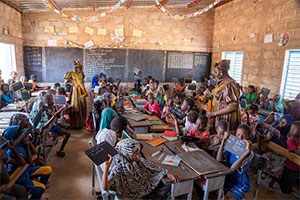 Two teachers work in a classroom in Forces Vives School in Dori, Burkina Faso. Credit: UNICEF/UNI978361
Safe and uninterrupted education is a fundamental right for all children. Education is paramount to global development, as it has been proven that investing in education – especially for girls and children – contributes significantly to economic growth and prosperity. Although more than 1 billion children go to school, many are subjected to conditions that are not conducive to a proper learning environment, including makeshift facilities, a lack of supplies, violence in classrooms, inadequate sanitation, untrained instructors, and widespread school closures. Since 2015, there have been immense gains in education with an increase of 109 million children in school. However, as of 2023, 272 million children are still out of school.
High poverty levels in developing countries also impede children’s access to a proper education. For example, from the early to mid 2000s, Sub-Saharan African nations witnessed a dramatic decline in trained teachers due to inadequate funding in the education sector. Furthermore, major cuts to United States international aid threaten an estimated 23 million additional children's access to education, as USAID‑funded school programmes across Africa and Asia face closure.
Various other factors contribute to the decline of education, notably hunger, which has increased as conflict and climate change interfere with global food production and dissemination. Meanwhile, certain social and cultural practices also impede children’s access to education, with gender inequality, discrimination, child labour, and child marriages preventing millions of children from attending school. Economic conditions such as the inaccessibility of higher education also affect disenfranchised communities across the world. In extreme situations, such as warfare where educational facilities are destroyed in their totality, notably in Gaza and Sudan, entire generations of children might grow up without access to education. Rebuilding educational infrastructure is a long and arduous process, especially when violence persists across generations, and this significantly stunts the development of societal prosperity and stability.
IPS is dedicated to telling the shocking truths about worldwide education through impassioned opinion pieces and comprehensive articles, highlighting global issues that impede worldwide education and the courses of action being taken by organizations such as UNICEF and Education Cannot Wait.

The Week with IPS

NEXT STOP - SDGs
Tracking global progress towards a sustainable world
Tracking global progress towards a sustainable world
