Languages
Friday, September 25, 2026



News and Views from the Global South
Education

ECW Interviews Dubai Cares Ceo H.E. Dr. Tariq Al Gurg
H.E. Dr. Tariq Al Gurg was appointed as Chief Executive Officer of Dubai Cares in 2009 and as Vice-Chairman in July 2021. Al Gurg has been a primary driver behind the organization’s success. He has enabled Dubai Cares to contribute to the evidence-base in education, leverage funding and invest in strategic relationships and programs that support the global education agenda. His focus has been to develop Dubai Cares as a recognized best-case practitioner and a global leader in education program design and innovation that is grounded in a philosophy of continuous monitoring and evaluation and rigorous research.
Afghanistan’s Girls Need our Unwavering Support in Education
The Taliban takeover of government in Kabul is just days old, and the eyes of Afghans and the world are cautiously watching and hopeful to see them stand by their word and ensure that girls’ education be promoted and protected.
Afghanistan: A Swedish Officer’s Point of View
Like most of us, I rely on news media to find an explanation to tragedies I watch on TV. Neverthelss, some of my opinions about the Afghan tragedy have furthermore been influenced by talks I once had with my friend Bernth Dagerklint. We had for some years been working as teachers at a high school, though this was not Bernth’s main occupation. Most of the time, he served as an officer during international, armed campaigns supported by the Swedish government. He had been to former Yugoslavia, the West Bank and not the least in Afghanistan, where he since 2003 on several occasions worked as ”instructor” for Afghan officers.
Afghanistan – Another Viet Nam?
There are several points of similarity between the war in Afghanistan and the war in Viet Nam. The Taliban, like the North Vietnamese and the Viet Cong, proved to be formidable tacticians and fighters. They managed to contain a far better equipped opponent and mount effective counteroffensives; access sufficient domestic and foreign funding to pay their fighters and support their families; build a formidable intelligence network; and acquire necessary technical capabilities in areas such as repair and maintenance of small arms.
Pacific Community Warns of Threat to Education Retention in the Wake of COVID-19
Before the pandemic, many Pacific Island countries grappled with low numbers of students completing secondary education. Now experts in the region are concerned that the closure of schools to contain the spread of COVID-19, and the economic downturn, will lead to even more students dropping out of education early.
As Climate Disaster Migration Rises, Girls Get Married Off
When 11-year-old Mitali Padhi hugged her childhood friends to say goodbye, she felt a deep-seated foreboding.
Prioritising Profits Reversed Health Progress
Instead of a health system striving to provide universal healthcare, a fragmented, profit-driven market ‘non-system’ has emerged. The 1980s’ neo-liberal counter-revolution against the historic 1978 Alma-Ata Declaration is responsible.
How Many More Innocent Lives Must be Lost in Tigray, asks Adama Dieng
Despite a June 30 unilateral ceasefire declaration by Ethiopian President Abiy Ahmed, United Nations agencies say a recent escalation in fighting has been ‘disastrous’ for children, amid reports of over 100 children being killed in an attack on displaced families.
How to Protect Your Data from Malicious Encryption?
Ransomware is deploying its encryption right on your computer. The malicious process runs in the background as you continue your everyday activities suspecting no cyber disaster ahead.
Bolstering Food Security in Marshall Islands
Forty schoolteachers and principals in the Republic of Marshall Islands (RMI) completed a five-day workshop last month equipping schools to play a key role in strengthening the food security efforts in the country.
Power of Creative Expression during Lockdown
Screens, devices, and smartphones replaced the human touch and day-to-day interactions as COVID-19 protocols forced millions of people into harsh lockdowns and prolonged isolation.
We Were Born to Do This!
The first time I visited South Sudan in 2004 - prior to its independence - I travelled across the entire the country which was then a region devastated by man’s inhumanity to man. Although South Sudan is slightly larger than France, I could find only one concrete school building in Rumbek.
ECW Interviews the Honourable Awut Deng Acuil, Minister of General Education and Instruction for South Sudan
Awut Deng Acuil is the first female Minister of Education for South Sudan, and only the second person to serve as Minister of Education for her country – which became independent country in 2011. Prior to this role, Minister Acuil was the first woman to serve as the country’s Minister of Foreign Affairs and International Cooperation. Recently, Minister Acuil made history as the first women to lead a South Sudan university when she was appointed head of council at the University of Bahr El-Ghazal.
German Development Agency Raises Awareness of Teen Pregnancy in Burkina Faso
 In Burkina Faso, Honorine Meda has been trained by the German Development Agency (GIZ) to raise awareness among teenage girls about pregnancy. While the Universal Declaration of Human Rights says all children have a right to education, adolescent girls who fall pregnant in Sub Saharan Africa tend to drop out of school. Meda and a group of model parents, also trained by GIZ, play an essential role in preventing teenage pregnancies and supporting learners, who fall pregnant, to get back to school.

To Prevent Teenage Pregnancies in Sub Saharan Africa, It Takes a Whole Village to Raise a Child
Honorine Meda is 23. Cycling through her hometown of Dissin, in Burkina Faso’s verdant southwest, she smiles, waves and stops to chat with one of the girls she counsels.
Child Rights’ Experts Warn that Displaced Children and Young People Risk Being Wiped Out of the Education System
The difficulties in accessing education faced by children and young people forcibly displaced from their homes were today laid bare in a virtual high-level roundtable convened by UNHCR, the UN Refugee Agency, Education Cannot Wait (ECW), the UK and Canada.
Honour Killings – Religion or Culture?
There is nothing honourable about murder. And murdering someone of your own family, your own child - a daughter, someone you held in your arms and rocked to sleep when they were babies? This is such a horrifying crime that there are no words to describe it – certainly not the word Honour. And yet it happens! It happens in Pakistan and to the shame of all of us in the diaspora, it has been brought to Italy.
It’s Time To Reopen Primary Schools in India
“The government should open schools, even if it’s for an hour, to facilitate some student-teacher interaction. Most teachers feel that students should be encouraged to come to school.
Papua New Guinea Battles COVID-19 and Health Workers’ Vaccine Scepticism
Papua New Guinea (PNG), like many other Pacific Island countries, successfully held COVID-19 at bay last year, aided by early shutting of national borders. However, by March this year, the pandemic was surging in the most populous Pacific Island nation, and by July, it had reported 17,282 cases of the virus and 175 fatalities.
Combating COVID-19 and Ensuring No One is Left Behind
If the world wants to beat back the COVID-19 pandemic and ensure no one is left behind in the recovery, two issues thrown into sharp relief by the pandemic need attention: digitalization and regional cooperation.
Nothing About Us, Without Us, Asian Youth Tell Parliamentarians
Youth advocates from Asian countries called for an overhaul of a system that excluded young people from participation in policymaking. During an interaction with parliamentarians from 23 countries, youth representatives considered an enabling political framework to be the most crucial reform required to remove inequities.« Previous Page — Next Page »


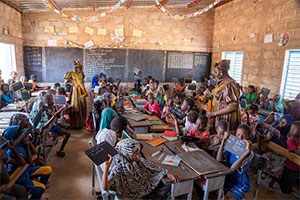 Two teachers work in a classroom in Forces Vives School in Dori, Burkina Faso. Credit: UNICEF/UNI978361
Safe and uninterrupted education is a fundamental right for all children. Education is paramount to global development, as it has been proven that investing in education – especially for girls and children – contributes significantly to economic growth and prosperity. Although more than 1 billion children go to school, many are subjected to conditions that are not conducive to a proper learning environment, including makeshift facilities, a lack of supplies, violence in classrooms, inadequate sanitation, untrained instructors, and widespread school closures. Since 2015, there have been immense gains in education with an increase of 109 million children in school. However, as of 2023, 272 million children are still out of school.
High poverty levels in developing countries also impede children’s access to a proper education. For example, from the early to mid 2000s, Sub-Saharan African nations witnessed a dramatic decline in trained teachers due to inadequate funding in the education sector. Furthermore, major cuts to United States international aid threaten an estimated 23 million additional children's access to education, as USAID‑funded school programmes across Africa and Asia face closure.
Various other factors contribute to the decline of education, notably hunger, which has increased as conflict and climate change interfere with global food production and dissemination. Meanwhile, certain social and cultural practices also impede children’s access to education, with gender inequality, discrimination, child labour, and child marriages preventing millions of children from attending school. Economic conditions such as the inaccessibility of higher education also affect disenfranchised communities across the world. In extreme situations, such as warfare where educational facilities are destroyed in their totality, notably in Gaza and Sudan, entire generations of children might grow up without access to education. Rebuilding educational infrastructure is a long and arduous process, especially when violence persists across generations, and this significantly stunts the development of societal prosperity and stability.
IPS is dedicated to telling the shocking truths about worldwide education through impassioned opinion pieces and comprehensive articles, highlighting global issues that impede worldwide education and the courses of action being taken by organizations such as UNICEF and Education Cannot Wait.

The Week with IPS

NEXT STOP - SDGs
Tracking global progress towards a sustainable world
Tracking global progress towards a sustainable world
