Languages
Monday, October 5, 2026



News and Views from the Global South
Education

Inclusive and Equitable Education in the Pacific
In 2019, the United Nations General Assembly proclaimed 24 January as International Day of Education, in celebration of the role of education for peace and development. The United Nations’ Sustainable Development Goal 4 challenges all nations to “ensure inclusive and equitable quality education and promote lifelong learning opportunities for all” by the year 2030. As we think about this in the context of the COVID-19 pandemic, and the emerging post-COVID-19 environment, what does inclusive and equitable education look like and how do we ensure that lifelong learning opportunities are benefitted by all?
“Their Hope for a Brighter Future Inspires Us All”
Looking back upon 2020, we all bear the scars of a devastating year; none so much as girls and boys around the world. The COVID-19 pandemic disrupted education for over 1.6 billion children and youth globally and continues to do so. It has also deepened socio-economic inequities and heightened insecurities around the world, further impacting the lives of girls and boys everywhere. Ongoing, protracted conflicts, forced displacement and the worsening climate crisis were no less forgiving.
“Teach Us How to Become Carpenters” – South Sudanese Want to Shape Their Future
Located in Jonglei state, one of the most underdeveloped regions of South Sudan, Likuangole is a town badly hit by floods and often battered by conflict. Despite the lack of secondary schools and industry, its residents aspire to transform their lives. But real investment is needed to spur development.
Protecting Mental Health of Families in a Pandemic
Dealing with COVID-19-related city lockdowns has been exceptionally stressful, particularly for those parents who have had to balance work, personal life, children and elderly, providing home schooling or facilitating virtual learning, managing infection control within the home, and more, all while being disconnected from support services.
Q&A: Why we Must Invest in Educating Children in Crisis-Hit Burkina Faso
Education Cannot Wait (ECW) - the first global fund dedicated to education in emergencies and protracted crises – was on the ground in Burkina Faso last week with its Director, Yasmine Sherif, to launch a new multi-year programme that aims to provide an education to over 800,000 children and adolescents in crisis-affected areas.
Jamaica Failing to Cope with Plastic Waste
For decades, every time it rains heavily in Jamaica, a daunting deluge of plastic bottles and bags, styrofoam and other garbage trundles its way down a network of countless gullies and streams. If they don’t get snagged somewhere, they end up in the Kingston Harbour or close to the beaches ringing the tourist-heavy North coast.
Learning From Indigenous Peoples: My Morocco Diary
Once a year, on 9 August, the International Day of the World’s Indigenous Peoples is commemorated, celebrating their unique culture and knowledge. This is done mostly from a distance, from our homes in (nominally) developed countries. But are we as developed as we pretend to be? On this question, I reflected for a while, still remembering a special and personal experience of having spent several days with an indigenous Berber family in Morocco.
COVID-19 Pandemic Shapes the Future World People Want
The peoples of the world are unanimous - access to basic services such as universal healthcare must become a priority going forward. So too should global solidarity, helping those hardest hit by the COVID-19 pandemic and addressing the climate change emergency.
Recovery: What Are We Talking About?
The new year has arrived, but the situation is worse than in the last months of 2020. The pandemic is still unleashed: the end of the year holidays, the official permissiveness, and the slowness of the distribution of vaccines seem to announce that the disease will continue to wreak havoc for several months in most of the world, particularly in America, Europe, and parts of Asia like India. It has therefore been required to redouble preventive measures: a new lockdown and the disruption of almost all economic and school activities. Therefore, the recovery looks still uncertain and distant.
Shifting Conversations in Multifaceted Policymaking
As the people of Kiribati, Samoa and Tonga gear up as the first nations to welcome 2021, communities around the Asia-Pacific region and beyond look forward to bidding farewell to the most tumultuous year in recent decades.
How Women-centred Digital Platforms can Enhance Empowerment
A cherished snapshot of a happy mother and a smiling grandmother is universally associated with a good childhood. In the movies, TV, or media, a broken or depressed mother’s face is hardly seen. But the reality is somewhat different. The measures communities and society take to ensure that women and girls are protected and supported are often questioned.
Ten Defining Moments for Women in 2020
While 2020 will be remembered most for the way COVID-19 changed our lives in nearly every way and in every part of the world, we made some strides for women’s rights and gender equality.
2020: A Yet More Devastating Year Closes With At Least Some Signs Of Hope
Despite its grim record of multiple natural disasters and a deepening climate crisis, one could be forgiven for looking back on 2019 with a degree of nostalgia. There is no disguising the extent of the calamity wrought this year by COVID-19, yet as we approach the end of 2020 we may also draw strength from positive developments emerging.
Hope Thrives on Action
As Mohammed, a Palestine refugee with impaired vision who attends a specialized UNRWA programme for children with disabilities, told us during our mission to Lebanon a week ago: “I was worried. I was worried that I could not continue my education because the programme was going to be cut. Now I have hope that I can continue to study and make my dream come true.” As 2020 comes to a close and we reflect on Education Cannot Wait’s mission this past year, two things stand out: hope and action. Amidst multiple crises around the globe, exacerbated by the COVID-19 global pandemic, hope has been the fuel driving us all forward to take action to deliver to those left furthest behind. Indeed, while hope is life-sustaining for a young girl or boy enduring conflict, forced displacement and disaster, it cannot be sustained without action.
The Impact of COVID-19 on Child Marriage and Other Gender-Based Violence
I recently visited rural areas of Bangladesh amid the COVID-19 pandemic and returned to Dhaka with a new understanding of the impact that COVID-19 is having on child marriage, a harmful practice that is a global challenge. The fundamental shift that I saw was that child marriage, which has typically been encouraged by struggling parents, is now being encouraged by struggling girls. This worrisome trend underscores a new burden of the pandemic on the poor.
Uganda’s School Plan for Refugee Children Could Become a Global Template
Thirteen-year-old Wita Kasanganjo is a pupil at Maratatu Primary School in the Kyangwali Refugee Settlement based in Uganda’s Hoima district. But last month, when Uganda’s President Yoweri Museveni ordered the re-opening of schools for the first time since the mid-March nationwide closure, Kasanganjo was not part of the returning group of students. The government, in a cautious lifting of coronavirus lockdown restrictions, has allowed only pupils who are part of the final year or candidate classes to return to their schooling.
How Africa can Lead the World in the COVID-19 Recovery
Africa, compared to Asia, Europe and the US, has largely escaped the devastating death toll of COVID-19, accounting for a fraction of the world’s 63 million cases.
Education Cannot Wait Interviews Colombia’s Minister of Education María Victoria Angulo
María Victoria Angulo is Colombia’s Minister of Education. She holds a Master´s Degree in Development Economics from the Universidad de Los Andes and a Master´s Degree in Specialized Economic Analysis from Pompeau Fabra University (Barcelona, Spain). The minister has more than 20 years of experience in educational policy development.
Pandemic Puts Jamaican Children at Heightened Risk of Abuse
In Jamaica, school playgrounds are deserted, filled only with phantom shrieks of delight. Blackboards remain devoid of arithmetic and uniforms hang wrinkle-free in closets. When the first case of Covid hit Jamaican shores in early March, the government closed primary and secondary schools and over 500,000 children transitioned to remote learning. The majority of schools have yet to resume face-to-face classes since the March 13 closure.
Getting Children in Lebanon Back to School Amongst Multiple Crises
Education and health care were high on the agenda when the United Nations vowed to work toward a better future by setting 17 Sustainable Development Goals (SDGs) to be met by 2030.
India: National Education Policy 2020 Could Transform Early Childhood Education If Implemented Effectively
It is after almost 34 years that the central government approved the new National Education Policy 2020 on July 29, 2020. This document contains comments on the entire education system and its various recommendations are being heavily debated.« Previous Page — Next Page »


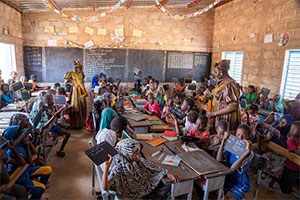 Two teachers work in a classroom in Forces Vives School in Dori, Burkina Faso. Credit: UNICEF/UNI978361
Safe and uninterrupted education is a fundamental right for all children. Education is paramount to global development, as it has been proven that investing in education – especially for girls and children – contributes significantly to economic growth and prosperity. Although more than 1 billion children go to school, many are subjected to conditions that are not conducive to a proper learning environment, including makeshift facilities, a lack of supplies, violence in classrooms, inadequate sanitation, untrained instructors, and widespread school closures. Since 2015, there have been immense gains in education with an increase of 109 million children in school. However, as of 2023, 272 million children are still out of school.
High poverty levels in developing countries also impede children’s access to a proper education. For example, from the early to mid 2000s, Sub-Saharan African nations witnessed a dramatic decline in trained teachers due to inadequate funding in the education sector. Furthermore, major cuts to United States international aid threaten an estimated 23 million additional children's access to education, as USAID‑funded school programmes across Africa and Asia face closure.
Various other factors contribute to the decline of education, notably hunger, which has increased as conflict and climate change interfere with global food production and dissemination. Meanwhile, certain social and cultural practices also impede children’s access to education, with gender inequality, discrimination, child labour, and child marriages preventing millions of children from attending school. Economic conditions such as the inaccessibility of higher education also affect disenfranchised communities across the world. In extreme situations, such as warfare where educational facilities are destroyed in their totality, notably in Gaza and Sudan, entire generations of children might grow up without access to education. Rebuilding educational infrastructure is a long and arduous process, especially when violence persists across generations, and this significantly stunts the development of societal prosperity and stability.
IPS is dedicated to telling the shocking truths about worldwide education through impassioned opinion pieces and comprehensive articles, highlighting global issues that impede worldwide education and the courses of action being taken by organizations such as UNICEF and Education Cannot Wait.

The Week with IPS

NEXT STOP - SDGs
Tracking global progress towards a sustainable world
Tracking global progress towards a sustainable world
