Languages
Monday, October 5, 2026



News and Views from the Global South
Education

Discriminatory Laws Still Holding Women Back in the Middle East
Decades of aggressive efforts to create equal opportunities for women, shatter the glass ceiling and build a more inclusive society only ends up in failure, when the key stake holders refuse to acknowledge discriminatory laws, socio-cultural and religious set ups that continue to threaten progress made by the female work force.
Women’s Bodies, COVID-19 and Male Chauvinism
COVID-19 has in some nations been converted into a noxious, political issue. One of many worrying examples is the rhetoric of Brazil´s president. On 10 November, when Brazil´s COVID-19 death toll surpassed 162,000 victims – the numbers have continued to raise and are now 179,032 second only to USA´s 296,745 – Jair Bolsonaro minimized the effects of COVID-19 by stating: ”All of us are going to die one day. There is no point in escaping from that, in escaping from reality. We have to cease being a country of sissies.” Bolsonaro actually said maricas, which like sissies is slang for gay people. Both expressions originally indicated ”small girls” – marica is a diminutive of Maria and sissy of “kid sister”. Bolsonaro thus defined homosexuality as effeminacy by associating gay men with affectation and cowardice. By connecting disease, fear, and femininity the Brazilian president not only ignored the strength and courage women throughout history have demonstrated by enduring childbirths and caring for others, it also shows a strong disregard for gender equality and the rights of women and gay people.
A Vaccine That Was Hijacked by the Rich
There is a longstanding belief that virtually everything in this world is stacked up against the poor and the downtrodden. The Covid-19 vaccine is no exception because some of world’s richest nations, including the US, Canada and UK, seem to have cornered most of the supplies -- whilst marginalizing the world’s poorer nations.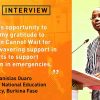
Education Cannot Wait Interviews H.E. Mr. Stanislas Ouaro, Minister of National Education and Literacy, Burkina Faso
H.E. Mr. Stanislas Ouaro became the Minister of National Education and Literacy of Burkina Faso in February 2018 after a long academic career. Between 2012 and 2018, Mr. Ouaro was the President of the Université Ouaga II. Prior to that, the eminent mathematician held several teaching and administrative posts with Ouagadougou University. Mr. Ouaro is widely published, and has also served as the President of the Réseau pour l’Excellence de l’Enseignement Supérieur en Afrique de l’Ouest (Network for Excellence in Higher Education in West Africa). A leading advocate for education and equality, Mr. Ouaro has been awarded several academic awards in Burkina Faso and elsewhere.
Celebrating Vanuatu’s Path to Sustainable Development
The Pacific Island Developing State of Vanuatu has emerged as one of the region’s great success stories. Vanuatu has joined the ranks of Samoa and the Maldives as one of only six countries to graduate from being a least developed country, since the category was introduced by the United Nations in 1971.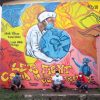
Human Rights Must Be at the Heart of the COVID-19 Recovery
On 10 December every year, we celebrate Human Rights Day, marking the anniversary of the adoption of the Universal Declaration of Human Rights. The Universal Declaration guarantees a spectrum of human rights that belong to each of us equally, and unite us as a global community and upholds our humanity.
Education Is a Fundamental Human Right and the Priority of the 21st Century
Education is not a privilege. It is a fundamental human right. Yet, education is undervalued even at the best of times. We often fail to connect the dots between the right to education and the realization of all human rights. As noted by the Nobel-winning economist Amartya Sen, we have failed to give ‘this massive potential in transforming human lives’ the attention it deserves.
Nyagoa’s Long Journey
Nyagoa Dak was born to a world in chaos. Her story is one of loss, of redemption, of struggle and of triumph. At a very early age, Nyagoa lost her parents to the conflict in South Sudan. As the conflict escalated, she escaped with her grandmother to Ethiopia in 2014. There they settled in the Pugnido refugee camp in Ethiopia’s Gambella region.
Pacific Data Hub to Make Data Accessible for All
Pacific Governments, agencies, donors and civil society now have a central source of reliable and current data to help them to make decisions that affect Pacific Islanders.
How Did Rural India Learn During Lockdown?
School closures due to the nationwide lockdown in March 2020 meant that children were disengaged with formal education for a prolonged period. The resulting talks around e-education exposed India’s digital divide, with only 24 percent of households having access to the internet.
Women Empowerment During COVID-19 Through Remote Learning – the Fuzia Perspective
This year, the world commemorated the 25th anniversary of the Beijing Declaration and Platform for Action, instead of celebration; however, its progress has been impeded by the COVID-19.
UN Special Session on COVID-19 Must Recognize Right to Health & Access to Vaccines
The holding of this Special Session (the 37th in the history of the UN) is of considerable importance. It is a unique opportunity to define and implement joint actions at the global level to fight the pandemic in order to ensure the right to life and health for all the inhabitants of the Earth. As the President of the UN General Assembly wrote in his letter of convocation: "Let us not forget that none of us are safe until we are all safe".
CARE Offers Policies That Engender Success for Young People in Agribusiness
Often cited as Africa’s greatest asset, its youth are also among the most vulnerable and volatile. A large and growing population of talented young people has the potential to drive economic growth and well-being of societies across the continent but, as the African Development Bank warns, current conditions of severe unemployment are translating into poorer living conditions, higher flows of migration, and greater risks of conflict – in short, a social disaster in the making.
How UN Helped Benin Become World’s Fastest Place to Start a Business via a Mobile Phone
Until recently, Benin was best known for its cotton exports and its vibrant clothing designs. Since this year it is also the fastest place in the world to start a company. By providing a full online service, the government helped entrepreneurs create businesses and jobs during the pandemic. A third of Benin’s new entrepreneurs are women.
My Voice, Our Equal Future! Joining the Chorus of Girls Who Are Speaking up for Change
Girls are change makers and world shapers! When girls speak up, they are a powerful force to be reckoned with.
Youth Demand a ‘Fair Share’ from World Leaders Ahead of G20 Summit
Heads of youth movements and student unions are challenging the world’s richest nations to correct an ‘incredibly unequal’ global response to COVID-19, by considering the plight of the world’s most vulnerable children and young people.Gordon Brown – Education Cannot Wait
"For 75M children & young people trapped in conflict zones, #EducationCannotWait. A lost generation is one where hope dies in those who live. It is our responsibility to rekindle hope." ~ Gordon Brown.
COVID-19 Compounding Inequalities
The United Nations’ renamed World Social Report 2020 (WSR 2020) argued that income inequality is rising in most developed countries, and some middle-income countries, including China, the world’s fastest growing economy in recent decades. Inequality dimensions While overall inter-country inequalities may have declined owing to the rapid growth of economies like China, India and East Asia, national inequalities have been growing for much of the world’s population, generating resentment.
Reversing the Rohingya Crisis: One Woman at a Time
“This is a crisis without a quick fix that could take years to resolve unless there are concerted efforts to address its root causes”, says Manuel Fontaine, UNICEF Director of Emergency Programmes.
They Deserve No Less in Central Sahel
“I am so happy. This is my success!” says 13-year old Cynthia, beaming proudly as she shows her Primary School Certificate with an average mark of 120 out of 150. Thanks to the Radio Education Programme, she will now graduate on to Grade 6! Cynthia’s sense of pride, joy and achievement can only be fully understood when placed in the context of her circumstances. Cynthia is an internally displaced girl, living in Burkina Faso in Central Sahel.
African Languages Matter: Is There Still Time to Prevent Cultural Genocide?
As a 10 year-old newly arrived in Lagos from England, I recall listening intently to how the Yoruba language - my father's language - was spoken. I would constantly repeat in my head or verbally repeat what I thought I had heard. I was not always successful. Many times, what would come out of my mouth would throw my friends into fits of laughter.« Previous Page — Next Page »


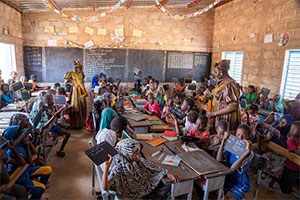 Two teachers work in a classroom in Forces Vives School in Dori, Burkina Faso. Credit: UNICEF/UNI978361
Safe and uninterrupted education is a fundamental right for all children. Education is paramount to global development, as it has been proven that investing in education – especially for girls and children – contributes significantly to economic growth and prosperity. Although more than 1 billion children go to school, many are subjected to conditions that are not conducive to a proper learning environment, including makeshift facilities, a lack of supplies, violence in classrooms, inadequate sanitation, untrained instructors, and widespread school closures. Since 2015, there have been immense gains in education with an increase of 109 million children in school. However, as of 2023, 272 million children are still out of school.
High poverty levels in developing countries also impede children’s access to a proper education. For example, from the early to mid 2000s, Sub-Saharan African nations witnessed a dramatic decline in trained teachers due to inadequate funding in the education sector. Furthermore, major cuts to United States international aid threaten an estimated 23 million additional children's access to education, as USAID‑funded school programmes across Africa and Asia face closure.
Various other factors contribute to the decline of education, notably hunger, which has increased as conflict and climate change interfere with global food production and dissemination. Meanwhile, certain social and cultural practices also impede children’s access to education, with gender inequality, discrimination, child labour, and child marriages preventing millions of children from attending school. Economic conditions such as the inaccessibility of higher education also affect disenfranchised communities across the world. In extreme situations, such as warfare where educational facilities are destroyed in their totality, notably in Gaza and Sudan, entire generations of children might grow up without access to education. Rebuilding educational infrastructure is a long and arduous process, especially when violence persists across generations, and this significantly stunts the development of societal prosperity and stability.
IPS is dedicated to telling the shocking truths about worldwide education through impassioned opinion pieces and comprehensive articles, highlighting global issues that impede worldwide education and the courses of action being taken by organizations such as UNICEF and Education Cannot Wait.

The Week with IPS

NEXT STOP - SDGs
Tracking global progress towards a sustainable world
Tracking global progress towards a sustainable world
