Languages
Thursday, October 29, 2026



News and Views from the Global South
Education
Palestine Crisis at Its Worst Since 1967, Says United Nations
In 2014, the ongoing humanitarian crisis in the occupied Palestinian territories (oPt) saw the worst escalation of hostilities since 1967, said a report by the United Nations Office of Coordination and Humanitarian Affairs (UNOCHA), released on March 26.U.N. Security Council Focuses on Children as Victims of Armed Groups
24 hours after the shocking kidnap of more than 400 women and children in Nigeria by Boko Haram, the United Nations Security Council discussed the safety of children as victims of non-state armed groups.
Opinion: Education as a Cornerstone for Women’s Empowerment
Earlier this month, the Barack Obama administration announced a new initiative designed to improve girls’ education around the world. Dubbed “Let Girls Learn,” the programme builds on current progress made, such as ensuring girls are enrolled in primary school at the same rates as boys, and is looking to expand opportunities for girls to complete their education.
Global Citizenship Essential for Gender Equality: Ambassador Chowdhury
At a recent panel discussion on women’s leadership during the U.N. Commission on the Status of Women, Ambassador Anwarul Chowdhury was the lone male voice.
Hold the Rich Accountable in New U.N. Development Goals, Say NGOs
When the World Economic Forum (WEF) met last January in Switzerland, attended mostly by the rich and the super-rich, the London-based charity Oxfam unveiled a report with an alarming statistic: if current trends continue, the world’s richest one percent would own more than 50 percent of the world’s wealth by 2016.
Women in the Philippines at the Forefront of the Health Food Movement
When Tinay Alterado’s team from ARUGAAN, an organisation of women healthcare advocates, visited Eastern Visayas, a region of the Philippines devastated by Typhoon Haiyan in November 2013, they noticed that the relief and rescue sites were flooded with donated milk formula, which nursing mothers were feeding to their babies in vast quantities.U.N. Envoy Pushes for Safer Schools Worldwide
Speaking from the United Nations Headquarters in New York on Wednesday, the U.N. Special Envoy for Global Education, Gordon Brown, defined 2015 as the year to end violations of the rights of the children worldwide.
Nobel Peace Laureate Calls for Global Human Compassion to Combat Child Slavery
Nobel Peace Laureate Kailash Satyarthi has called for globalised human compassion to combat the global and persistent problems of child labour and child slavery.Millions of Children Impacted by Ebola Outbreak
Nine million children live in areas affected by the Ebola outbreak in West Africa, while thousands have lost parents to the virus, according to a new report from The United Nations Children's Fund (UNICEF).
Empower Rural Women for Their Dignity and Future
Rural women make major contributions to rural economies by producing and processing food, feeding and caring for families, generating income and contributing to the overall well-being of their households – but, in many countries, they face discrimination in access to agricultural assets, education, healthcare and employment, among others, preventing them from fully enjoying their basic rights.
Meet the 10 Women Who Will Stop at Nothing
On Apr. 6, 2013, Nadia Sharmeen, a crime reporter, was assigned to cover a rally organised by Hefazat-e-Islam, an association of fundamentalist Islamic groups in Bangladesh whose demands included a call to revoke the proposed National Women Development Policy.
Opinion: A Radical Approach to Global Citizenship Education
Although global citizenship education has now received the recognition it deserves, much of the literature recycles old agendas under another name - 'education to promote peace and justice', 'sustainability', 'care for the environment', 'multi-faith' and 'multi-cultural understanding' - and so forth.
‘Cli-Fi’ Reaches into Literature Classrooms Worldwide
From Columbia University in New York to the University of Cambridge in Britain, college classrooms are picking up on the "cli-fi" genre of fiction, and cinema and academia is right behind them.
Opinion: The World Sees Progress Against Undernutrition, but it’s Uneven
In 2014, an estimated 805 million people – one in nine people worldwide – were estimated to be chronically hungry. All but 14 million of the world’s hungry live in developing countries, i.e., 791 million are in developing countries, where the share of the hungry has declined by less than half – from 23.4 per cent (1990-1992) to 13.5 per cent (2012-2014).
Bolivia’s School Meals All About Good Habits and Eating Local
A successful school meals programme that serves breakfast and lunch with Andean flavours to 140,000 students in La Paz gave rise to a new law aimed at promoting healthy diets based on local traditions and products in Bolivia’s schools, while combating malnutrition and bolstering food sovereignty.
The 15 Journalists Putting Women’s Rights on the Front Page
Media coverage of maternal, sexual and reproductive health rights is crucial to achieving international development goals, yet journalists covering these issues often face significant challenges.
World Misses Its Potential by Excluding 50 Percent of Its People
The meeting is billed as one of the biggest single gatherings of women activists under one roof.
By Girls, For Girls – Nepal’s Teenagers Say No to Child Marriage
If not for a group of her school friends coming to her rescue, Shradha Nepali would have become a bride at the tender age of 14.
Opinion: It’s Time to Step It Up for Gender Equality
If we look at the headlines or the latest horrifying YouTube clip, Mar. 8 – International Women’s Day – may seem a bad time to celebrate equality for women.Namibian President Wins $5 Million African Leadership Prize
Outgoing Namibian President Hifikepunye Pohamba was Monday named winner of the Ibrahim Prize for Achievement in African Leadership, believed to be the most lucrative individual award in the world.

Farm Projects Boost Bangladeshi Women, Children
Women in Bangladesh are carving healthier, wealthier futures for themselves and their children – and they have chicken eggs and pineapples to thank.« Previous Page — Next Page »





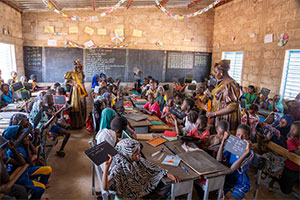 Two teachers work in a classroom in Forces Vives School in Dori, Burkina Faso. Credit: UNICEF/UNI978361
Safe and uninterrupted education is a fundamental right for all children. Education is paramount to global development, as it has been proven that investing in education – especially for girls and children – contributes significantly to economic growth and prosperity. Although more than 1 billion children go to school, many are subjected to conditions that are not conducive to a proper learning environment, including makeshift facilities, a lack of supplies, violence in classrooms, inadequate sanitation, untrained instructors, and widespread school closures. Since 2015, there have been immense gains in education with an increase of 109 million children in school. However, as of 2023, 272 million children are still out of school.
High poverty levels in developing countries also impede children’s access to a proper education. For example, from the early to mid 2000s, Sub-Saharan African nations witnessed a dramatic decline in trained teachers due to inadequate funding in the education sector. Furthermore, major cuts to United States international aid threaten an estimated 23 million additional children's access to education, as USAID‑funded school programmes across Africa and Asia face closure.
Various other factors contribute to the decline of education, notably hunger, which has increased as conflict and climate change interfere with global food production and dissemination. Meanwhile, certain social and cultural practices also impede children’s access to education, with gender inequality, discrimination, child labour, and child marriages preventing millions of children from attending school. Economic conditions such as the inaccessibility of higher education also affect disenfranchised communities across the world. In extreme situations, such as warfare where educational facilities are destroyed in their totality, notably in Gaza and Sudan, entire generations of children might grow up without access to education. Rebuilding educational infrastructure is a long and arduous process, especially when violence persists across generations, and this significantly stunts the development of societal prosperity and stability.
IPS is dedicated to telling the shocking truths about worldwide education through impassioned opinion pieces and comprehensive articles, highlighting global issues that impede worldwide education and the courses of action being taken by organizations such as UNICEF and Education Cannot Wait.

The Week with IPS

NEXT STOP - SDGs
Tracking global progress towards a sustainable world
Tracking global progress towards a sustainable world
