Languages
Tuesday, October 27, 2026



News and Views from the Global South
Education

Opinion: Let’s Talk Menstruation. Period.
Every month, more than two billion women around the world menstruate, and yet the topic is still shrouded by a veil of silence. While some girls celebrate their period as the first step into womanhood, many girls in developing or emerging countries are shocked and ashamed of their monthly cycles.
Reviving Dignity: The Remarkable Perseverance of Myanmar’s Displaced
In Myanmar’s Western Rakhine State, over a hundred thousand people displaced by inter communal violence that broke out nearly three years ago remain interned in camps on torrid plains and coastal marshes, struggling to survive.
Opinion: Renewable Energy – How to Make It More Bird-Friendly
Climate change is one of the greatest risks to human societies, but also to biodiversity, often creating a “snowball effect” exacerbating existing pressures such as habitat fragmentation.
Sri Lanka’s Development Goals Fall Short on Gender Equality
When Rosy Senanayake, Sri Lanka’s minister of state for child affairs, addressed the U.N. Commission on Population and Development (CPD) in New York last month, she articulated both the successes and shortcomings of gender equality in a country which prided itself electing the world’s first female head of government: Mrs. Sirimavo Bandaranaike in July 1960.
Opinion: Healthy Diets for Healthy Lives
In the last half-century, people’s lifestyles have changed dramatically. Life expectancy has risen almost everywhere, but this has been accompanied by an increase of so-called non-communicable diseases (NCDs) – such as cardiovascular diseases, cancer, respiratory diseases, and diabetes – causing more and more deaths in all corners of the world.
In India, a Broken System Leaves a ‘Broken’ People Powerless
As India paid glowing tributes to Bhimrao Ramji Ambedkar, the architect of its constitution and a champion of the downtrodden, on his 124nd birth anniversary last month, public attention also swivelled to the glaring social and economic discrimination that plagues the lives of lower-caste or ‘casteless’ communities – who comprise over 16 percent of the country's 1.2 billion people.
In India, a Broken Systems Leaves a Broken People Powerless
 As India paid glowing tributes to Bhimrao Ramji Ambedkar, the architect of its constitution and a champion of the downtrodden, on his 124nd birth anniversary last month, public attention also swivelled to the glaring social and economic discrimination that plagues the lives of lower-caste or ‘casteless’ communities – who comprise over 16 percent of the country’s 1.2 billion people.

Q&A: “People Need to Be at the Centre of Development”
In a populous archipelago nation like Indonesia, where 250 million live spread across some 17,500 islands, speaking over 300 languages, the question of development is a tricky one.Anti-Foreigner Discrimination ‘Fostered in South African Schools’
A practice of denying admission to South African public schools of children without visas or whose parents are refugees from other African countries is creating a foundation for the current rash of xenophobia, critics of the practice say.Push to Privatise Education in Global South Challenged
The multinational education and publishing company Pearson PLC was challenged during its annual general meeting on Apr. 24 by representatives of civil society and trade union groups over various profit-driven programmes aimed at expanding private education in numerous countries in the global South.
Instead of Scaling up Funding for Education, Major Donors Are Cutting Back
Despite commitments by the international community to achieve universal primary education by 2015, funds for education have been decreasing over the past ten years, according to a report released Friday by the global advocacy campaign ‘A World at School’.
781 Million People Can’t Read this Story
If you are reading this article, consider yourself one of the lucky ones; lucky enough to have received an education, or to be secure in the knowledge that your child will receive one. Lucky enough to be literate in a world where – more often than not – the ability to read and write can mean the difference between a decent life and abject poverty.
‘Cli-fi’ to Heat Up Literature Course in India
University lecture halls in North America are no strangers to the ''cli-fi" genre of climate-themed novels and movies, but now India is getting into the act as well, thanks to the pioneering work of Professor T. Ravichandran of the Indian Institute of Technology Kanpur (IITK) in Uttar Pradesh.“Food Safety Policies Are Globally Necessary” Says World Health Organisation
To mark World Health Day, the World Health Organisation (WHO) has called on governments around the world and all sectors involved in the food business to introduce food safety policies into their political agendas.
Women Still Struggling to Gain Equal Foothold in Nepal
Kali Sunar, 25, a resident of the Dumpada village in the remote Humla District in Far-West Nepal, lives a life that mirrors millions of her contemporaries.
U.N.’s Next Stop: Humanitarian Summit to Resolve Exploding Refugee Crisis
As the world's spreading humanitarian crisis threatens to spill beyond the borders of Syria and Iraq into Libya and Yemen, the United Nations is already setting its sights on the first World Humanitarian Summit scheduled to take place in Istanbul next year.
Pledges for Humanitarian Aid to Syria Fall Short of Target by Billions
When United Nations Secretary-General Ban Ki-moon stood before 78 potential donors at the Bayan Palace in Kuwait Tuesday, his appeal for funds had an ominous ring to it: the Syrian people, he remarked, "are victims of the worst humanitarian crisis of our time."
Activists Protest Denial of Condoms to Africa’s High-Risk Groups
Tatenda Chivata, a 16-year old from Zimbabwe’s Mutoko rural district, was suspended from school for an entire three-month academic term after he was found with a used condom stashed in his schoolbag.
Cash-Strapped U.N. to Seek Funds for Syria at Pledging Conference in Kuwait
A cash-strapped United Nations, which is struggling to reach out to millions of Syrian refugees with food, medicine and shelter, is desperately in need of funds.Palestine Crisis at Its Worst Since 1967, Says United Nations
In 2014, the ongoing humanitarian crisis in the occupied Palestinian territories (oPt) saw the worst escalation of hostilities since 1967, said a report by the United Nations Office of Coordination and Humanitarian Affairs (UNOCHA), released on March 26.U.N. Security Council Focuses on Children as Victims of Armed Groups
24 hours after the shocking kidnap of more than 400 women and children in Nigeria by Boko Haram, the United Nations Security Council discussed the safety of children as victims of non-state armed groups.« Previous Page — Next Page »





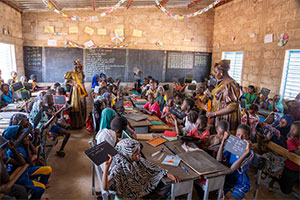 Two teachers work in a classroom in Forces Vives School in Dori, Burkina Faso. Credit: UNICEF/UNI978361
Safe and uninterrupted education is a fundamental right for all children. Education is paramount to global development, as it has been proven that investing in education – especially for girls and children – contributes significantly to economic growth and prosperity. Although more than 1 billion children go to school, many are subjected to conditions that are not conducive to a proper learning environment, including makeshift facilities, a lack of supplies, violence in classrooms, inadequate sanitation, untrained instructors, and widespread school closures. Since 2015, there have been immense gains in education with an increase of 109 million children in school. However, as of 2023, 272 million children are still out of school.
High poverty levels in developing countries also impede children’s access to a proper education. For example, from the early to mid 2000s, Sub-Saharan African nations witnessed a dramatic decline in trained teachers due to inadequate funding in the education sector. Furthermore, major cuts to United States international aid threaten an estimated 23 million additional children's access to education, as USAID‑funded school programmes across Africa and Asia face closure.
Various other factors contribute to the decline of education, notably hunger, which has increased as conflict and climate change interfere with global food production and dissemination. Meanwhile, certain social and cultural practices also impede children’s access to education, with gender inequality, discrimination, child labour, and child marriages preventing millions of children from attending school. Economic conditions such as the inaccessibility of higher education also affect disenfranchised communities across the world. In extreme situations, such as warfare where educational facilities are destroyed in their totality, notably in Gaza and Sudan, entire generations of children might grow up without access to education. Rebuilding educational infrastructure is a long and arduous process, especially when violence persists across generations, and this significantly stunts the development of societal prosperity and stability.
IPS is dedicated to telling the shocking truths about worldwide education through impassioned opinion pieces and comprehensive articles, highlighting global issues that impede worldwide education and the courses of action being taken by organizations such as UNICEF and Education Cannot Wait.

The Week with IPS

NEXT STOP - SDGs
Tracking global progress towards a sustainable world
Tracking global progress towards a sustainable world
