Languages
Tuesday, October 27, 2026



News and Views from the Global South
Education

Studying and Working Poses New Challenges for Argentina’s Youth
Until not too long ago, youngsters in Argentina faced a choice: whether to study or drop out and go to work. But now most children and adolescents in Argentina who work also continue to study – a change that poses new challenges for combating school dropout, repetition and truancy, as well as the circle of poverty.
Take Good News on Afghanistan’s Reconstruction With a ‘Grain of Salt’
Since 2002, a year after it invaded Afghanistan, the United States has poured over 100 billion dollars into developing and rebuilding this country of just over 30 million people. This sum is in addition to the trillions spent on U.S. military operations, to say nothing of the deaths of 2,000 service personnel in the space of a single decade.
Opinion: 2015 and Beyond, Young Voices, Loud Demands
As a young person interested in development, my heart beats a little faster when I look at the potential of 2015. There has never been so much at stake as this year for the future of our planet.
Opinion: Building Civil Service Excellence in the Post-2015 Development Agenda
This September, we usher in the post-2015 development agenda with a set of Sustainable Development Goals (SDGs) agreed upon by Member States, with civil society participation, based on national, regional and global consultations.
Farmers Find their Voice Through Radio in the Badlands of India
Eighty-year-old Chenabai Kushwaha sits on a charpoy under a neem tree in the village of Chitawar, located in the Tikamgarh district in the central Indian state of Madhya Pradesh, staring intently at a dictaphone.Opinion: The University for Peace, Chronicle of a Death Foretold
You've probably never heard of it. When, in 2007, I tentatively searched the web for “peace education” and Google told me that a U.N.-mandated University in Costa Rica was offering a master's degree in precisely that, I was dumbfounded. As soon as I set foot on campus, I fell in love with UPEACE.
When a Kid With Low Self-Esteem Dreams of Becoming the President
You may have heard of Global Citizenship Education (GCED), but unless you move in international development circles, chances are you’re not entirely sure what the acronym means.
Kidney Disease Treatment Not For All in Uganda
Vincent Mugyenyi, a 65-year-old retired pilot from the Ugandan Air Force, has lost count of how many dialysis treatment slots he has had to attend in the eight years he has been fighting chronic kidney disease.
Q&A: Better Students, Better Citizens, Better World: Education Is the Key to Peace
In a world where high levels of social and religious intolerance, conflicts, violent extremism and environmental degradation are threatening justice and peace, the United Nations is trying to find ways to maintain world order and promote sustainable development.
U.N. Urged to Put Global Citizenship at Centre of Post-2015 Development Agenda
When Denmark hosted the World Summit on Social Development (WSSD) in March 1995, one of the conclusions of that international gathering in Copenhagen was to create a new social contract with “people at the centre of development.”
Opinion: Journey Towards an African Taxation Renaissance
Africa is known as the ‘paradox of plenty’. How can a continent so rich in natural resources be so poor?
India Erupts Over Loopholes in Child Labour Law
In a bid to overhaul the country's child labour laws, the Indian government has banned the employment of children below 14 years of age in various commercial ventures, while permitting them to work in family enterprises and on farmlands after school hours and during vacations.
Israel, Hamas Escape U.N.’s List of Shame on Attacks on Children
Secretary-General Ban Ki-moon, reportedly under heavy pressure from the United States and Israel, has decided not to blacklist the Jewish state in an annex to a new U.N. report on children victimised in armed conflicts.
Countries Commit to Protecting Education During Conflict
With thousands worldwide being denied education due to attacks on schools and universities, and the use of school buildings by armed groups, 37 countries have committed to protecting students and their education during armed conflict.
Opinion: Internet Should be Common Heritage of Humankind – Part II
The Internet – and the applications that it has spawned – is the single most important technological innovation that has brought together and interlinked humankind in a real, tangible and interactive way.
Sri Lankan Women Stymied by Archaic Job Market
Wathsala Marasinghe, a 33-year-old hailing from the town of Mirigama, just 50 km from Sri Lanka’s capital, Colombo, once had high hopes that the progressive education and employment policies of this South Asian island nation would work in her favour. Today, she feels differently, believing that “an evil system” has let her down.
Q&A: Papua New Guinea Reckons With Unmet Development Goals
As Papua New Guinea celebrates 40 years of independence, 2015 marks a defining year for the largest Pacific Island nation, set to record 15 percent GDP growth this year.
School Gardens Combat Hunger in Argentina
In Argentina, where millions of families have unmet dietary needs despite the country’s vast expanse of fertile land, the Huerta Niño project promotes organic gardens in rural primary schools, to teach children healthy eating habits and show them that they can grow their own food to fight hunger.
Pakistan’s Streets Kids Drop the Begging Bowl, Opt for Pencils Instead
Khalil Ahmed's life story sounds like it could have come straight out of the plot of a Bollywood flick, but it didn’t. And that makes it all the more inspiring.
The U.N. at 70: Time to Prioritise Human Rights for All, for Current and Future Generations
Seventy years ago, with the founding of the United Nations, all nations reaffirmed their faith in fundamental human rights, in the dignity and worth of the human person, and in the equal rights of men and women and of nations large and small.
Opinion: Edinburgh University Bows to Fossil Fuel Industry
The University of Edinburgh has taken the decision to not divest from fossil fuels, bowing to the short-term economic interests of departments funded by the fossil fuel industry, with little to no acknowledgement of the long-term repercussions of these investments.« Previous Page — Next Page »





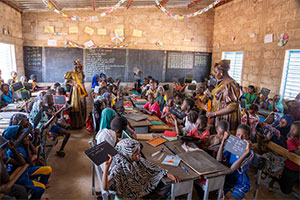 Two teachers work in a classroom in Forces Vives School in Dori, Burkina Faso. Credit: UNICEF/UNI978361
Safe and uninterrupted education is a fundamental right for all children. Education is paramount to global development, as it has been proven that investing in education – especially for girls and children – contributes significantly to economic growth and prosperity. Although more than 1 billion children go to school, many are subjected to conditions that are not conducive to a proper learning environment, including makeshift facilities, a lack of supplies, violence in classrooms, inadequate sanitation, untrained instructors, and widespread school closures. Since 2015, there have been immense gains in education with an increase of 109 million children in school. However, as of 2023, 272 million children are still out of school.
High poverty levels in developing countries also impede children’s access to a proper education. For example, from the early to mid 2000s, Sub-Saharan African nations witnessed a dramatic decline in trained teachers due to inadequate funding in the education sector. Furthermore, major cuts to United States international aid threaten an estimated 23 million additional children's access to education, as USAID‑funded school programmes across Africa and Asia face closure.
Various other factors contribute to the decline of education, notably hunger, which has increased as conflict and climate change interfere with global food production and dissemination. Meanwhile, certain social and cultural practices also impede children’s access to education, with gender inequality, discrimination, child labour, and child marriages preventing millions of children from attending school. Economic conditions such as the inaccessibility of higher education also affect disenfranchised communities across the world. In extreme situations, such as warfare where educational facilities are destroyed in their totality, notably in Gaza and Sudan, entire generations of children might grow up without access to education. Rebuilding educational infrastructure is a long and arduous process, especially when violence persists across generations, and this significantly stunts the development of societal prosperity and stability.
IPS is dedicated to telling the shocking truths about worldwide education through impassioned opinion pieces and comprehensive articles, highlighting global issues that impede worldwide education and the courses of action being taken by organizations such as UNICEF and Education Cannot Wait.

The Week with IPS

NEXT STOP - SDGs
Tracking global progress towards a sustainable world
Tracking global progress towards a sustainable world
