Languages
Thursday, October 22, 2026



News and Views from the Global South
Education

U.N. to Unleash “Power of Education” to Fight Intolerance, Racism
The United Nations is planning to launch a global campaign against the spread of intolerance, extremism, racism and xenophobia -- largely by harnessing the talents of the younger generation.
Widowhood in Papua New Guinea Brings an Uncertain Future
It has only been six months since Iveti, 37, lost her husband of 18 years, but already she is facing hardship and worry about the future.
Opinion: Time for the World to Protect and Value its Young Human Rights Defenders
There’s a deep irony that as people around the world mark International Youth Day on Aug. 12, hardly any attention will be paid to the shrinking space for young human rights defenders who increasingly find themselves on the receiving end of government repression.
Partnerships Critical to the SDGs, Reducing Inequality
Last week, South Korea's Permanent Representative Oh Joon was inaugurated as the new president of the U.N. Economic and Social Council (ECOSOC). As such, he will have a key role in setting the course for implementing the ambitious Post-2015 Sustainable Development Goals (SDGs) that will be adopted at the summit of world leaders in September.
Digital Era Here to Stay in Argentina’s Classrooms
The showcases in the Colegio Nacional Rafael Hernández, a public high school in La Plata, Argentina, tell the story of the stern neoclassical building which dates back to 1884. But the classrooms reflect the digital era, thanks to the computers distributed to all public school students as part of a government social inclusion programme.
U.N. Leads Youth Battling Intolerance, Racism and Extremism
When the 21-year-old Crown Prince of Jordan, Al Hussein bin Abdullah II, presided over a Security Council meeting last April, he was described as the youngest ever to chair one of the U.N.’s most powerful political bodies armed with powers to wage wars and declare peace.
Papua New Guinea’s Unemployed Youth Say the Future They Want Begins With Them
Zibie Wari, a former teacher and founder of the Tropical Gems grassroots youth group in the town of Madang on the north coast of Papua New Guinea, has seen the hopes of many young people for a decent future quashed by the impacts of corruption and unfulfilled promises of development.
Fear Stalks Students in Northern Pakistan
It has been seven months since a group of gunmen raided the Army Public School in Pakistan’s northern Khyber Pakhtunkhwa (KP) province, killing 145 people, including 132 students.
New Census Paints Grim Picture of Inequality in India
Despite being Asia’s third-largest economy, positioning itself as a major geopolitical player under a new nationalist government, India's first ever Socio Economic and Caste Census (SECC) paints a grim picture of poverty and deprivation despite billions of dollars being funneled into state-sponsored welfare schemes.
South Sudanese Girls Given Away As ‘Blood Money’
So extreme are gender inequalities in South Sudan that a young girl is three times more likely to die in pregnancy or childbirth than to reach the eighth grade – the last grade before high school – according to Plan International, one of the oldest and largest children’s development organisations in the world.
Science and Technology a Game Changer for Post-2015 Development Agenda
A group of international scientists, designated as advisers to U.N. Secretary-General Ban Ki-moon, has conveyed a significantly timely message to him: science, technology and innovation (STI) can be "the game changer" for the U.N.’s future development efforts.
“Why Hire a Lawyer When You Can Buy a Judge?”
A woman is stopped at a checkpoint; she gives birth, and dies. Another is sold in a slave market. A boy is killed by a tank. A young man drowns at sea, trying to reach a haven safe from oppression and poverty.
Opinion: Unlocking the Potential of Mali’s Young Women and Men
The recent peace agreements in Mali offer grounds for optimism. It’s now time to capitalise on the accord to accelerate recovery, reconciliation and development. An important part of that process will entail placing the country’s youth at the center of the country’s agenda for peace and prosperity.“Books, Not Bullets,” Malala Yousafzai Urges at Oslo Summit
Nobel Peace Prize laureate and education activist Malala Yousafzai spoke Tuesday of her mission to bring 12 years of education to all children, rather than the previous goal of nine years, at the final day of the Oslo Summit on Education for Development.
Opinion: SDGs, FfD and Every Single Dollar in the World
Ethiopia will host an important meeting on Financing for Development (FfD) Conference next week. One of the most-asked questions is: How much will it cost us to achieve the Sustainable Development Goals (SDGs)?
Day One of Oslo Summit Urges Increased Funding for Global Education
At the first day of the Oslo Summit on Education for Development, U.N. Secretary-General Ban Ki-moon told a personal story of his experience during the Korean War, when his family "had to run for the mountains". He spoke of how he was able to receive textbooks because of United Nations Educational, Scientific and Cultural Organization (UNESCO).
Equality, a Hard Game to Win for Women Footballers in Argentina
During a women’s football match in a poor neighbourhood in Buenos Aires, team manager Mónica Santino has to stop the game and ask a group of boys and young men not to invade the pitch where they’re playing. This frequent occurrence is just one symbol of a struggle being played out, centimeter by centimeter, on Argentina’s pitches.
German Development Cooperation Piggybacks Onto Africa’s E-Boom
In a major paradigm shift, the German government is now placing its bets on digitalisation for its development cooperation policy with Africa, under what it calls a Strategic Partnership for a ’Digital Africa’.
Helping People with Disabilities Become Agents of Change
Participation, political and economic empowerment, inclusion, accessible technology and infrastructure as well as indicators for meaningful implementation are among the key issues persons with disabilities want to see reflected in the Sustainable Development Goals (SDGs).
Studying and Working Poses New Challenges for Argentina’s Youth
Until not too long ago, youngsters in Argentina faced a choice: whether to study or drop out and go to work. But now most children and adolescents in Argentina who work also continue to study – a change that poses new challenges for combating school dropout, repetition and truancy, as well as the circle of poverty.
Take Good News on Afghanistan’s Reconstruction With a ‘Grain of Salt’
Since 2002, a year after it invaded Afghanistan, the United States has poured over 100 billion dollars into developing and rebuilding this country of just over 30 million people. This sum is in addition to the trillions spent on U.S. military operations, to say nothing of the deaths of 2,000 service personnel in the space of a single decade.« Previous Page — Next Page »





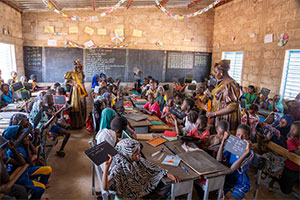 Two teachers work in a classroom in Forces Vives School in Dori, Burkina Faso. Credit: UNICEF/UNI978361
Safe and uninterrupted education is a fundamental right for all children. Education is paramount to global development, as it has been proven that investing in education – especially for girls and children – contributes significantly to economic growth and prosperity. Although more than 1 billion children go to school, many are subjected to conditions that are not conducive to a proper learning environment, including makeshift facilities, a lack of supplies, violence in classrooms, inadequate sanitation, untrained instructors, and widespread school closures. Since 2015, there have been immense gains in education with an increase of 109 million children in school. However, as of 2023, 272 million children are still out of school.
High poverty levels in developing countries also impede children’s access to a proper education. For example, from the early to mid 2000s, Sub-Saharan African nations witnessed a dramatic decline in trained teachers due to inadequate funding in the education sector. Furthermore, major cuts to United States international aid threaten an estimated 23 million additional children's access to education, as USAID‑funded school programmes across Africa and Asia face closure.
Various other factors contribute to the decline of education, notably hunger, which has increased as conflict and climate change interfere with global food production and dissemination. Meanwhile, certain social and cultural practices also impede children’s access to education, with gender inequality, discrimination, child labour, and child marriages preventing millions of children from attending school. Economic conditions such as the inaccessibility of higher education also affect disenfranchised communities across the world. In extreme situations, such as warfare where educational facilities are destroyed in their totality, notably in Gaza and Sudan, entire generations of children might grow up without access to education. Rebuilding educational infrastructure is a long and arduous process, especially when violence persists across generations, and this significantly stunts the development of societal prosperity and stability.
IPS is dedicated to telling the shocking truths about worldwide education through impassioned opinion pieces and comprehensive articles, highlighting global issues that impede worldwide education and the courses of action being taken by organizations such as UNICEF and Education Cannot Wait.

The Week with IPS

NEXT STOP - SDGs
Tracking global progress towards a sustainable world
Tracking global progress towards a sustainable world
