Languages
Thursday, October 1, 2026



News and Views from the Global South
Energy

Making Policy out of Scientific Bricks, not Straw
Given the enormity of the challenges confronting humanity, the world’s investment in science, technology and innovation is woefully inadequate.
Wave Energy on the Horizon in the Pacific Islands
Waves are ubiquitous in the more than 20 island states scattered across 165 million square kilometres of the Pacific Ocean. But only this year, following a ground-breaking study by oceanographic experts, are they now seen as an economically viable source of renewable energy in the region.
Fossil Fuels: At What Price?
We often read comparisons between the prices of solar energy or wind energy with the prices of fossil fuels. It is encouraging to see that renewables are rapidly becoming competitive, and are often cheaper than coal or oil. In fact, if coal, oil and natural gas were given their correct prices renewables would be recognized as being incomparably cheaper than fossil fuels.
The Devil in Development
The word “development” - eliciting as it does grandiloquent notions of progress - has become, at least in Bangladesh, something of a red herring. It is used as a catch-all phrase to justify just about anything — from eviction of slum-dwellers to make way for high-rise housing projects to forceful grabbing of ancestral lands to build eco-parks and tourism spots, from rampant deforestation of our woodlands to unapologetic pollution of our rivers, from undemocratic and top-down imposition of anti-people projects to suppression of dissent through violence both sponsored or otherwise. It matters little that such so-called development only exacerbates the extreme vulnerabilities of people already on the margins, destroys scarce natural resources and intensifies the ever-widening gap between the haves and the have-nots; that it does precisely the opposite of what “development”—real, pro-people development—ought to do. If one protests these actions as unjust, undemocratic or inequitable, one can be easily dismissed as being “anti-development”, and by extension, “unpatriotic”, making it ever more difficult to have any sort of constructive conversation about Bangladesh's development priorities (or the lack thereof).
Olympic Games End Decade of Giant Mega-projects in Brazil
An era of mega-events and mega-projects is coming to a close in Brazil with the Olympic Games to be hosted Aug. 5-21 by Rio de Janeiro. But the country’s taste for massive construction undertakings helped fuel the economic and political crisis that has it in its grip.
New Alliance to Shore Up Food Security Launched in Africa
As over 20 million sub-Saharan Africans face a shortage of food because of drought and development issues, representatives of the U.N. Food and Agriculture Organisation (FAO) and the Pan African Parliament (PAP) met in Johannesburg to forge a new parliamentary alliance focusing on food and nutritional security.
Lessons from Germany for Latin America’s Energy Transition
Germany has been undergoing an energy transition for over 20 years, and it can offer valuable lessons to Latin America with regard to promoting renewable energy and moving towards a low-carbon economy.
Newly Empowered Black Farmers Ruined by South Africa’s Drought
Almost half a decade of drought across most of South Africa has led to small towns in crisis and food imports for the first time in over 20 years, as well as severely hampering the government’s planned land redistribution programme.
Chronic Hunger Lingers in the Midst of Plenty
In a fraught global economic environment, exacerbated by climate change and shrinking resources, ensuring food and nutrition security is a daunting challenge for many nations. India, Asia's third largest economy and the world's second most populous nation after China with 1.3 billion people, is no exception.
African Leaders Driving Push for Industrialisation: UN Official
Industrialisation in Africa is being driven by African leaders who realise that industries as diverse as horticulture and leather production can help add value to the primary resources they currently export.
Indian Climate Activist Ponders the ‘Unthinkable’
For acclaimed Indian novelist and essayist Amitav Ghosh, the future of humankind as global warming impact events spread worldwide looks grim. So grim that the 60-year-old pamphleteer has titled his new book of three climate-related essays "The Great Derangement."
Germany’s Energy Transition: The Good, the Bad and the Ugly
Immerath, 90 km away from the German city of Cologne, has become a ghost town. The local church bells no longer ring and no children are seen in the streets riding their bicycles. Its former residents have even carried off their dead from its cemetery.
Fast-track Development Threatens to Leave Indigenous Peoples Behind
Fast-tracked development often means that indigenous people and their territories get run over and their rights are not taken into consideration, Roberto Borrero, from the International Indian Treaty Council and Indigenous Peoples Major Group, said here Friday.
Rewriting Africa’s Agricultural Narrative
Albert Kanga Azaguie no longer considers himself a smallholder farmer. By learning and monitoring the supply and demand value chains of one of the country’s staple crops, plantain (similar to bananas), Kanga ventured into off-season production to sell his produce at relatively higher prices.
Biogas Brings Heat and Light to Pakistan’s Rural Poor
Nabela Zainab no longer chokes and coughs when she cooks a meal, thanks to the new biogas-fueled two-burner stove in her kitchen.
Making Sustainability Part of the Corporate DNA
Companies, governments and non-profit actors agree that economic growth and sustainable development have to go hand in hand to shape our increasingly globalised world in a fair way.
The Environment: Latin America’s Battleground for Human Rights
2015 was the deadliest year on record for the killings of environmental activists around the world, according to a new Global Witness report.
Grim News from Cape Grim puts Australians on Alert
There's some grim news in the media now, if you read newspapers or surf the internet, and it's coming from a scientific CO2 monitoring station in Tasmania situated on Cape Grim there. But more on this later, a few paragraphs down. First the good news, if it can be called that.
Building Africa’s Energy Grid Can Be Green, Smart and Affordable
It’s just after two p.m. on a sunny Saturday and 51-year-old Moses Kasoka is seated outside the grass-thatched hut which serves both as his kitchen and bedroom.
Western Nations, Blaming Cash Crunch, Pull out of UNIDO
The 134-member Group of 77, the largest single coalition of developing countries, has expressed serious concern over the “unprecedented” withdrawal of nine member states from the Vienna-based UN Industrial Development Organization (UNIDO).
Uruguay Seeks Future as Oil Producer in Ultra-Deep Waters
Uruguay is just weeks away from finding out if it will have a chance to stop being totally reliant on oil imports at some point in the future, when the first offshore exploration well in national waters – which set a new world record in terms of water depth - is completed.« Previous Page — Next Page »


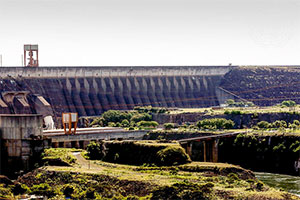 UN Power Plant, Paraguay. Credit: UN Photo/Evan Schneider
Energy has posed a great challenge for economies around the world. As global energy consumption skyrockets throughout the years, so does the need for sustainable solutions. The Sustainable Development Goals are essential in providing people with access to safe, affordable, and sustainable energy sources that minimize harm on the planet. Progress towards these goals opens the door for an advancement in modernization for communities on a global level and allows for a potential mitigation of tensions between nations.
The UN’s Summit of the Future in 2024 offered new initiatives that are being taken to achieve these goals, including a decreased reliance on fossil fuels, a switch to renewable energy sources, and improved climate financing.
IPS is well positioned to provide relevant, insightful, and compelling analysis of recent updates and measures being taken around the world to achieve a cleaner future.

The Week with IPS

NEXT STOP - SDGs
Tracking global progress towards a sustainable world
Tracking global progress towards a sustainable world
