Languages
Monday, September 28, 2026



News and Views from the Global South
Energy

Another Town in El Salvador Votes No to Mining
The citizens of Cinquera municipality in Cabañas delivered a resounding vote against mining, on Sunday February 26th, when 98 percent of residents voted in favour of becoming El Salvador's fifth "territory free of mining."
Maritime Boundary Dispute Masks Need for Economic Diversity in Timor-Leste
Juvinal Dias has first-hand experience of mistreatment at the hands of a foreign power. Born in 1981 in Tutuala, a village in the far east of Timor-Leste, Dias’ family fled into the jungle following the 1975 invasion by Indonesia.
Humankind’s Ability to Feed Itself, Now in Jeopardy
Mankind’s future ability to feed itself is in jeopardy due to intensifying pressures on natural resources, mounting inequality, and the fallout from a changing climate, warns a new United Nations’ report.
Expansion of Renewable Energies in Mexico Has Victims, Too
The growing number of wind and solar power projects in the southern Mexican state of Yucatán are part of a positive change in Mexico’s energy mix. But affected communities do not see it in the same way, due to the fact that they are not informed or consulted, and because of how the phenomenon changes their lives.
Improved Cookstoves Boost Health and Forest Cover in the Himalayas
Mountain communities in the Himalayan region are almost entirely dependent on forests for firewood even though this practice has been identified as one of the most significant causes of forest decline and a major source of indoor air pollution.
Energy Access Builds Inclusive Economies and Resilient Communities
Jaipal Hembrum runs three one-man home enterprises - a bicycle repair shop, a tiny food stall and a tailoring unit in Kautuka, a remote village in eastern India. Sewing recycled clothes into mattresses late into the evening, the 38-year-old father of three girls says two light bulbs fed by a solar power system have changed his life.
Riverbank Populations Displaced by Dams in Brazil Miss Old Way of Life
“Now we have internet and TV. Before, we didn't even have electricity, but it was better,” said Lourival de Barros, one of the people displaced by the hydropower plants which have mushroomed aorund Brazil, mainly since the 1970s.
Regional Solutions Key for Asia-pacific’s Transition to Sustainable Energy
The Asia-Pacific region is at a turning point in its energy trajectory. The energy solutions that have fuelled growth in the region over the past few decades are no longer compatible with the sustainable development aspirations of our nations and their people. In transitioning to a new era of sustainable energy, policymakers across the region face complex decisions. Supplies must be secure and affordable, and they must fill the energy access gap which leaves half a billion people across the region without access to electricity. At the same time mitigating the local impacts of energy generation and use will be vital in resolving problems such as the air pollution choking our cities and the global consequences of greenhouse gas emissions causing climate change. Solutions exist, but only through regional cooperation and integration can Asia and the Pacific transition to sustainable energy in time to meet the ambitious 2030 Agenda for Sustainable Development and its Goals.
Ordinary Citizens Help Drive Spread of Solar Power in Chile
Chile, Latin America’s leader in solar energy, is starting the new year with an innovative step: the development of the country´s first citizens solar power plant.
Looting and Unrest Spread in Mexico Over Gas Price Hike
“We are absolutely fed up with the government’s plundering and arbitrary decisions. We don´t deserve what they’re doing to us,“ said Marisela Campos during one of the many demonstrations against the government´s decision to raise fuel prices.
Anti-Fracking Movement Alarmed at Trump’s Focus on Fossil Fuels
Earl Hatley, a descendant of the Cherokee/Delaware tribe, has witnessed the consequences of using hydraulic fracturing or “fracking” on his native land to produce shale gas.
Battle Lines Drawn Over Indian Mega Mine
Among those leading the fight against the massive Indian-owned Carmichael coal project in Australia’s Queensland state is 21-year-old Murrawah Johnson of the Wangan and Jagalingou aboriginal people, the traditional owners of the land where the proposed mine is to be located.
Beyond Standing Rock: Extraction Harms Indigenous Water Sources
Since the decision by the U.S. army to suspend the Dakota Access pipeline on 4 December, many are still unsure of the controversial pipeline's future or its implications for other mega infrastructure projects affecting indigenous communities across North America.
Convincing Investors to Unlock Africa’s Green Energy Potential
Lowering investment risks in African countries is key to achieving a climate-resilient development pathway on the continent, say experts here at the U.N.-sponsored Climate Conference.
Opposition to Oil Pipeline in U.S. Serves as Example for Indigenous Struggles in Latin America
Canadian activist Clayton Thomas-Muller crossed the border between his country and the United States to join the Native American movement against the construction of an oil pipeline, which has become a model to follow in struggles by indigenous people against megaprojects, that share many common elements.
Stronger Collaboration for Greater Energy Access in Asia Pacific
The emergence of new ideas, technological advancements and innovative market-driven financing solutions has lent confidence to the idea that universal access to energy services is attainable. This is particularly good news in the Asia and the Pacific region, where, despite making significant contributions to global growth and poverty reduction since 2000, nearly half a billion citizens still have no access to modern energy, principally in rural and far-flung areas. Three-quarters of these people live in South Asia alone. Some 70% of the Pacific island households are un-electrified, a level similar to sub-Saharan Africa. The lack of electricity and clean cooking options marginalizes predominantly remote and slum communities who are trapped in energy poverty, preventing them from stepping on the first rung of the ladder to prosperity.
Few Families Overcome Forced Displacement by Hydropower Plants in Brazil
The construction of mega-hydropower plants in Brazil has been a tragedy for thousands of families that have been displaced, and a nightmare for the companies that have to relocate them as required by local law.
Making Policy out of Scientific Bricks, not Straw
Given the enormity of the challenges confronting humanity, the world’s investment in science, technology and innovation is woefully inadequate.
Wave Energy on the Horizon in the Pacific Islands
Waves are ubiquitous in the more than 20 island states scattered across 165 million square kilometres of the Pacific Ocean. But only this year, following a ground-breaking study by oceanographic experts, are they now seen as an economically viable source of renewable energy in the region.
Fossil Fuels: At What Price?
We often read comparisons between the prices of solar energy or wind energy with the prices of fossil fuels. It is encouraging to see that renewables are rapidly becoming competitive, and are often cheaper than coal or oil. In fact, if coal, oil and natural gas were given their correct prices renewables would be recognized as being incomparably cheaper than fossil fuels.
The Devil in Development
The word “development” - eliciting as it does grandiloquent notions of progress - has become, at least in Bangladesh, something of a red herring. It is used as a catch-all phrase to justify just about anything — from eviction of slum-dwellers to make way for high-rise housing projects to forceful grabbing of ancestral lands to build eco-parks and tourism spots, from rampant deforestation of our woodlands to unapologetic pollution of our rivers, from undemocratic and top-down imposition of anti-people projects to suppression of dissent through violence both sponsored or otherwise. It matters little that such so-called development only exacerbates the extreme vulnerabilities of people already on the margins, destroys scarce natural resources and intensifies the ever-widening gap between the haves and the have-nots; that it does precisely the opposite of what “development”—real, pro-people development—ought to do. If one protests these actions as unjust, undemocratic or inequitable, one can be easily dismissed as being “anti-development”, and by extension, “unpatriotic”, making it ever more difficult to have any sort of constructive conversation about Bangladesh's development priorities (or the lack thereof).« Previous Page — Next Page »


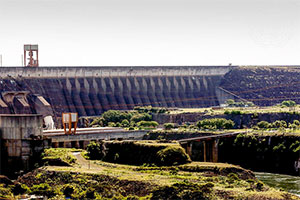 UN Power Plant, Paraguay. Credit: UN Photo/Evan Schneider
Energy has posed a great challenge for economies around the world. As global energy consumption skyrockets throughout the years, so does the need for sustainable solutions. The Sustainable Development Goals are essential in providing people with access to safe, affordable, and sustainable energy sources that minimize harm on the planet. Progress towards these goals opens the door for an advancement in modernization for communities on a global level and allows for a potential mitigation of tensions between nations.
The UN’s Summit of the Future in 2024 offered new initiatives that are being taken to achieve these goals, including a decreased reliance on fossil fuels, a switch to renewable energy sources, and improved climate financing.
IPS is well positioned to provide relevant, insightful, and compelling analysis of recent updates and measures being taken around the world to achieve a cleaner future.

The Week with IPS

NEXT STOP - SDGs
Tracking global progress towards a sustainable world
Tracking global progress towards a sustainable world
