Languages
Friday, November 6, 2026



News and Views from the Global South
Energy

ENERGY-MALAWI: Rise in Paraffin Prices Leaves Traders in the Dark
Increasing energy prices have caused anxiety for many small-scale Malawian traders, especially those in rural areas and peri-urban areas who rely on paraffin for lighting their business premises.Permafrost Melt Soon Irreversible Without Major Fossil Fuel Cuts
Thawing permafrost is threatening to overwhelm attempts to keep the planet from getting too hot for human survival.
CLIMATE CHANGE: In Europe, Pollution Is a Masculine Noun
Many aspects of gender inequality are well known and well documented. But there seems to be little awareness that male behaviour leads to greater emissions of climate-changing gases.Link Confirmed Between Warming and Heavy Storms
Human-induced heating of the planet has already made rainfall more intense, leading to more severe floods, researchers announced Wednesday.
China and Brazil Inundate Latin America with Dams
The growing presence of Chinese and Brazilian capital in Latin America's energy sector is facilitating the construction of hydroelectric complexes, but is also the fuelling nationalist stances that are adding to the environmental criticisms of those major projects.
Questions About China’s “Win-Win” Relationship With Angola
Crouched on their haunches on the edge of a crumbling pavement, a group of Chinese construction workers are eating noodles from tin bowls, wearing floppy straw hats under their green safety helmets to protect them from the aggressive midday sun.
France Holds Back the Sun
France's high tariffs for solar-generated electricity have led to an investment boom in photovoltaic panels, but now the government is rowing back, much to the chagrin of environmentalists.
PERU: Environmental Crime Doesn’t Pay
A legislative bill in Peru aims to channel the fines for environmental crimes to repair the damages to rivers, soils and other public goods that directly affect the population. Until now, the fines collected have ended up elsewhere in the government.
Q&A: “It’s Essential to Change the Energy Model”
Latin America could see more Spanish investment in renewable energy if this otherwise strong sector in Spain is hurt in the war being waged by fossil fuel interests, according to expert Sergio de Otto.ECUADOR: Seven Foreign Oil Companies to Pull Out
Seven of the 16 foreign oil companies operating in Ecuador have decided to pull out of the country in disagreement with a reformed oil law that turned the firms into providers of services to which the government will pay a fixed tariff for operating the fields.
Mexico Tempted to Shift From Tortillas to Ethanol
Farmers' protests and the rise in corn tortilla prices in late December put temporary brakes on the Mexican Senate, which was preparing to lift the national ban on utilising maize to make fuel alcohol, or ethanol.
BRAZIL: “Don Quixote” of River Transport Starting to Win Battles
It is mere ignorance that stands in the way of Brazil having a broad network of navigable waterways and leads to the wasted potential of the country's great rivers, laments José Alex de Oliva, superintendent of inland navigation at Brazil's national waterways transport regulator (ANTAQ).
ENVIRONMENT: Delhi Chokes on Winter Smog
Winter in the Indian capital is a season of mists, minus the mellow fruitfulness. The air becomes charged with toxic emissions and particles that cannot disperse due to a meteorological phenomenon called "atmospheric inversion".
MAURITIUS: Renewable Energy Gets a Boost
A new initiative to support production of renewable energy in Mauritius may provide a model for other countries to follow suit.
In Corrupt Global Food System, Farmland Is the New Gold
Famine-hollowed farmers watch trucks loaded with grain grown on their ancestral lands heading for the nearest port, destined to fill richer bellies in foreign lands. This scene has become all too common since the 2008 food crisis.Sanctions Forced Iran to Slash Bloated Energy Subsidies
Touring Iran's Arab rivals this week, U.S. Secretary of State Hillary Rodham Clinton sounded almost triumphant as she asserted that economic sanctions have helped slow Tehran's nuclear progress.Latest Food Crisis Brewing for Months
The United Nations, which is trying to reach out to nearly a billion undernourished people, some living in perpetual hunger, is anticipating another food crisis later this year.
ECONOMY: Namibia Embarks on Nuclear Policy
Namibia is set to develop its rich uranium resources and intends to pursue uranium enrichment locally. It also plans to build its own nuclear electricity plant.BANGLADESH: Solar Advocates See A Sunshine Nation
Good news may sometimes be hard to come by in this South Asian country, but for solar power advocates here, Bangladesh has been a sunshine nation for the last few years.
PORTUGAL: Economic Crisis Looms, But Clean Energy Shines On
While the shadow of a speculative assault looms over Portugal, similar to the economic crises that hit Greece and Ireland, this Iberian nation manages to hold up the beacon of renewable energy.ENERGY: Cleaner Coal Technology Heats Up in Pakistan
As a dutiful new bride, Rubina Ikram moved into her in-laws’ home lugging a huge dowry that consisted not only of clothes, furniture and linen, but also a wide array of electric appliances – from a DVD player to a washing machine.« Previous Page — Next Page »





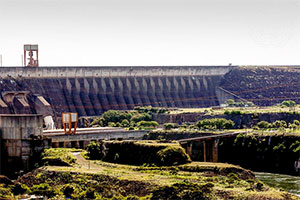 UN Power Plant, Paraguay. Credit: UN Photo/Evan Schneider
Energy has posed a great challenge for economies around the world. As global energy consumption skyrockets throughout the years, so does the need for sustainable solutions. The Sustainable Development Goals are essential in providing people with access to safe, affordable, and sustainable energy sources that minimize harm on the planet. Progress towards these goals opens the door for an advancement in modernization for communities on a global level and allows for a potential mitigation of tensions between nations.
The UN’s Summit of the Future in 2024 offered new initiatives that are being taken to achieve these goals, including a decreased reliance on fossil fuels, a switch to renewable energy sources, and improved climate financing.
IPS is well positioned to provide relevant, insightful, and compelling analysis of recent updates and measures being taken around the world to achieve a cleaner future.

The Week with IPS

NEXT STOP - SDGs
Tracking global progress towards a sustainable world
Tracking global progress towards a sustainable world
