Languages
Saturday, November 21, 2026



News and Views from the Global South
Food and Agriculture
TRADE: France Conned EU’s Controversial Subsidies Scheme
The European Commission is demanding that the French government pays back 500 million euros spent on aid to French farmers. The scheme is in breach of European competition law as it financed competition with France’s neighbours by providing vegetable and fruit producers with hefty subsidies for more than a decade.
TRADE: Namibia Caught in Stand-Off Between South Africa and EU
Access to the European markets is not a goal Namibia wants to accomplish at all costs. Neither is the Southern African Customs Union (SACU) holy. What counts in the country’s realpolitik approach is a close relationship with its neighbours, especially regional economic powerhouse South Africa but also oil-rich Angola.
ZIMBABWE: Small-Scale Farmers Gearing Up to Take Cotton Buyers on
Zimbabweans like to believe that there is strength in numbers, which is the idea behind a local non-governmental organisation’s attempt to organise small-scale rural cotton farmers in cotton producer associations.EUROPE: Small Farmers Lost in Transition
"Our country would have gone through the economic crisis much smoother had we invested more in agriculture over the past 20 years, and had we not wasted so many resources on consumption," Romanian President Traian Basescu declared Aug. 7. That remark has drawn attention to serious questions whether countries like Romania are wasting their potential for agriculture.
BRAZIL: Italian Immigrants Helped Forge Local Identity in the South
In 1875 a handful of families from the Veneto region of northern Italy, fleeing hardship and hunger, took ship for the Empire of Brazil. Disembarking in Porto Alegre in the southeast, they hacked their way for over 100 kilometres through densely wooded country into the Serra Gaúcha hills, up to 800 metres above sea level.COTE D’IVOIRE: Communities Determined to Preserve Tanoe Swamps Forest*
When a major agribusiness company began clearing the rich reservoir of biodiversity of southeast Côte d'Ivoire's Tanoé Swamps Forest for an oil palm plantation, ecologists and local communities demonstrated in favour of preserving it.URUGUAY: Countryside Offers Different Kind of Tourism
Uruguayans and tourists from other countries escape the stress of city life and learn about rural living on once prosperous dairy farms and picturesque small farms near the city of Colonia in western Uruguay, where families have found a new livelihood – and way of life – in "agro-ecotourism".
Q&A: Recipes for Food Sovereignty
In 1975, Brazilian nutritionist and paediatrician Clara Brandão introduced "multimixture" in the diet of 13 preschools in Santarém, in the northern state of Pará, and noted how the malnourished children gained weight and completed their schooling. Some even went on to university.Q&A: EPAs Will Provide Africa With "Better Export Opportunities"
The European Union has pressurised Ghana to sign an economic partnership agreement (EPA) despite civil society concerns being raised about the detrimental effects further trade liberalisation will have on development in the West African country.BRAZIL: Marching for Real Land Reform
After 10 years of waiting for secure title to the land they occupy and farm, 35 families in Resende, in the southeastern Brazilian state of Rio de Janeiro, have joined a huge march organised by the Landless Workers Movement (MST) in Brasilia to demand effective agrarian reform.AFRICA: UNCTAD Recommends Privatisation to Mali
How can an African country define its own policy without getting lost in dozens of treaties and international commitments and the jungle of studies prepared by foreign donors and so-called experts, compounded by policy interference by international financial institutions and governments in the North?ENVIRONMENT-US: Urban Farms Take Root
Juxtapose the word urban in front of farm and there’s bound to be a lot of head scratching. But in cities around the U.S. small-scale farms and garden plots are coming to life in unlikely places. Abandoned city lots, and neglected yards are being converted into vegetable gardens - as basic food literacy becomes part of the vocabulary of city dwellers.
U.S.-AFRICA: Clinton Backs Agricultural Development
U.S. Secretary of State Hillary Clinton is using her trip to Africa to promote agricultural development as an approach to food aid which she has described as a "signature element" of the new Obama administration’s foreign policy.
RIGHTS-SOUTH AFRICA: Women Want Land to Call Their Own
In 1956, twenty thousand women marched to parliament to protest discriminatory pass laws. The march, commemorated as Women’s Day in South Africa on Aug. 9 each year, has become iconic of women’s quest for equality.RIGHTS: Disfiguring Disease Linked to Right to Food
Noma, an ulcerous disease whose name comes from a Greek word that means "to devour" because it literally eats away at malnourished children's faces in just a few months, is found in the developing world, mainly in Africa.
TRADE-INDIA: Kerala Angered Over FTA With ASEAN
Southern Kerala state is known for the lush expanses of cardamom, pepper, tea and rubber that grow on its misty hills, and the bountiful catches of fish on a coastline punctuated by lagoons and backwaters. But a cloud hovers over this picture of plenty - a free trade deal with the Association of Southeast Asian Nations (ASEAN) bloc.CUBA: Compulsory Rural Boarding School on the Way Out
Without fanfare or major explanations, the Cuban government has begun to dismantle the system of mandatory rural boarding school for students in the last three years of high school – one of various reforms aimed at improving the quality of education that will start to be implemented at the start of the next school year in September.
PAKISTAN: Ruined Farmers Say Children Won't Go to School
Fertile Swat's famous orchards of peach, plum and apple were just starting to ripen when the Pakistan military launched an air and land attack on Taliban fighters in end-April, uprooting tens of thousands of civilians.WORLD: Fishy Fishing Practices Threaten the Environment
For years, fishing communities along Africa’s 30,000 km-long coastline have been raising the alarm on the depletion of their fish stocks, to no avail. Over- fishing by foreign vessels has been wiping out the livelihood of West African fishers, contributing to desperate migration attempts into Europe.
AGRICULTURE: Cultivating Rural Prosperity in Cameroon
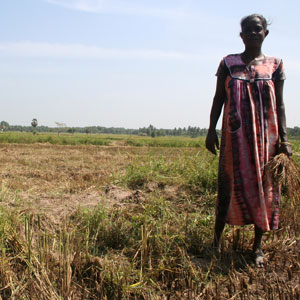
Emilie Nyate has a two million CFA smile on her face these days. She's one of the beneficiaries of the Roots and Tubers Market- Oriented Programme, known better by its French acronym of PNDRT, which is transforming the lives of small-scale farmers in Cameroon.HAITI: Aid Flowing, But Food Crisis Drags On
Though beleaguered with their own financial problems, donor countries say they are not planning to withdraw financial support for cash-strapped Haiti.« Previous Page — Next Page »


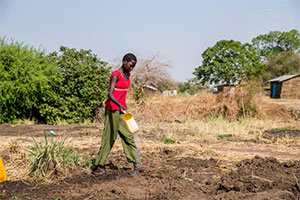 Farming on the Outskirts of Juba. Credit: UN Photo/JC McIlwaine
Promoting human and planetary health is a central focus of the United Nations, as laid out in the 2030 Sustainable Development Goals (SDGs). World hunger and unsustainable farming practices continue to be pressing concerns for the world. According to the 2025 State of Food Security and Nutrition in the World report by the Food and Agriculture Organization (FAO), 673 million people faced hunger in 2024. There are stark regional disparities, with the FAO projecting that 60% of the world population facing hunger will reside in Africa by 2030. Globally, the prevalence of food insecurity has remained consistently higher for women than men.
Sustainable and efficient national food systems are essential in preserving health, education, environmental well-being, peace, economy, and security. However, creating sustainable food systems can be a challenging endeavor, as food production takes a heavy toll on the environment. The agricultural sector accounts for a significant portion of greenhouse gases. Finding safe, sustainable, and ethical strategies to feed the world is crucial in ensuring planetary longevity. A recent initiative from 2023, the EU Regulation on Deforestation-free Products (EUDR), seeks to advocate for sustainable food systems. The main driver of deforestation is the expansion of agricultural land used to produce commodities like cattle, wood, cocoa, coffee, etc. The EUDR is part of the 2020 European Green New Deal and the EU Biodiversity Strategy for 2030 and aims to limit Europe’s consumption of products linked with deforestation by requiring that companies prove that their products are deforestation-free. Despite aiming to achieve major strides in sustainability, policies such as EUDR also raise socioeconomic concerns for targeted countries. Many emerging Latin American economies are impacted by the policy, and have raised the question of how developing countries can grapple with the tensions between economic development and advancing sustainability.
IPS has been at the forefront of providing compelling and insightful stories on communities facing hunger as well as the cost of food production. IPS uses statistics from FAO, the World Food Programme (WFP) and the International Fund for Agricultural Development (IFAD) to bring relevant and hard-hitting facts to readers. This gathering of information and data from such organizations helps bring the best stories from IPS journalists working in the different regions in consultation with experts on the ground.

The Week with IPS

NEXT STOP - SDGs
Tracking global progress towards a sustainable world
Tracking global progress towards a sustainable world