Languages
Saturday, September 26, 2026



News and Views from the Global South
Food and Agriculture

New Seed Bank to Support Agriculture of the Future
As he points to a white shelf that holds bean seeds, Austrian biologist Peter Wenzl explains that one of them, obtained in Ecuador, provided a gene for the discovery that major seed protein arcelin offers resistance to the bean weevil.
The Middle East’s Food Crisis Spells Disaster
In a short period, the war in Ukraine has already had a major effect on the world economy. The United States and the European Union have levied sanctions on an unprecedented scale against Russia, energy prices have skyrocketed, and with the Black Sea closed, the world’s most fertile region is no longer linked to its markets. This will cause an appreciation of food prices that could wreak havoc in the European periphery.
Why Russia’s War on Ukraine Poses a Risk to Global Food Security
The situation in Ukraine is first and foremost a humanitarian crisis, and the food security and wellbeing of the people of Ukraine should be our immediate concern. However, because of the dominant roles of Russia and Ukraine in global food, fuel and fertiliser markets, there are also massive knock-on effects for people around the world. This is particularly true for the supply and cost of food. Here are three ways that the invasion of Ukraine leads to potential risks to food security in other countries.
Donors Must Rethink Africa’s Flagging Green Revolution, New Evaluation Shows (Commentary)
• A scathing new analysis of the Alliance for a Green Revolution in Africa (AGRA) finds that the program is failing at its objective to increase food security on the continent, despite massive funding from the Bill & Melinda Gates Foundation and the US, UK, and German governments.
Zimbabwe Crackdown on NGOs Could Impact Election Observation
Zimbabwe is pressing ahead with a controversial bill that critics say seeks to criminalise the operations of nongovernmental organisations working in the country.
Addressing Global Food Security with Optimism and Resilience
In an exclusive interview with IPS, Ambassador Cindy Hensley McCain, Permanent Representative of the US Mission to the food and agriculture organizations of the United Nations in Rome, Italy, shares her thoughts on food security, sustainable food systems, the impact of climate change on food production, conflicts and the ongoing crisis in Ukraine, and her plans while working with the Food Agricultural Organization of the United Nations (FAO), International Fund for Agricultural Development (IFAD) and World Food Programme (WFP) with Farhana Haque Rahman and Sania Farooqui.
The Rise in Food Insecurity Amid the COVID-19 Pandemic and Conflicts
The effects of COVID-19 over the past two years, in addition to the increase in wars and conflicts, climate change and economic crises, have aggravated global food insecurity, generating serious concerns for 2022.
Ethanol Not Enough to Heal Sugarcane’s Environmental Legacy in Colombia
As a visitor drives across the plains of the department of Valle del Cauca in southwestern Colombia, green carpets dominate the view: sugarcane fields that have been here since the area got its name.
What This Year’s “No 1 Central Policy Document” Tells Us about Beijing’s Food Security and Rural Revitalisation Ambitions
The recently published “No 1 central policy document” (“No 1 document”), China’s national blueprint for rural policy, further demonstrates Beijing’s commitment to safeguarding food security and advancing rural revitalisation. The document’s release comes against an increasingly complicated geopolitical environment which, along with factors, such as disruptions to the global food chain supplies and worsening climate change impacts, have forced Beijing to rethink how its national goals can be achieved.
Lessons from Liberia for Scaling Poverty Reduction Globally
For the past three years, BRAC International has been piloting in Liberia an adaptation of its acclaimed Graduation approach, whose impact on reducing extreme poverty was first proven in Bangladesh. The success of the Liberia pilot, which I managed, provides not only further proof of impact but vital lessons that can enhance and accelerate scaling of the approach globally.
The Future of Food: Jellyfish, Farmed Insects, 3D Printed Meat?
Between the devastating effects of climate change and the fast advancing new technologies, it seems now evident that the future of food will change. Whether it's new foods like jellyfish, edible insects and cell-based meat, or new technologies like blockchain, artificial intelligence and nanotechnology, the future promises exciting opportunities for feeding the world, says a new report.
War in Ukraine Poised to Threaten Global Food Security
The war in Ukraine is a catastrophe for that country and for the world. In any crisis it is the most vulnerable that will be most affected, and this time it is no different.
Egypt Rushes to Find Alternative Wheat Suppliers Following Ukraine Crisis
Egypt is scrambling to find alternate sources of wheat after the Russian invasion of Ukraine has put supply to the country in jeopardy. This is especially urgent because the price of bread in Egypt has in the past sparked protests in the country.
The Very Hungry Dragon: Meat-ing China’s Self-sufficiency Targets for Dairy and Protein
Food security has long been a high priority for the Chinese central government and has been linked to China’s national security in recent years. The Ministry of Agriculture and Rural Affairs recently released a national five-year plan under which China will seek to maintain a target to produce 95 percent of the protein domestically until 2025: China aims to become self-sufficient in poultry and eggs, 85 percent self-sufficient for beef and mutton, 70 percent for dairy, and 95 percent self-sufficient in pork. These targets intersect with many of the Chinese central government’s current aims to meet the growing demand for protein and dairy, safeguard food security, and other major policies.
Peasants Marginalized by Big Farmers
A recent Food and Agriculture Organization (FAO) study shows the largest farms cultivate a high and increasing share of agricultural land in much of the world. Farm size concentration World Agricultural Census data for 129 countries show about 40% of the world’s farmland is operated by farms over 1000 hectares (ha) in size. About 70% is operated by the top 1% of farms, all bigger than 50 ha each.
Agricultural Power, Waning Industry Dictate Brazil’s Future
With its accelerated growth agriculture has emerged as a key sector of Brazil's economy, but it is failing on its own to spread prosperity and reduce poverty and inequality, with industry in decline.
Many Good Reasons to Eat More Pulses – And Perhaps Less Meat!
Pulses and meat are both needed as part of your diet, however… While the total emissions of greenhouse gases from global livestock amount to 7.1 Gigatonnes of Co2-equivalent per year, representing 14.5% of all anthropogenic emissions, pulses have root nodules that absorb inert nitrogen from soil air and convert it into biologically useful ammonia, a process referred to as biological nitrogen fixation.
From Zero Yield to Bumper Harvest
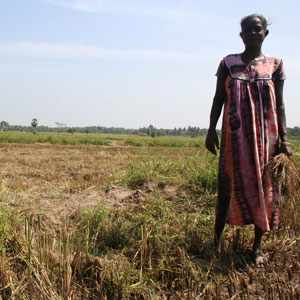
In the past, the people of Sande Village in Chikwawa district, Malawi, would go to bed with empty stomachs even when the rest of the country harvested bumper yields.
Looking to the Future: China’s Priorities for Food Security in 2022 and Beyond
Safeguarding food security has long been a critical priority for the Chinese central government. President Xi’s latest comments and meetings demonstrate continued concerns at the top about China’s food security. Ahead of the 20th National Congress this year and the release of the No 1 policy document, there are already several hints regarding what the Chinese central authorities could prioritise in terms of food security for this year and beyond. Other factors, including the potential influences of gene-edited plants, commercialisation of genetically modified (GM) crops, and of a Russia-Ukraine conflict should also be considered.
No Perfect Solution: Africa’s Smallholder Farmers Must Use Both Traditional and New Practices
As an agricultural and environmental scientist, I’ve worked for decades exploring the practical challenges that smallholder farmers encounter in East Africa. These include controlling weeds that can choke their crops and looking for new ways to deal with pests or diseases that threaten their harvests.
The Dilemma of Zimbabwe’s Food Security Efforts
On January 10, the Zimbabwe Republic Police (ZRP) arrested three men found with fertilizer worth about 130,000 US dollars.« Previous Page — Next Page »


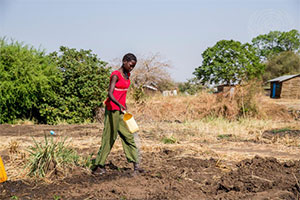 Farming on the Outskirts of Juba. Credit: UN Photo/JC McIlwaine
Promoting human and planetary health is a central focus of the United Nations, as laid out in the 2030 Sustainable Development Goals (SDGs). World hunger and unsustainable farming practices continue to be pressing concerns for the world. According to the 2025 State of Food Security and Nutrition in the World report by the Food and Agriculture Organization (FAO), 673 million people faced hunger in 2024. There are stark regional disparities, with the FAO projecting that 60% of the world population facing hunger will reside in Africa by 2030. Globally, the prevalence of food insecurity has remained consistently higher for women than men.
Sustainable and efficient national food systems are essential in preserving health, education, environmental well-being, peace, economy, and security. However, creating sustainable food systems can be a challenging endeavor, as food production takes a heavy toll on the environment. The agricultural sector accounts for a significant portion of greenhouse gases. Finding safe, sustainable, and ethical strategies to feed the world is crucial in ensuring planetary longevity. A recent initiative from 2023, the EU Regulation on Deforestation-free Products (EUDR), seeks to advocate for sustainable food systems. The main driver of deforestation is the expansion of agricultural land used to produce commodities like cattle, wood, cocoa, coffee, etc. The EUDR is part of the 2020 European Green New Deal and the EU Biodiversity Strategy for 2030 and aims to limit Europe’s consumption of products linked with deforestation by requiring that companies prove that their products are deforestation-free. Despite aiming to achieve major strides in sustainability, policies such as EUDR also raise socioeconomic concerns for targeted countries. Many emerging Latin American economies are impacted by the policy, and have raised the question of how developing countries can grapple with the tensions between economic development and advancing sustainability.
IPS has been at the forefront of providing compelling and insightful stories on communities facing hunger as well as the cost of food production. IPS uses statistics from FAO, the World Food Programme (WFP) and the International Fund for Agricultural Development (IFAD) to bring relevant and hard-hitting facts to readers. This gathering of information and data from such organizations helps bring the best stories from IPS journalists working in the different regions in consultation with experts on the ground.

The Week with IPS

NEXT STOP - SDGs
Tracking global progress towards a sustainable world
Tracking global progress towards a sustainable world